
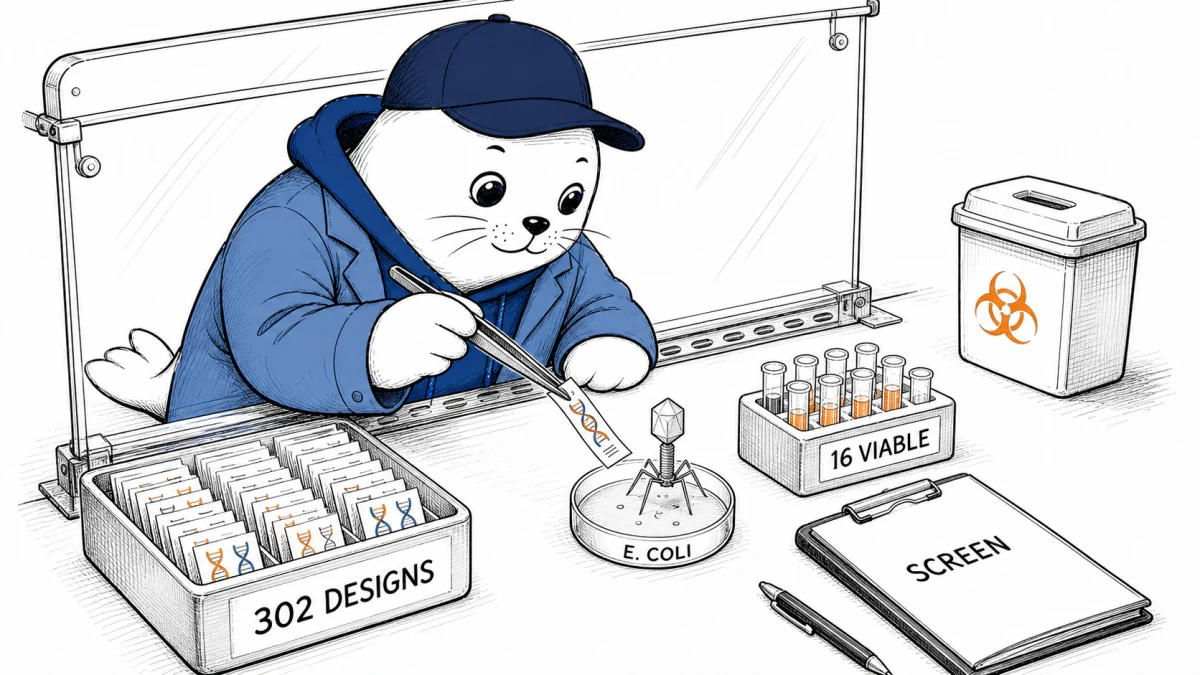
Scientists did not ask a general chatbot to invent a human virus. They used genome language models, screened thousands of outputs, synthesized 302 selected designs, and found 16 bacteriophages that could replicate and kill E. coli in a dish. The result is important, and much narrower than today’s viral headline.
AI-designed viruses are real, but the host was bacteria
A Stanford-led team used the Evo 1 and Evo 2 genome language models to design complete genomes based on the small lytic bacteriophage ΦX174. Bacteriophages, usually shortened to phages, are viruses that infect bacteria. The successful designs in this study targeted strains of E. coli; the researchers did not design viruses that infect people.
The work first appeared as a bioRxiv preprint in September 2025. It became fresh news on August 6, 2026, when the peer-reviewed study appeared in Science alongside a biosecurity commentary. That chronology matters: the experiment is not new today, but peer review and the accompanying governance debate are.
Evidence ladder
What the study demonstrates, and what it does not
Demonstrated
Sixteen AI-designed phage genomes produced viable bacteriophages in laboratory tests.
Demonstrated
A cocktail of generated phages overcame resistance in tested E. coli strains.
Promising
Rapid phage design could help research on antibiotic-resistant infections, but this was not a human clinical trial.
Not demonstrated
The study does not show a general AI autonomously creating a human pathogen or a treatment ready for patients.
From thousands of sequences to 16 viable phages
The models generated thousands of candidate genomes. Researchers did not synthesize all of them. They filtered and selected 302 designs for laboratory construction. Sixteen produced viable phages, a yield of about 5.3% among the synthesized candidates.
That low yield is not a reason to dismiss the result. Whole genomes require many parts to work together: replication, packaging, capsid assembly, host recognition, and lysis. A plausible-looking sequence is not enough. The laboratory step remained the reality check that separated a generated string from a reproducing biological system.
The peer-reviewed report describes multiple generated phages that outperformed the natural ΦX174 reference in growth competitions and lysis kinetics. One phage used an evolutionarily distant DNA-packaging protein inside its capsid. A mixture of generated phages could also overcome resistance that had developed against the natural reference phage.
Design-to-lab funnel
Generation was broad; biological success was selective
Thousands
Candidate genomes generated by Evo 1 and Evo 2.
302
Filtered designs selected and synthesized for lab testing.
16
Viable phages, about 5.3% of synthesized candidates.
The funnel is the safety and credibility story: software proposed; researchers screened; DNA synthesis and wet-lab tests determined what actually worked.
The training boundary was deliberate
The team trained and refined the approach on genetic data that included roughly two million bacteriophages. Genetic code from viruses that infect humans, other animals, or plants was intentionally excluded from the relevant training set. The researchers chose a small bacteriophage system partly to reduce biosafety risk while testing whether generative models could assemble a coherent full genome.
That precaution lowers the risk of this particular experiment. It does not solve governance for the general capability. Once a method can propose a complete viable viral genome, oversight has to cover more than the model: research review, data access, DNA synthesis screening, laboratory containment, incident reporting, and the choice of organism all matter.
The Science commentary by Tom Inglesby and Moritz Hanke argues that governance has not yet caught up with generative viral-genome design. That warning should not be collapsed into "the researchers made a pandemic." It is a call to install controls before the same techniques reach more complex and consequential organisms.
A 2026 analysis calls this efficient optimization, not unconstrained novelty
A separate June 2026 preprint, Quantifying evolutionary novelty and design efficiency in generative genome design, re-examined the Evo 2 phage results. Its framework places the design in an "optimization" quadrant: very efficient at navigating viable sequence space, but still close to patterns evolution has already explored.
That is a useful correction to both hype and dismissal. The system did not need to invent biology unconstrained by evolution to be valuable. It used a learned map to reach viable combinations faster than random search, simple heuristics, or many plausible serial-passage paths. The new capability is efficient search across a difficult design space.
The 2026 analysis is itself a preprint. Its conclusions should be treated as an analytical interpretation, not the final word on novelty or hazard. Still, it offers a more precise question than "Did AI create life?" Ask instead: how much experimental search did the model save, how far did its designs move from known genomes, and which biological constraints remained in place?
Why phage therapy is the practical opportunity
Phages can kill bacteria that antibiotics struggle to control, but they are often narrow specialists. Bacteria can also evolve resistance to a phage. A faster design system could help researchers assemble cocktails aimed at a particular bacterial strain and update them as resistance changes.
The present result is several steps from a treatment. It was performed in laboratory cultures, not patients. A clinical path would need toxicity and immune-response work, manufacturing quality, dosing, resistance monitoring, regulatory review, and evidence that the designed phages target the intended bacteria without undesirable gene transfer or ecological effects.
That gap between a dish and a patient is where many viral headlines fail. The right comparison is not "AI virus versus antibiotic tomorrow." It is "a new design engine enters a long biological and clinical validation pipeline."
How to read the next AI-biology headline
Reader preflight
Five questions before sharing
01
What organism is it?
A bacteriophage that infects E. coli is not a respiratory virus that infects people.
02
What did the model do?
Separate generating candidates from selecting, synthesizing, culturing, and validating them.
03
What is the success rate?
Report the funnel, including failed designs, rather than showcasing one successful specimen.
04
Where was it tested?
A petri dish, an animal study, and a clinical trial support very different claims.
05
Which controls cover the physical step?
Model safeguards matter, but DNA synthesis screening and laboratory governance are decisive.
The same evidence discipline applies beyond biology. Our report on AI cyber-evaluation containment failures separates model behavior from test-environment errors. Our guide to choosing an AI model explains why a result only matters inside the workflow and controls that produced it.
My verdict: neither panic nor a shrug fits the evidence
The result deserves attention because complete AI-designed genomes crossed from sequence generation into viable, reproducing phages. Sixteen successes out of 302 synthesized candidates is not an autonomous biology revolution, but it is a real capability milestone.
The immediate benefit is easier to see than the headline suggests: faster design of bacteria-killing phages for research on antibiotic resistance. The longer-term risk is also real: methods, training data, synthesis access, and lab capability could be combined irresponsibly. Both conclusions can be true without pretending that this experiment created a human pathogen.
The right response is layered governance at the model, dataset, synthesis, laboratory, and publication stages. Keep the biological host, the validation funnel, and the date attached to every claim. Those details turn a scary headline into a decision people can actually evaluate.
Go deeper
- Read the peer-reviewed Science paper.
- Compare the original September 2025 bioRxiv preprint.
- Review the Science biosecurity commentary.
- Read the June 2026 novelty and efficiency analysis.
- See the Reddit discussion as a record of public reaction, not scientific evidence.
Which safeguard should be hardest to bypass: model access, DNA synthesis screening, or laboratory approval?
Checked August 6, 2026. The study concerns bacteriophages that infect bacteria, not human-infecting viruses. The 5.3% yield is Musthave.ai’s calculation: 16 viable phages divided by 302 synthesized designs. Laboratory performance does not establish clinical safety or efficacy.