
AI use in college is no longer a policy debate waiting to happen. Students are already using it, employers are already asking about it, and blanket bans are losing contact with the classroom. The missing subject is judgment: when to use AI, how to challenge it, and how to prove the thinking is still yours.
A three-year survey from American University’s Kogod School of Business found regular AI use among 483 business students rose from 6.2% to 29%. More than 80% reported academic use in the previous six months, and nearly one-third now use AI 11 or more times a week for school or work tasks.
The sample is one business school, so it cannot stand in for every college. National and cross-campus surveys point in the same direction, though: AI has become routine faster than institutions have created clear learning rules.
Two three-year changes at Kogod
Reported starting and current shares among surveyed business students.
- Regular AI use: 6.2→29%
- AI in interviews: 11.6→42.6%
AI use in college rose faster than classroom rules
The regular-use share increased about 4.68 times over three years. The share of job interviews that included AI questions increased about 3.67 times, from 11.6% to 42.6%. Those are Musthave calculations from Kogod’s reported percentages.
That second number explains why “just ban it” feels incomplete to many students. A professor may prohibit AI for an assignment while an employer expects a graduate to explain how they use it. Colleges have to protect learning and prepare people for work at the same time.
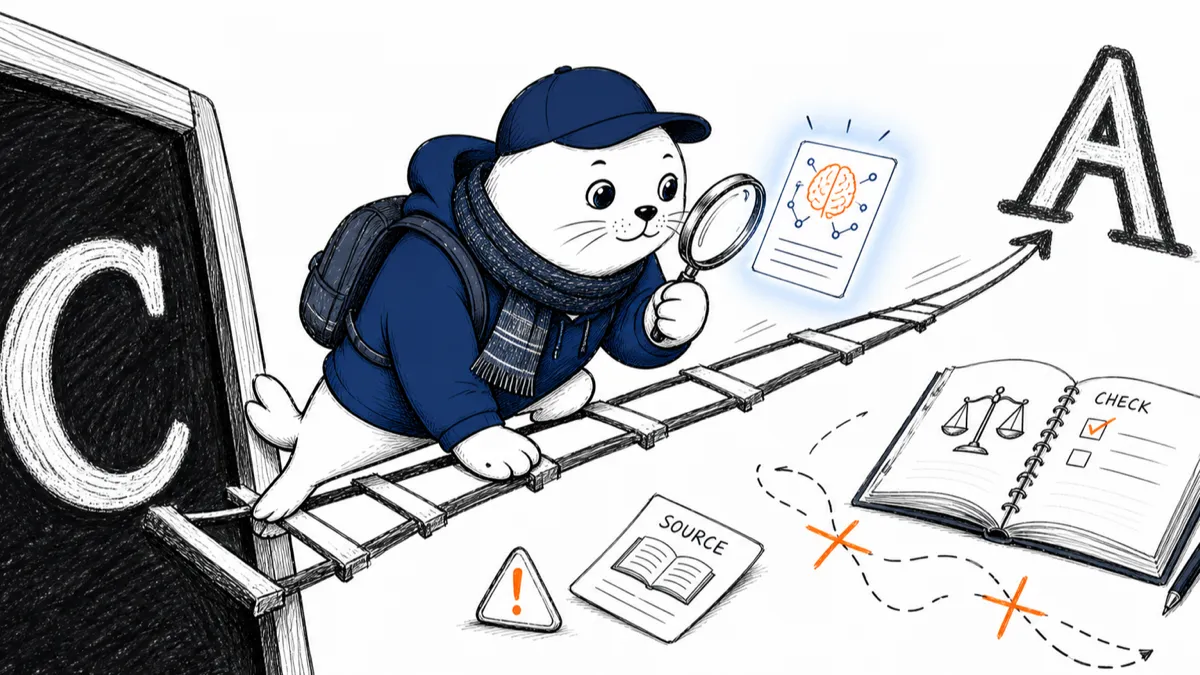
Kogod’s response is revealing. Faculty can put an assignment into AI, show students the mediocre draft, then ask how to move it from a C to an A. The lesson is not prompt decoration. It is diagnosis, revision, evidence, and responsibility.
Students looking for structured practice can also compare that approach with the OpenAI Student Collective program, which emphasizes workshops and campus projects rather than passive access.
Other surveys confirm use, and the discomfort
Adoption is high; confidence in the learning effect is not
Different samples and time windows, so compare direction rather than treating them as one dataset.
- 57%: U.S. college students using AI in coursework at least weekly, Gallup.
- 85%: Students reporting generative-AI coursework use in 12 months, Inside Higher Ed.
- 40%: Students worried AI reduces independent thinking, Inside Higher Ed.
Gallup surveyed nearly 4,000 associate- and bachelor’s-degree students and found 57% use AI for coursework at least weekly, including roughly one in five daily. An Inside Higher Ed flash survey of 1,038 students found 85% used generative AI for coursework over the past year.
High use does not equal high trust. Forty percent in the Inside Higher Ed survey worried that AI was reducing their or their peers’ independent thinking. Nearly half of the Kogod respondents expressed concern about academic integrity.
That tension is not hypocrisy. People routinely use a tool while worrying about the habit it creates. Colleges should design around that reality instead of sorting students into “pro-AI” and “anti-AI” camps.
Brainstorming can broaden output and narrow thought
Brainstorming was Kogod students’ most common use case. It feels safe because the model is producing options, not a final submission. Yet research cited by Axios found people using their own thinking and web search produced a broader range of ideas than people using ChatGPT alone.
The fix is not to forbid AI brainstorming. It is to change the sequence. Write three ideas before opening the tool. Ask AI for contradictions or missing audiences rather than “give me ideas.” Add ideas from classmates, field observation, or primary sources. Then record which input changed the final choice.
That approach preserves variance. It also resembles the research discipline in our research-to-publishing workflow: gather evidence before asking a model to organize it.
A four-step ladder keeps the student in the work
From AI draft to defensible learning
A practical assignment pattern for students and instructors.
- 1. Attempt: Do the first reasoning step before asking AI.
- 2. Challenge: Ask for objections, gaps, or alternative explanations.
- 3. Verify: Check claims against assigned and primary sources.
- 4. Disclose: State what the tool changed and what you decided.
This ladder creates evidence of learning. A professor can inspect the initial attempt, the model’s challenge, the source checks, and the student’s final decisions. A student gets practice with the exact skill employers need: using a capable system without surrendering judgment.
It also makes assessment more resilient. A final essay alone is easy to outsource. A documented sequence of claims, checks, rejected suggestions, and reflection is harder to fake and more useful to review.
My read: teach AI out loud
AI use in college will not become responsible because every syllabus contains a longer prohibition. Students need instructors to demonstrate uncertainty: show a wrong answer, inspect a citation, reject a smooth paragraph, and explain why an apparently helpful suggestion weakens the argument.
Colleges should publish assignment-level rules, not one vague campus policy. “AI allowed” needs a permitted role, a disclosure rule, a verification standard, and a consequence for fabricated evidence. “AI prohibited” needs a learning reason, not nostalgia.
The goal is not to produce graduates who can operate a chatbot. It is to produce graduates who know when the chatbot has stopped helping. That is the judgment employers will eventually test, whether or not the interview question says “AI.”
Go deeper
- Read Gallup’s 2026 college AI-use findings.
- Explore Inside Higher Ed’s student survey and classroom recommendations.
- Try our NotebookLM guide for source-grounded study.
Reporting checked August 4, 2026. Survey samples and time windows differ. The 4.68x and 3.67x figures are Musthave calculations from Kogod’s reported percentages.