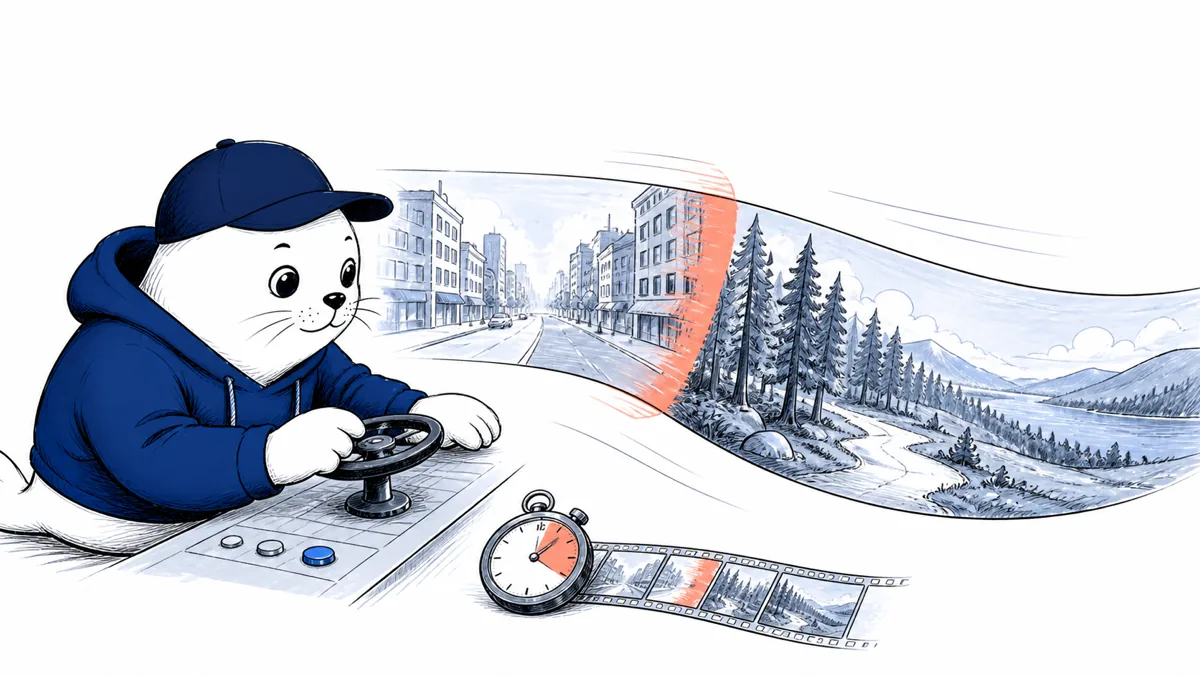
Most AI video tools make a clip, stop, and make you render again. Visko Orbis is trying to keep the world running. The company says its model can stream interactive 4K video at 24 frames per second, accept a new prompt while generation continues, and hold a scene together for hours.
That is a different product category from a polished five-second shot. A live model has to decide the next moment quickly enough for a person to steer it, while remembering characters, objects, motion, and visual state across a much longer session.
Visko launched Orbis on September 1 alongside a $10 million pre-seed round. Its technical paper was first posted in July and updated in August. The release is new. The 4K claim is company-reported, and the most useful caution is hiding in Visko’s own comparison table.
Orbis generates a stream, not a stack of finished clips
The Orbis 1.0 paper describes a distilled generator that produces video in chunks, a streaming upscaler, and an optimized GPU serving engine. A multiscale memory system is designed to preserve recent detail while compressing older context, so the model does not have to carry every prior frame at full fidelity.
Visko says a user can change the prompt during generation and see the world respond without restarting the video. That opens uses such as live story direction, interactive backgrounds, previsualization, simulations, and game-like experiences. It does not automatically make Orbis the best tool for a finished commercial shot. Interactivity and maximum per-frame polish are different goals.
The benchmark lead comes with two visible losses
Visko ran a human-preference arena across long-video systems and reports Elo-style scores. Orbis leads the overall column and the temporal-stability column. HappyOyster leads visual fidelity and instruction following or scene switching.
| Model | Overall | Visual fidelity | Instruction and switch | Temporal stability |
|---|---|---|---|---|
| Visko Orbis | 1838 | 1843 | 1711 | 1940 |
| HappyOyster | 1734 | 1937 | 1722 | 1807 |
Orbis is 104 Elo points ahead overall and 133 ahead on temporal stability. It is 94 points behind on visual fidelity and 11 behind on instruction following and scene switching. That is the actual tradeoff the headline compresses. Visko appears to have optimized the system for continuity and total experience rather than winning every frame-quality judgment.
Do not convert those gaps into percentages. Elo scores are relative ratings produced by the study’s matchups and preference judgments. They are useful for comparing the rows inside this experiment, not for claiming that one model is a fixed percentage better in production.
A 4K output claim needs a latency budget
Twenty-four frames per second is enough for continuous motion, but creators need more than a frame rate. Measure the delay from a new instruction to the first visible change. A model can stream at 24 fps and still feel unresponsive if the world takes several seconds to obey a direction.
- Input latency: time from submitting a new direction to acknowledgement.
- Switch latency: time until the requested change becomes visible.
- Recovery time: how long the world takes to look coherent after a large change.
- Steady-state rate: whether 4K at 24 fps holds during a long session, not only a short demo.
- Cost per live minute: total serving cost, including upscaling and idle time.
Visko’s public materials do not provide a production price table in the reviewed launch package. The public Try Demo route currently begins with a login. That is enough to explore access, but not enough to budget a live installation or client workflow.
The hour test should try to break memory
An hour-scale claim should be tested with state that can fail visibly. Give one character a distinctive jacket, place a cup on a specific table, define the weather, and establish a camera direction. Then change scenes and return.
- At minute zero, record the character, object, location, color, and camera facts.
- At minute five, request a large scene change that should preserve the character.
- At minute fifteen, revisit the original location and inspect object permanence.
- At minute thirty, introduce a contradictory instruction and see whether the model asks, ignores, or rewrites history.
- At minute sixty, compare identity, color, geometry, motion, and camera language against the opening minute.
Score each checkpoint before watching the whole video. A beautiful hour can hide dozens of small continuity failures that make the output unusable for editing or interactive production.
Where Orbis fits beside today’s AI video tools
Our guide to Runway’s change from unlimited generation to credits is about batch economics and hard generation budgets. Our Wan 3.0 review focuses on API cost, reference inputs, and a finished 30-second clip. Orbis belongs in a different box: live continuity under user intervention.
I would use a conventional shot generator when the deliverable is a short, art-directed clip with tight reference matching. I would test Orbis when the product requires a world to continue, react, and remember. A game prototype, virtual set, live performance, or interactive story can value responsiveness and persistence more than the cleanest individual frame.
My verdict: test the switch before the spectacle
Visko Orbis is worth watching because it changes the unit of AI video from a rendered clip to a running world. The company reports a technically ambitious combination: 4K, 24 fps, live prompt intervention, and hour-scale continuity.
The launch does not prove every part independently. Visko’s own benchmark says Orbis leads overall and on stability, while another system wins visual fidelity and instruction switching. That makes the first creator test obvious. Change the scene, time the response, return to an old object, and inspect what survived. If the world cannot remember what the user cares about, 4K only makes the mistake sharper.
Read the primary material
- Read Visko’s launch and funding announcement.
- Review the Orbis 1.0 paper.
- Open the Visko models page for current access.
Checked September 1, 2026. Resolution, frame rate, architecture, continuity, funding, and benchmark results are reported by Visko and its authors. Benchmark differences and the production test are Musthave.ai calculations and analysis.