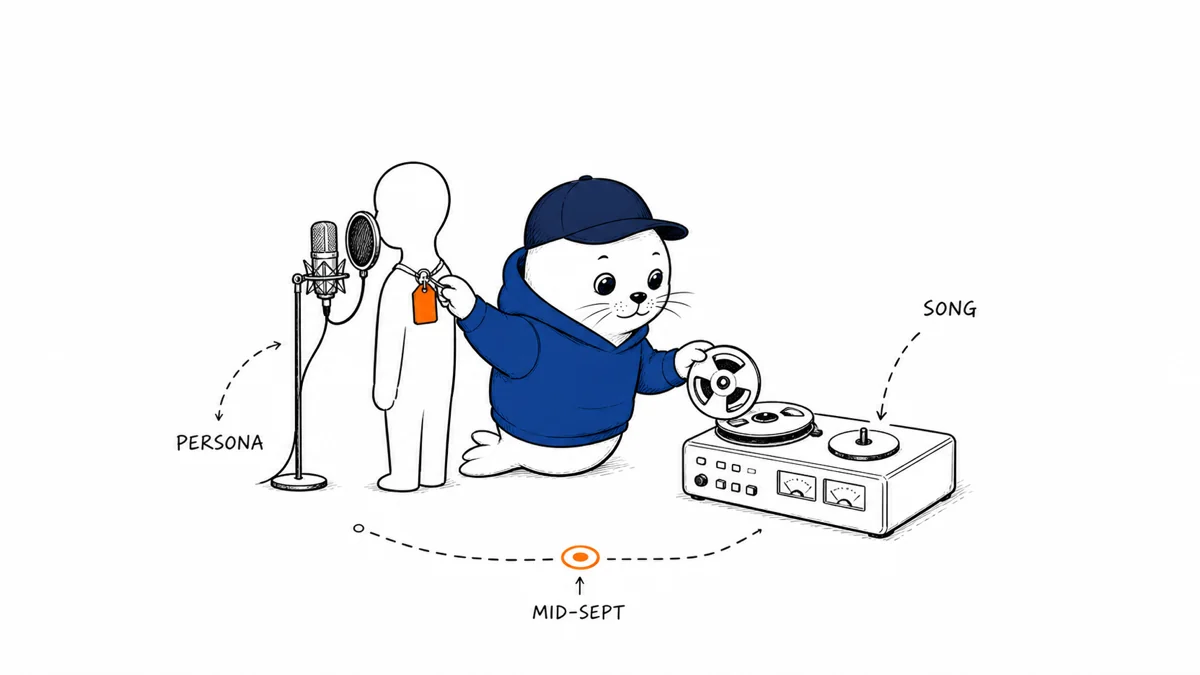
Spotify is about to label an AI-generated artist identity. That still does not answer whether the song itself was made with AI.
Starting in mid-September, Spotify will add an AI Persona badge to some artist profiles whose public identity may be generated and does not represent a real person. The badge will appear on profile banners and About pages, in Search, and beside tracks inside playlists.
The recommendation change is more consequential than the label. Spotify says AI Persona artists will be excluded by default from editorial and algorithmic recommendations. A listener can still reach their music by following or deliberately engaging with the profile.
The badge labels the artist identity, not the song
Spotify draws a firm line between who an artist claims to be and how a recording was made. The AI Persona badge answers the first question. It is aimed at profiles using a name, biography, and often photorealistic imagery that appear to present a human artist when no such person exists.
AI Credits and SongDNA address the production side. A human artist who uses an AI tool for one part of a track would not automatically become an AI Persona. An entirely synthetic song attached to a clearly fictional character may receive production disclosures without pretending that character is a real person.
| Spotify signal | Question it answers | What it does not prove |
|---|---|---|
| AI Persona badge | Does this public artist identity represent a real person? | How the music was produced |
| AI Credits | How did the artist disclose AI use in the creative process? | That the artist identity is fictional |
| SongDNA | Who contributed to the track and its creative history? | That every contributor or tool is disclosed perfectly |
| Verified by Spotify | Has Spotify verified a human artist’s identity? | That no AI tools were used in the music |
Recommendation exclusion changes the incentive
A badge can be ignored. Default recommendation exclusion affects discovery. Spotify says its editorial and personalized programming will not include AI Personas unless the listener has deliberately signalled interest, such as by following them.
That is not a ban. Search, direct listening, artist follows, and intentional engagement remain available. The design creates a consent boundary: the platform will not introduce the persona as if it were an ordinary artist, but a listener can opt into it.
The real product change is not "AI gets a badge." It is "AI personas stop receiving default distribution."
Spotify will not rely on self-disclosure alone
Artists can disclose an AI Persona through Spotify for Artists immediately. Spotify also plans to review profiles and apply the badge when the public identity appears to be a photorealistic AI-generated persona. It says the first review wave will focus on profiles that meet defined audience thresholds, covering most profiles listeners actually visit.
When Spotify applies a badge, the artist will be notified and can self-disclose or appeal. Listener reporting is not part of the September launch; Spotify says it will arrive in the coming months. That gap should be visible in any rollout assessment. A promised reporting channel is not the same as an operational one.
The review policy also leaves edge cases. A cartoon act, a masked producer, a virtual idol, and a photorealistic fake band may all have fictional presentation, but only some create the impression of a real person. Spotify’s public announcement describes the target without publishing the full threshold or reviewer rubric.
The company-reported scale is already large
Spotify says hundreds of thousands of artist profiles are already Verified by Spotify, representing more than 99% of artists listeners actively search for. It also says artists submit tens of thousands of AI Credits each day. Those figures are company-reported, but they show why identity and production need separate systems.
A single binary label would collapse a wide range of uses: a human singer cleaning noise, a producer generating a backing texture, a fully synthetic voice, and a fake biography fronting a catalog. The AI Persona badge addresses the last problem. It should not be presented as a complete answer to AI-generated music.
That distinction also matters for rights. Our coverage of Spotify’s licensed AI remix work focuses on authorization and training partners, while the Suno export and commercial-rights changes show how platform rules can alter what creators may do with a finished track. Neither issue is settled by an identity badge.
What artists, labels, and playlist teams should do
- Separate identity and production disclosures. State whether the artist is a real person, then document AI use in the recording independently.
- Preserve contribution records. Keep prompts, stems, performer agreements, tool terms, and version history where rights or credits may be disputed.
- Audit discovery changes. If a badge appears, measure the impact on recommendations separately from direct search and followers.
- Use the appeal process with evidence. Provide identity records and explain fictional branding rather than arguing only about musical quality.
- Do not promise listener reporting at launch. It is scheduled for a later phase.
My verdict: a clear label with a deliberately narrow job
The AI Persona badge solves a real deception problem: a profile that looks like a human artist until the listener discovers the person never existed. Spotify’s decision to show the badge in Search and playlist rows is stronger than hiding it in an About page. The default recommendation exclusion gives the policy teeth.
It remains an identity policy, not an AI-music detector. The system will be judged on review consistency, appeal speed, edge cases, and whether later listener reports create useful evidence rather than brigading. For now, read the badge literally: it describes the persona, not every sound in the track.
Read the primary source
- Read Spotify’s AI Persona badge announcement.
- Review Spotify for Artists guidance on AI Credits.
Which would change your listening decision more: a fictional artist identity, or undisclosed AI use in the song?
Checked August 11, 2026. Rollout timing, badge placement, recommendation treatment, review and appeal rules, and scale figures are attributed to Spotify. Listener reporting was announced for a later phase.