The Cursor exit test is no longer hypothetical. OpenAI says it intends to end the model-supply contract behind Cursor’s bundled OpenAI access, with November 12, 2026 proposed as the transition date.
Update, August 29, 2026: OpenAI says the final termination date is not yet confirmed and Cursor may end bundled access sooner. Existing supplied models are expected to remain available during the transition, but Cursor will not receive future OpenAI models under the contract.
The SpaceX Cursor acquisition still matters for ownership and strategy. The new model-supply notice changes the immediate builder decision: identify which workflows rely on bundled OpenAI models, then test a direct route before the product route changes.
Update: three continuity paths exist
OpenAI’s notice and support guidance describe three ways to keep using OpenAI models with Cursor:
- Bring an OpenAI API key. Configure local Cursor Chat or Agent to call the API directly where the product supports it.
- Use the Codex IDE extension. Run the extension inside Cursor rather than relying on Cursor’s bundled model contract.
- Use a compatible gateway. Route calls through an approved gateway that supports the required OpenAI API behavior.
These routes have different billing, data handling, authentication and feature behavior. A model name appearing in the interface does not prove that prompts, tools, reasoning controls or costs are equivalent. Run the same repository task through the current bundled route and the intended replacement now.
OpenAI also alleges contract violations. That is OpenAI’s position. Cursor and SpaceX had not published a matching formal response in the official sources checked for this update, so the article does not present the allegation as an adjudicated fact.
What the closing filing proves
| Question | Current evidence | Responsible reading |
|---|---|---|
| Did the acquisition close? | Yes. The merger became effective August 14, 2026 | Cursor is now a wholly owned SpaceX subsidiary |
| What was the value? | The filing uses a $60.0B implied Cursor equity value | This is the transaction basis, not a forecast of future revenue |
| How were holders paid? | Cursor shares converted into rights to receive SpaceX Class A shares | The deal is primarily an equity exchange |
| Will customer terms or data practices change? | The closing filing does not specify that | Check the live contract, privacy notice, and data-use documentation |
| Will models become cheaper? | Cursor says that is the ambition | Treat lower cost as a company goal until product pricing proves it |
SpaceX’s Form 8-K says Cursor common and preferred stock converted into the right to receive 389,289,254 SpaceX Class A shares. The exchange was based on an implied Cursor equity value of $60 billion and SpaceX’s seven-trading-day volume-weighted average price before closing.
The filing also records 1,752,426 SpaceX shares for vested Cursor restricted stock units before tax withholding. Unvested awards were assumed or converted into about 29.1 million SpaceX restricted stock units and 44.4 million options. Those figures explain the transaction mechanics. They do not tell a customer what will happen to a repository, prompt, subscription, or model route.
Cursor’s product promise is broader than the filing
Cursor’s announcement says the acquisition completes a process that started with an April model-training partnership. The company says it will join SpaceXAI, gain access to what it describes as the world’s largest GPU fleet, and use that compute to build more capable models that cost less to run. It presents Grok 4.6 as an early example of what the companies can build together.
These are first-party product ambitions, not contractual guarantees. Cursor does not use the closing post to publish a new price sheet, data-retention policy, model-availability commitment, or migration timetable. Our analysis of Grok 4.6 for long-running agents explains why the economics still have to be measured across the entire trajectory, including retries and failures.
Ownership changes three kinds of dependency
1. Contract dependency
Your plan, data-use choices, enterprise addendum, retention settings, and security commitments are documents, not vibes. Capture the versions in force today. Set a calendar check for any notice period that would let you object, export, renegotiate, or leave.
2. Model-routing dependency
Modern coding products can route tasks among first-party and third-party models. A familiar editor can therefore change behavior even if its interface barely moves. Record the model and reasoning controls behind critical workflows where the product exposes them. Keep a small regression set for repository questions, refactors, tests, migrations, and code review.
3. Workflow dependency
The hardest lock-in may be operational: rules files, memories, plugins, MCP servers, hooks, cloud-agent images, review conventions, and team habits. The more of this state lives only inside one vendor’s product, the harder an emergency move becomes.
Cursor’s localized Start plan shows how much of a product can sit beyond the editor itself. Our Cursor Start India analysis covers its payment rails, mobile access, cloud agents, plugins, hooks, MCP servers, and skills. A fallback plan has to account for those surfaces, not simply open the same repository in another IDE.
Run a two-hour exit test before you need it
- Choose one representative repository. Include tests, build instructions, a medium refactor, and one task that needs repository-wide context.
- Export the portable layer. Save rules, prompts, tool definitions, environment notes, accepted patches, and audit records in vendor-neutral files where possible.
- Start the alternative from a clean session. Do not rely on hidden local state from the primary tool.
- Run the same three jobs. Compare a diagnosis, a code change, and a review using the same acceptance tests.
- Measure human recovery work. Count setup, corrections, permissions, failed tool calls, and reviewer time, not only generation speed.
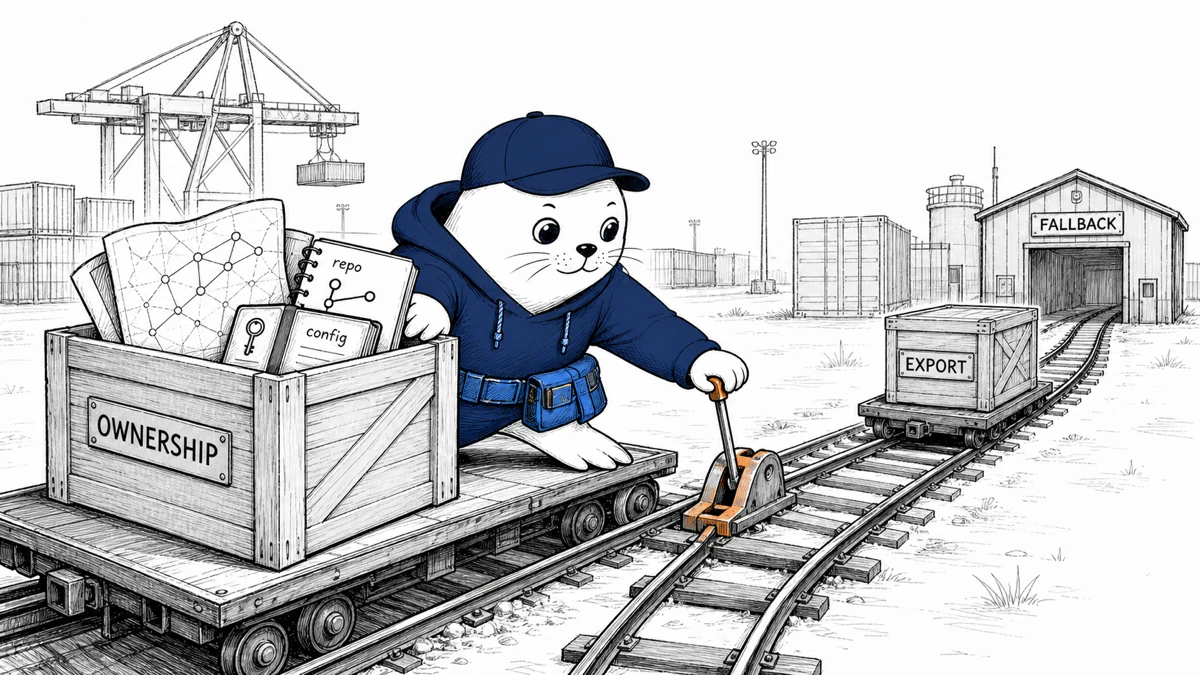
- Write the cutover order. Name the account owner, secret rotation path, billing action, export location, and rollback point.
The test does not require abandoning Cursor or predicting a bad outcome. It tells you whether your team owns its workflow. A fallback that has never opened the repository, run the tests, and produced an acceptable patch is only a vendor name on a risk register.
Check the data boundary separately
Acquisition news often triggers claims that the buyer automatically gains a new dataset. The closing documents reviewed here do not establish how customer code or prompts will be handled after the merger. Cursor maintains separate data-use, privacy, security, and contractual pages. Those are the records to inspect.
- Confirm whether code data is stored and for how long.
- Check whether training or improvement use is disabled by plan, setting, or contract.
- List subprocessors and the regions where data may be processed.
- Verify how cloud agents handle repository credentials and generated artifacts.
- Capture audit-log and deletion behavior before changing the account.
Do not infer a change where the documents do not show one. Do not assume no change is possible either. Version the evidence.
My verdict: keep Cursor, but prove you can leave
The SpaceX Cursor acquisition gives Cursor access to capital, compute, models, and distribution that could improve the product. It also concentrates more of the coding stack inside one corporate group. Neither outcome is a reason for panic.
The builder response is simple: separate verified transaction facts from roadmap claims, record the terms that govern your code today, and run one real fallback exercise. If the product improves and nothing material changes, the exercise still pays for itself by exposing undocumented workflow state.
Read the source record
- Read SpaceX’s August 14 Form 8-K reporting the merger close.
- Read Cursor’s official acquisition announcement.
- Review OpenAI’s contract wind-down notice.
- Use OpenAI’s continuity instructions for Cursor.
- Review Cursor’s April model-training partnership announcement.
- Compare the original deal report from the Associated Press.
Could your team produce an accepted patch tomorrow if its primary coding tool were unavailable?
Updated August 29, 2026. Transaction facts come from SpaceX’s SEC filing. The proposed November 12 transition, unconfirmed final date, model-supply limits and continuity paths come from OpenAI. Contract allegations remain OpenAI’s position; no matching formal Cursor or SpaceX response was found in the official sources checked.