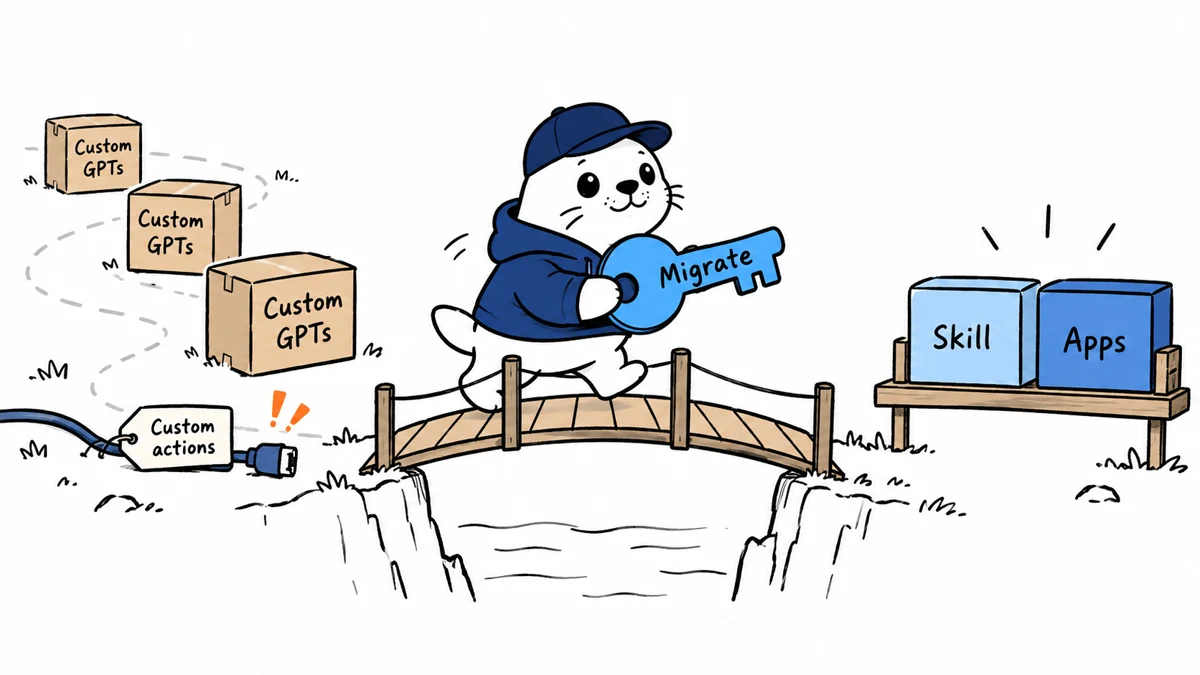
OpenAI is preparing to retire Custom GPTs for affected ChatGPT Enterprise workspaces. Migration begins September 17, 2026, but the most important detail is what does not move automatically: custom actions.
OpenAI’s current Enterprise schedule targets September 17 for migration, the end of September 25 for stopping new GPT creation, and December 11 for retirement. The company says timing for other plans may vary, so those dates should not be presented as a universal deadline for every personal account.
The migration map in one table
| Custom GPT element | Expected destination | Owner action |
|---|---|---|
| Instructions | Skill | Review the migrated behavior and permissions |
| Connected apps | Plugin apps | Reconnect and confirm access |
| Custom actions | No automatic transfer | Rebuild through a supported app or plugin path |
| Conversation starters | May not transfer | Preserve useful prompts separately |
| Previous chats and selected model | May not transfer | Export or document what matters |
Why custom actions are the migration risk
A Custom GPT that only wraps instructions can often be recreated as a skill. A GPT that calls an internal API is a different system. Its action schema may encode authentication, data formats, approval logic, error handling and assumptions about which user can see which record. OpenAI says custom actions will not transfer automatically, which means the riskiest migrations are also the ones least suited to a simple copy operation.
- Inventory every external endpoint and credential.
- Record which user roles can trigger each action.
- Identify write operations that need confirmation.
- Capture failure messages and retry behavior.
- Run the replacement against a test environment before production.
A replacement plugin starts private
OpenAI says migrated replacements begin as private plugins. That is a useful safety default, but it changes the rollout plan. An administrator should not assume that everyone who used a Custom GPT will immediately see its replacement. Ownership, sharing, app permissions and publication scope need a separate check.
A six-step migration runbook
- Export an inventory of GPT names, owners, users and business purpose.
- Classify each GPT as instructions-only, connected-app, custom-action or mixed.
- Assign a named owner and test user for every replacement.
- Rebuild custom actions with least-privilege authentication and explicit approval for writes.
- Compare old and new outputs on a fixed test set.
- Publish the replacement only after access, logs, rollback and support ownership are verified.
What teams should test before September 25
The first test should be ordinary work, not a polished demo. Ask the migrated skill to follow a long instruction, retrieve data through a connected app and explain why it cannot perform an unauthorized operation. For an action-based GPT, test an expired token, a missing field, a duplicate request and a user without permission. Those cases reveal whether the replacement preserved the original control boundary.
How this fits OpenAI’s broader app strategy
The shift separates reusable behavior from connected services: skills hold instructions, while apps and plugins provide access to systems. That direction also appears in newer agent workflows covered in our OpenAI Habitat and Codex analysis and in the operational permissions behind ChatGPT Ads and Shopify agent tools.
The practical verdict
Custom GPT retirement is not merely a naming change. Instructions can move toward skills and connected apps can become plugin apps, but action-heavy GPTs need a real software migration. The safest plan is to preserve the old configuration, rebuild writes carefully, verify private access and keep the Enterprise dates separate from timelines that OpenAI may later announce for other plans.
Primary sources
- OpenAI: Custom GPT retirement and migration FAQ
- OpenAI: ChatGPT release notes
- OpenAI: Skills and plugins migration guidance
Checked September 16, 2026. Enterprise dates are confirmed in OpenAI’s current help guidance. Timing for other ChatGPT plans may differ.