
October 5 update: visual ads are planned for image-generation sessions
OpenAI’s October 5 announcement adds a planned visual-ad test during image generation. Testing is scheduled for later October with an initial US advertiser group. OpenAI says the ads will carry labels and appear separately from the image the user creates. Its stated policy keeps advertising separate from ChatGPT’s answers.
The announcement also expands conversion-data integrations through Hightouch, Tealium and LiveRamp. OpenAI describes early work with measurement partners on geographic experiments to estimate incremental sales. DoubleVerify and Integral Ad Science brand-suitability evaluations are planned pilots; the announcement does not establish a completed independent audit.
Separate a tracked sale from an additional sale
Attribution assigns credit to an interaction under a chosen rule. Incrementality asks how many outcomes happened because of the campaign. A purchase recorded after an ad click can count in attribution even if that customer would have bought anyway.
Before increasing spend, record the attribution window and reconcile purchase identifiers across systems. Decide how to handle refunds and orders credited to several channels. For a lift experiment, agree on treatment and comparison regions before launch, then keep other major promotions stable where practical. These are proposed measurement controls, not results from a MustHave.ai campaign test.
Check access to the visual format separately from access to Ads Manager. A working advertiser account does not establish eligibility for a limited placement test. Ask which formats the account can use and which reporting fields distinguish their performance.
September 23 update: ChatGPT Ads opens in seven Asia-Pacific markets
OpenAI announced the expansion of ChatGPT Ads to Indonesia, Malaysia, the Philippines, Singapore, Thailand, Vietnam, and Taiwan on September 23, 2026. Its current Ads Manager country list marks self-service availability in those markets. OpenAI says the product now operates in more than 60 countries, but the live country list is the better place to check before planning a campaign.
Keep the three eligibility questions separate. Where a ChatGPT user can see an ad is not the same as where an advertiser can open an account: self-service depends on the billed legal entity being in an eligible country. Neither condition establishes that a particular Shopify merchant can immediately activate every related integration. Confirm the advertiser’s billing country, account access, and merchant-specific workflow in the actual onboarding screens before promising a launch date.
Under OpenAI’s current policy, ads appear for Free and Go users, while Plus, Pro, and Enterprise remain ad-free. The regional rollout does not establish campaign reach, conversion rates, or return on ad spend. Merchants should test product-feed accuracy, landing-page readiness, disclosure, and measurement on a small campaign rather than treating geographic availability as a performance forecast.
OpenAI confirms Sponsored Agents, HubSpot, Shopify, and AI ad creation.
Update, September 17, 2026: OpenAI’s first-party launch overview confirms that Sponsored Agents are being tested with select advertisers in the United States. The Ads Manager plugin can create, update, and analyze campaigns through natural-language requests, while Ads Manager can suggest copy and imagery and offers optional text customization.
| Feature | Availability confirmed by OpenAI |
|---|---|
| Sponsored Agents | Testing with select US advertisers |
| Ads Manager plugin | Natural-language campaign creation, updates and analysis |
| Suggested copy and imagery | Available as AI-assisted creative tools in Ads Manager |
| Text customization | Optional control for generated ad variations |
| HubSpot integration | Available now |
| Shopify app | US at launch; check current merchant and Ads Manager eligibility by market |
The official post strengthens the sourcing for the product details below and clarifies geography. It does not remove the need to verify conversion events, catalog quality, creative review, and spend controls before scaling a campaign. Read OpenAI’s advertising launch overview.
OpenAI has launched its first ecommerce integration for ChatGPT Ads, a Shopify app that syncs products, creates campaigns, installs conversion measurement and reports performance inside Shopify. The wider September 16 release also adds Sponsored Agents, prompt-based campaign management in ChatGPT Work, AI-generated ad suggestions and a HubSpot integration.
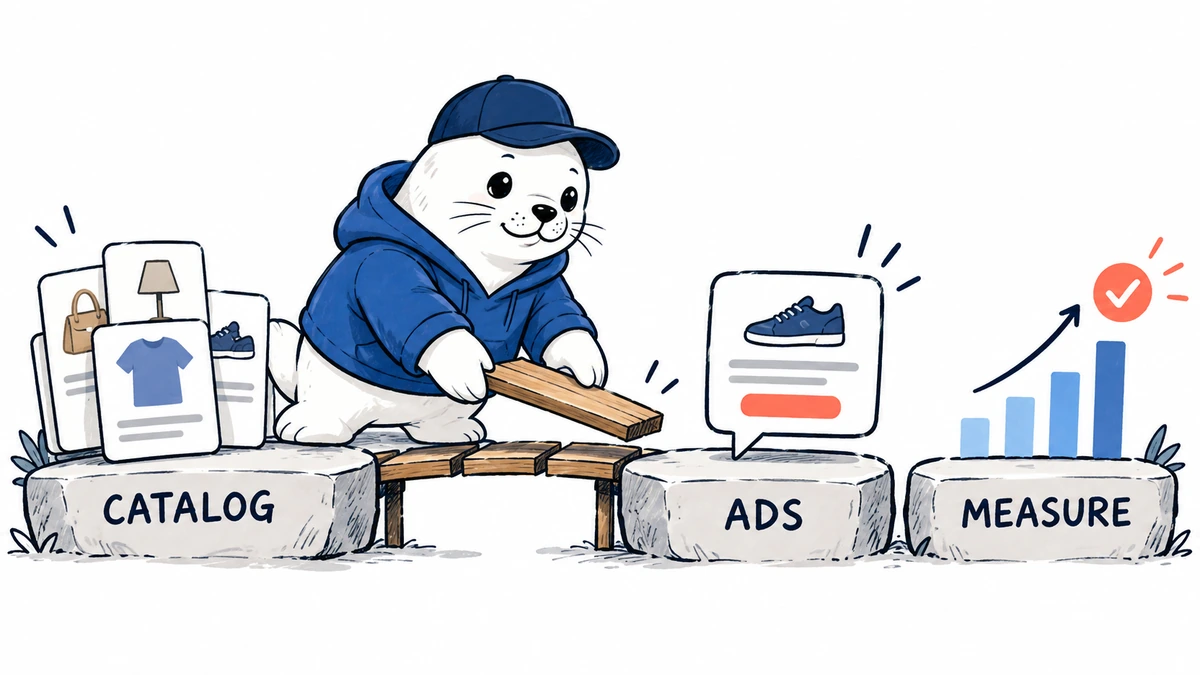
The headline is bigger than a new sales channel. OpenAI is connecting the four parts of an advertising system that previously lived in separate tools: catalog data, campaign creation, customer conversations, and conversion measurement.
For merchants, the most important detail is also the easiest to miss. Shopify product discovery in ChatGPT, paid ChatGPT Ads, and checkout are related, but they are not the same product. Mixing them can create duplicate feeds, inaccurate attribution, and false assumptions about what an app installation actually buys.
What OpenAI launched on September 16
| Feature | What it does | Availability |
|---|---|---|
| ChatGPT Ads for Shopify | Syncs catalog data, creates product ads, connects conversion events and manages performance in Shopify | US merchants at launch; confirm current app, merchant and Ads Manager eligibility |
| Sponsored Agents | Lets a user start a clearly labeled conversation with a business-sponsored agent after clicking an ad | Testing with select US advertisers |
| Ads Manager in ChatGPT Work | Uses natural-language prompts to create, update and analyze campaigns | Rolling out to eligible advertisers |
| AI creative assistance | Suggests copy and imagery from the landing page and campaign objective | Rolling out in Ads Manager |
| AI text customization | Adapts existing headlines and descriptions to conversation context and translates them to the user’s preferred language | Advertiser opt-in |
| HubSpot integration | Creates ads, reports performance and supports lead follow-up inside HubSpot | Available from September 16 |
The launch changes both the ad unit and the advertiser workflow. Sponsored Agents add a conversational step after an ad click. ChatGPT Work and Ads Manager add AI to campaign operations. Shopify and HubSpot bring the channel into systems where merchants already store products, customers, and performance data. Our earlier ChatGPT Ads rollout analysis covers the audience, targeting, and privacy questions beneath these advertiser tools.
The Shopify integration is a paid ads app, not organic ranking
OpenAI develops the official ChatGPT Ads app in the Shopify App Store. It lets a merchant connect an existing ChatGPT Ads account or create one from Shopify, sync product inventory into Ads Manager, build ads from catalog information, set up conversion measurement, and review campaign performance without leaving Shopify.
- Catalog connection: product listings, products, and collections can supply the ad catalog.
- Campaign creation: merchants can build product-based ads and campaigns from Shopify.
- Measurement: the app uses a Shopify pixel and conversion events. OpenAI says it also sets up a server pixel, which it describes as a server-to-server Conversions API integration.
- Reporting: Shopify can report spend, click-through rate, conversions, and cost per acquisition.
- Optimization: The listing includes bid optimization, custom audiences, and controls for location, platform, and product category.
The app itself is listed as free. That does not make the advertising free. Merchants still fund their ChatGPT Ads campaigns, and ordinary Shopify or payment-processing costs can still apply to sales.
Three ChatGPT commerce paths now sit beside each other
| Path | How products get in | What the merchant pays for | Where checkout happens |
|---|---|---|---|
| Organic Shopify discovery | Shopify Catalog supplies eligible product data to ChatGPT automatically | No special ChatGPT selling fee, according to Shopify | The merchant’s online-store checkout in an in-app browser or a new tab |
| Paid Shopify campaigns | The OpenAI Shopify app syncs the catalog to ChatGPT Ads Manager | Advertising media spend under the selected campaign objective | The advertised landing page and merchant flow |
| Direct Ads Manager feed | CSV/TXT upload, hosted HTTPS feed or SFTP | Advertising media spend | The advertised landing page and merchant flow |
OpenAI states that products uploaded through an Ads Manager feed are eligible only for ads during the beta. They do not become eligible for organic ChatGPT shopping conversations just because they are in the advertising feed. Conversely, a Shopify product can be discoverable through Shopify Catalog without the merchant buying a campaign.
This separation should shape the setup. A Shopify merchant generally does not need a second manual organic feed to appear in product discovery. The paid app adds campaign and measurement functions. A non-Shopify retailer can use OpenAI’s direct feed specification and Advertiser API instead.
Sponsored Agents turn the click into a conversation
A normal ad sends the user to a landing page to answer every pre-purchase question. Sponsored Agents introduce another route. After clicking an eligible ad, the user can choose to start a clearly labeled conversation with an agent sponsored by the business.
OpenAI’s example is a shopper asking whether a dining table fits a room, how many people it seats, and how to care for the finish. The agent can handle those follow-up questions and then link to the business when the user is ready. OpenAI says this sponsored conversation is separate from ChatGPT’s independent answer and from the conversation the user originally started.
The format has obvious potential for products with high consideration or configuration complexity. It also creates a new quality-control surface. A merchant will need to audit product facts, prices, availability, warranties, disclosures, and escalation behavior, not only the ad headline. Sponsored Agents are currently a limited test with select US advertisers, so they should not yet be described as a generally available placement.
Campaign creation is moving into the prompt.
OpenAI says eligible advertisers can now use the Ads Manager plugin in ChatGPT Work to create, update, and analyze campaigns with natural-language prompts. A marketer can turn a website or brief into a campaign, ask for a performance explanation, and request recommendations for the next action.
That can remove interface work, but it should not remove review. Account selection, objective, budget type, geography, conversion event, and landing page are consequential settings. A practical workflow is to ask the plugin to prepare a campaign, inspect the structured settings in Ads Manager, and only then launch it.
In Ads Manager, AI creative assistance can suggest copy and imagery based on the landing page and campaign objective. The advertiser can review and edit those suggestions. A separate opt-in text-customization feature can adapt existing copy to the context of a conversation and translate it into the user’s preferred language.
Those are two different controls. Draft-time suggestions are visible before use. Runtime text customization can create contextual variants at delivery time. Brands in regulated, policy-sensitive, or multilingual categories should test both the original and likely translated claims, preserve approved terminology, and monitor landing-page consistency.
Conversion optimization is more capable, but it is not pay-per-sale
ChatGPT Ads now supports reach, clicks, and conversion-optimized campaign objectives. Conversion campaigns can use click billing, called oCPC, or eligible impression billing, called oCPM. OpenAI says oCPM remains in beta and access is expanding.
The word “conversion” describes the optimization goal, not the billing event. An oCPC campaign is billed for valid clicks, while an oCPM campaign is billed for impressions. Neither means the advertiser pays only when a purchase or lead happens.
- Choose one supported standard event: purchase, signup, lead submission, or another event supported by Ads Manager.
- Install reliable measurement: use the OpenAI Pixel, the Conversions API, or both.
- Verify the signal before optimizing: a page view is not a purchase, completed form, or qualified lead.
- Keep the objective stable: OpenAI says you can’t change the objective, billing model, or selected conversion event after campaign creation.
- Judge enough volume: a rare event gives the system and the analyst too little evidence.
OpenAI’s Maximize Results bid strategy can automatically adjust bids toward clicks or conversions. It does not guarantee a target CPA, CPC, or return on ad spend. Merchants that need a hard bid ceiling should inspect the manual controls instead of treating automation as a profitability promise.
A safe Shopify setup sequence
- Confirm market eligibility—the Shopify app launched with US merchants. Check current Shopify app and Ads Manager eligibility for the merchant’s market before activation.
- Review the app permissions. The listing includes products, collections, marketing events, analytics, web and server pixels, browsing behavior, and selected personal or store-owner data. Confirm that the access fits company policy.
- Connect the correct ad account. Avoid creating a duplicate account if the company already has one.
- Audit the product catalog. Check titles, images, prices, sale prices, variants, availability, shipping information, prohibited-product rules, and required disclosures.
- Define the conversion before launch. Decide whether success is a purchase, lead, signup, or another supported outcome. Test the event and confirm it reaches Ads Manager.
- Create one narrow campaign. Start with a controlled product group, geography, and budget instead of syncing the catalog and advertising everything at once.
- Add durable attribution. Preserve OpenAI click identifiers and add first-party UTM parameters so Shopify, analytics, and Ads Manager can be reconciled.
- Compare orders, not only clicks. Review conversion count, cost per conversion, revenue quality, returns, and margin. Investigate gaps between Shopify and Ads Manager before scaling.
Our earlier ChatGPT Ads Morocco case study demonstrates why the conversion step matters. The campaign produced 91 clicks at a reported $0.46 average CPC, but its outcome layer was incomplete. Cheap traffic and profitable customer acquisition are different findings.
What the Shopify app does not solve automatically
- Feed quality: synced data can still contain weak titles, missing attributes, poor images, or stale merchandising choices.
- Incrementality: a tracked purchase does not by itself prove the ad created a sale that would not otherwise have happened.
- Cross-channel duplication: the same shopper may also encounter organic ChatGPT discovery, search, social, or email.
- Consent and privacy: pixel and server-side measurement must fit the merchant’s consent, disclosure, retention, and regional compliance requirements.
- Creative accuracy: AI suggestions and customized text still need policy, brand, and factual review.
- Sponsored-agent behavior: the conversation needs its own product-grounding, safety, and escalation tests.
The app reduces integration work. It does not eliminate the need for a measurement plan, catalog governance, or controlled experimentation.
The strategic shift: ads are becoming an operating layer
Traditional ad platforms largely separate ads, landing pages, commerce systems, and CRMs. OpenAI’s September launch starts to join those surfaces. Shopify supplies products and transactions. HubSpot supplies customer context and lead workflows. ChatGPT Work can operate campaigns through prompts. Sponsored Agents can answer questions between the ad and the merchant site.
That integration can make a small team faster. It can also make errors travel farther. A wrong price in the catalog can affect the ad. A weak event can misdirect optimization. Overbroad permissions can expose more data than expected. An unreviewed translation can change a claim.
The best early adopters will not be the merchants who automate the most. They will be the ones who connect the stack in a way that remains observable: clean product data, one meaningful conversion, consistent identifiers, reviewable creative, clear permissions and a small initial test.
Verdict: Shopify makes ChatGPT Ads easier to start, not easier to judge
The Shopify app removes several technical barriers at once. It can create or connect the ad account, synchronize products, prepare catalog-based campaigns, establish conversion signals, and return performance data to the merchant’s admin. For a store that already keeps its Shopify catalog accurate, that is a meaningful reduction in setup work.
Sponsored Agents and prompt-based campaign operations are the more ambitious part of the release. They move ChatGPT Ads away from a conventional display unit and toward a conversational sales and marketing system. They also need the most careful testing because a fluent interaction can still use outdated product data or optimize toward the wrong event.
Start with the Shopify integration if it replaces manual catalog and measurement work you already understand. Do not start by turning on every automated feature. First prove that products sync correctly, purchases are attributed consistently, and the campaign creates profitable outcomes. Then test AI creative, text customization, and, when available, Sponsored Agents as separate experiments.
Primary sources
- OpenAI: Reimagining advertising with AI
- Shopify App Store: ChatGPT Ads by OpenAI
- OpenAI: Create campaigns from product feeds
- OpenAI: Conversion-optimized campaigns
- OpenAI: Conversion measurement
- OpenAI Ads developer documentation
- OpenAI: Powering product discovery in ChatGPT
- Shopify: Selling on ChatGPT
Paid campaigns are only one route into conversational commerce. The ChatGPT ecommerce vs Shopify comparison separates organic discovery, merchant operations, checkout, and advertising.
Reporting completed September 16, 2026 from OpenAI and Shopify primary sources. ChatGPT Ads and several features described here are in beta or limited rollout. Availability, permissions, and product behavior can change.