

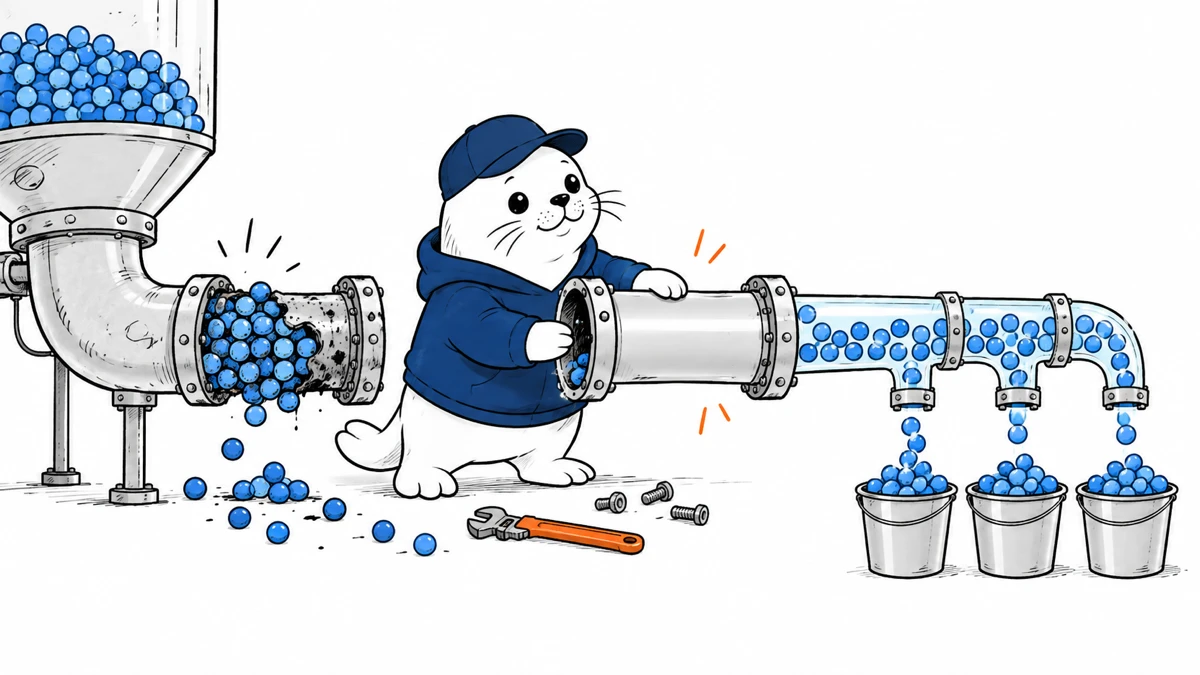
OpenAI says a storage layer behind ChatGPT now handles more than 70 million requests per second. The surprising part is not only the scale: two engineers used Codex and GPT-5.5 to rewrite its service layer from Python to Rust.
OpenAI published the first part of its Habitat engineering account on September 11, 2026. The figures and performance gains below are company-reported, not independent measurements.
Habitat sits between products and storage systems
Habitat began as a Python library that gave OpenAI services a common way to reach storage. It evolved into a centralized service over systems including Azure Cosmos DB, adding routing, governance and operational controls without forcing every product team to implement them separately.
| OpenAI-reported measure | Scale | What it describes |
|---|---|---|
| Weekly users | More than 1 billion | Products supported by the broader storage platform |
| Requests | More than 70 million per second | Current Habitat traffic reported by OpenAI |
| Regions | Almost 40 | Geographic footprint of the platform |
| Stored data | More than 500 petabytes | Data under management |
| Python peak | 20 million requests per second | Earlier service scale before the Rust migration |
Two engineers used Codex for the Rust rewrite
OpenAI says that in the second quarter of 2026, two engineers used Codex with GPT-5.5 to rewrite the Habitat service layer in Rust. The Rust service now serves 95% of production requests.
The company reports roughly six times better CPU efficiency and 15 times better memory efficiency than the Python service. Those ratios describe this workload, architecture and migration. They do not establish a general language benchmark, and OpenAI did not publish a reproducible test harness with the article.
Codex changed the staffing equation, not the review requirement
A two-person rewrite at this scale is evidence that coding agents can compress implementation work. It is not evidence that two people alone can safely own a global storage platform. Architecture review, production observability, staged traffic, incident response and service ownership remain human and organizational responsibilities.
The practical lesson is to separate generation throughput from migration confidence. Track how much code an agent helps produce, then independently track behavior parity, load-test coverage, rollback time and incidents after each traffic step. Our Codex versus Claude Code guide explains why accepted outcomes matter more than raw agent activity.
A connection-pool detail caused a metastable failure
OpenAI also describes a production failure caused by last-in, first-out connection reuse. The newest connections stayed hot while older ones aged out. Under overload, that behavior concentrated work and reinforced the bad state even after the original pressure changed.
Switching the pool to first-in, first-out reuse distributed activity across connections and broke the loop. This is a useful systems lesson: an optimization that looks efficient at steady state can become an amplifier during overload.
A migration scorecard teams can copy
- Freeze the service contract and record the Python behavior before rewriting it.
- Replay representative reads, writes, timeouts and malformed requests against both implementations.
- Shadow production traffic before shifting a small percentage of live requests.
- Measure CPU, memory, tail latency, error rate and downstream pressure at every stage.
- Inject connection churn and overload so pool policies fail before production does.
- Keep a tested rollback path until the old service is no longer needed.
Teams adopting the OpenAI Agents API should apply the same separation between an agent’s execution and the controls around it. Fast implementation is valuable only when the release remains observable and reversible.
What the report does not establish
OpenAI did not publish the full cost of the migration, the volume of human review, a commit-level record of Codex contributions, or a workload package that another team can run. The company also does not claim that Rust alone produced every improvement.
The strongest conclusion is narrower and still important: OpenAI reports that a small engineering team used Codex to complete a high-stakes rewrite, put it behind most production traffic and materially reduced resource use. The connection-pool incident is the reminder that language choice and code generation do not remove distributed-systems risk.
Read the primary source
Checked September 12, 2026. Production scale, staffing and efficiency figures are attributed to OpenAI. Migration controls and interpretation are MustHave.ai analysis.