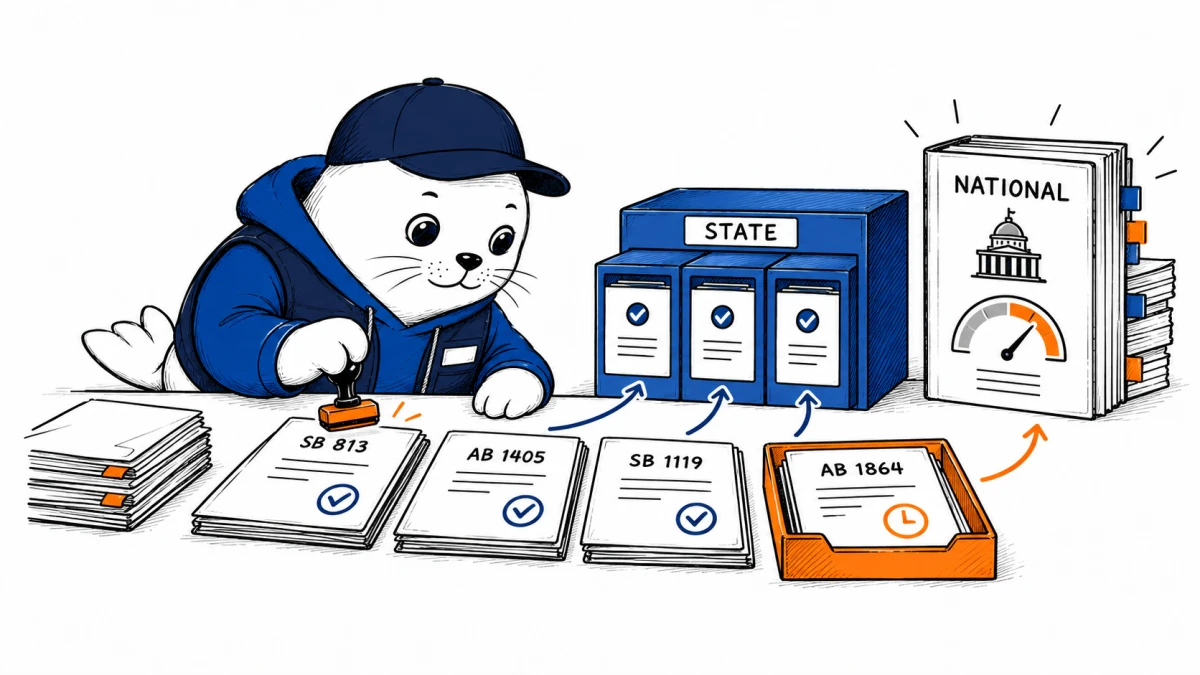
OpenAI endorsed four California AI-safety bills on September 9. The status changed almost immediately: three are now law, while the fourth still awaits gubernatorial action.
OpenAI’s new AI safety policy position calls for mandatory capability-based federal regulation, continued state action and shared frontier-model standards. The company tied that argument to SB 813, AB 1405, SB 1119 and AB 1864. This article checks each bill against California’s live legislative record as of September 13, 2026.
The status board changed after OpenAI published
| Measure | Subject | Status checked September 13 | Main date |
|---|---|---|---|
| SB 813 | Independent verification organizations | Chaptered | Governor approved September 9 |
| AB 1405 | AI auditor registry | Chaptered | Governor approved September 9 |
| SB 1119 | Child safety for companion chatbots | Chaptered | Governor approved September 10 |
| AB 1864 | Gene-synthesis screening | Enrolled | Sent after legislative passage |
SB 813 creates the verifier framework, not mandatory audits
SB 813 was approved September 9 as Chapter 179. It directs California’s Government Operations Agency to develop requirements and criteria for designating independent verification organizations by January 1, 2028.
The distinction matters. The law builds a way to qualify organizations that assess AI risks, but it explicitly says developers are not required to hire one merely because this chapter exists. An audit can be relevant in a harm case without being conclusive.
AB 1405 turns AI auditing into a registered profession
AB 1405 became Chapter 178 on September 9. It requires an online AI Auditor Registry by January 1, 2029. Beginning that year, a person may not offer or conduct a covered AI audit without registration.
Registered auditors must disclose methods, explain limitations, preserve documentation and manage conflicts of interest. The state can remove an auditor from the registry and refer violations for enforcement. This is infrastructure for audit quality, not a claim that every registered audit is correct.
SB 1119 puts product rules around child chatbot use
SB 1119 was approved September 10 as Chapter 190. Starting July 1, 2027, covered companion-chatbot operators must assess child-safety risks and implement protections when children can use the service.
The law covers age assurance, crisis-response protocols, parental controls, limits on persistent memory and push notifications, usage reminders, advertising restrictions and safeguards against manipulative relationship behavior. It also creates an audit path and private remedies under specified conditions. Builders should read the operative sections, exemptions and dates rather than treating “child safety” as a single content filter.
AB 1864 is the one bill not yet chaptered
AB 1864 remains enrolled on the official page checked September 13. It would require covered gene-synthesis providers and benchtop equipment manufacturers operating in California to follow a specified federal screening framework, attest to compliance and publish that attestation. Civil penalties could reach $5,000 per day depending on severity.
OpenAI frames the bill as a physical safeguard against AI-enabled biological threats. That is a broader view of AI safety: control a consequential downstream capability, not only a model interface.
The federal proposal is narrower than a general AI license
OpenAI says mandatory federal rules should be capability-based and focused on the small number of well-resourced labs developing the most capable systems. Its outline calls for common testing, independent assessments, stronger cybersecurity, incident reporting and measures that track progress toward recursive self-improvement.
The company also says policy should not become an indirect ban on open weights and that development should slow or stop when safety bars cannot be met. These are policy positions, not enacted federal requirements. Our earlier analysis of OpenAI’s recursive self-improvement warning explains the technical premise behind the timing argument.
What builders should do with this policy map
- Separate enacted obligations from corporate endorsements and future proposals.
- Assign an owner to track effective dates, implementing rules and later amendments.
- Preserve evaluation evidence now if independent audits may later require it.
- For child-facing chatbots, map each product behavior against SB 1119 instead of relying on a generic safety review.
- For biotech tooling, monitor AB 1864 until the governor acts and verify the exact screening framework referenced by the final law.
The implementation habit is similar to the release gates in our OpenAI research intern analysis: write down the threshold, the reviewer and the stop condition before the system reaches a consequential action.
My take: the verification market is becoming policy infrastructure
Taken together, SB 813 and AB 1405 try to define who can verify AI systems and how that work should be documented. SB 1119 applies product duties to one high-risk context. AB 1864 reaches into a physical supply chain. The common thread is not one grand AI law. It is a growing network of assessors, records, controls and enforceable domain rules.
Primary sources
- OpenAI policy statement
- California SB 813 official text and status
- California AB 1405 official text and status
- California SB 1119 official text and status
- California AB 1864 official text and status
Checked September 13, 2026. Bill status can change. This is a reporting and implementation overview, not legal advice.