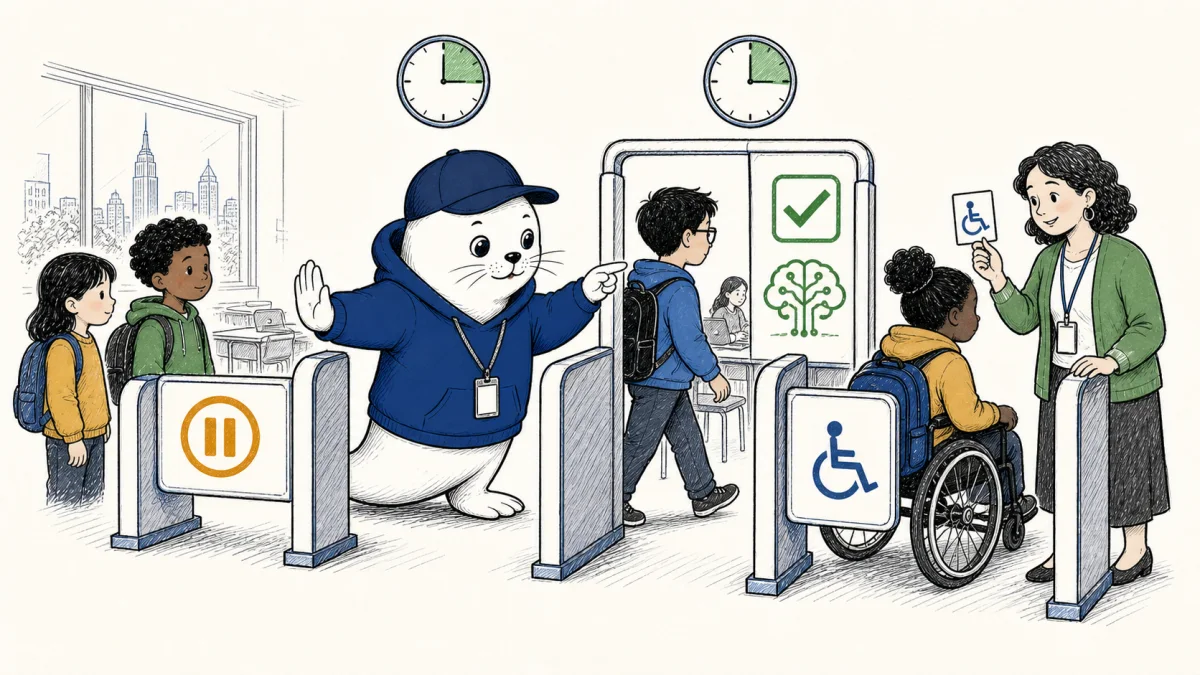
New York City Public Schools has replaced the vague question "is AI allowed?" with three different answers. Student-facing generative AI is paused in grades 2K through 8 for the 2026-27 school year. High school use is limited to approved programs. Accessibility and language supports remain possible under documented exceptions.
The policy affects a district large enough to influence vendor road maps and school procurement well beyond New York. It also gives teachers and families a practical model: separate age, purpose, tool approval, literacy, and accommodation instead of writing one rule for every AI use.
The NYC schools generative AI policy by grade
| Group | 2026-27 rule | Operational check |
|---|---|---|
| Grades 2K-8 | Moratorium on student-facing generative AI | Remove ordinary student access and document exceptions |
| Grades 9-12 | Limited to approved, vetted programs | Match the tool and use case to the approved list |
| High school students | Two 45-minute AI literacy modules | Record completion before or alongside access |
| Students with documented needs | Accessibility and language exceptions may apply | Follow IEP, 504, multilingual, and screen-time processes |
| Pilot participants | One listed pilot per student | Avoid overlapping experiments and consent records |
The moratorium applies to student-facing use, not every behind-the-scenes task a teacher or administrator might perform. A lesson-plan draft and a chatbot that talks directly to a child create different data, instructional, and dependency risks.
High school access has two gates
For grades 9 through 12, approval of the program is one gate. AI literacy is another. The district requires two 45-minute modules, which creates a 90-minute baseline but does not turn a student into an expert or certify every classroom use.
A school should still name the assignment, permitted assistance, disclosure expectation, grading rule, and escalation path. "Use an approved tool" does not answer whether a student may brainstorm, revise, generate a complete submission, or analyze private records.
Accessibility exceptions are not loopholes
The district keeps room for assistive technology tied to an IEP or 504 plan, tools for English language learners, and other established screen-time exceptions. These paths protect access needs that a blanket ban could harm.
Document the learning or accessibility need, the minimum data required, the responsible adult, and the review date. Do not force a student to publicly disclose a disability to explain why an approved support is available.
The five pilots have different jobs
NYC lists Quill, Edia, Brisk Teaching, Playlab, and Intel AI-Ready Schools. The district says each student should participate in only one pilot, while schools can apply for additional programs case by case.
Do not compare pilots by sign-ups alone. Define a result for each one: writing practice completed, math misconception corrected, teacher preparation time reduced, safe student project shipped, or AI literacy demonstrated. Track errors, overrides, teacher time, and student access alongside the outcome.
A vendor needs more than a safety page
- State the exact grade band and instructional purpose.
- Describe data collection, retention, model training, and deletion.
- Expose teacher controls, student history, and incident reporting.
- Support identity, roster, and least-privilege access.
- Document model and policy changes during the school year.
- Provide an accessibility review and a non-AI fallback.
The teacher judgment guide for AI education plugins explains why a generated lesson or answer still needs a human acceptance test. District approval should narrow risk, not transfer responsibility away from the classroom.
Teachers need an assignment-level rule
Put the allowed use on the assignment itself. A simple four-level scale works: no AI; AI for accessibility or translation only; AI for brainstorming and feedback with disclosure; or approved AI as part of the assessed method. Give one example of allowed and prohibited behavior.
Do not rely on an AI detector as the enforcement layer. Scores can be wrong and do not prove authorship. Use drafts, source checks, oral explanation, version history, and task design to understand the student’s work.
A first-week implementation check
- Inventory every student-facing AI tool by grade.
- Disable or remove access that conflicts with the moratorium.
- Map high school tools to the approved program and use case.
- Schedule and record the two literacy modules.
- Review accessibility and language exceptions privately.
- Give teachers a one-page assignment disclosure template.
- Publish a family contact and incident route.
Link each tool to an owner and renewal date. A school cannot manage a program it no longer knows is installed. Our AI integration checklist is commercial, but its principles of scoped access, logged actions, and rollback also apply to school systems.
Measure access as well as outcomes. A pilot can appear successful while excluding students who lack devices, broadband, language support, or accessible interfaces. Report who was eligible, who participated, who completed the work, and which supports were required. Compare the AI path with a credible non-AI path so the district can tell whether the tool improved learning or merely changed the activity.
My verdict: the useful unit is a governed use case
NYC’s policy is stricter for younger students and more conditional for high school. Its best feature is not the word moratorium. It is the separation of ordinary access, approved programs, literacy, pilots, and accommodations.
Schools should implement that separation visibly and review it with evidence. Vendors should stop selling "AI for education" as one category and prove the grade, task, data boundary, teacher control, and learning result their product supports.
Read the official policy
- Read NYC Public Schools’ Guidance on Artificial Intelligence and Screen Time.
- Use the district’s linked approval and pilot materials for current implementation details.
Checked September 3, 2026. Grade rules, module length, exceptions, and pilot names come from NYC Public Schools. The implementation checklist and vendor tests are Musthave.ai analysis, not legal advice.