
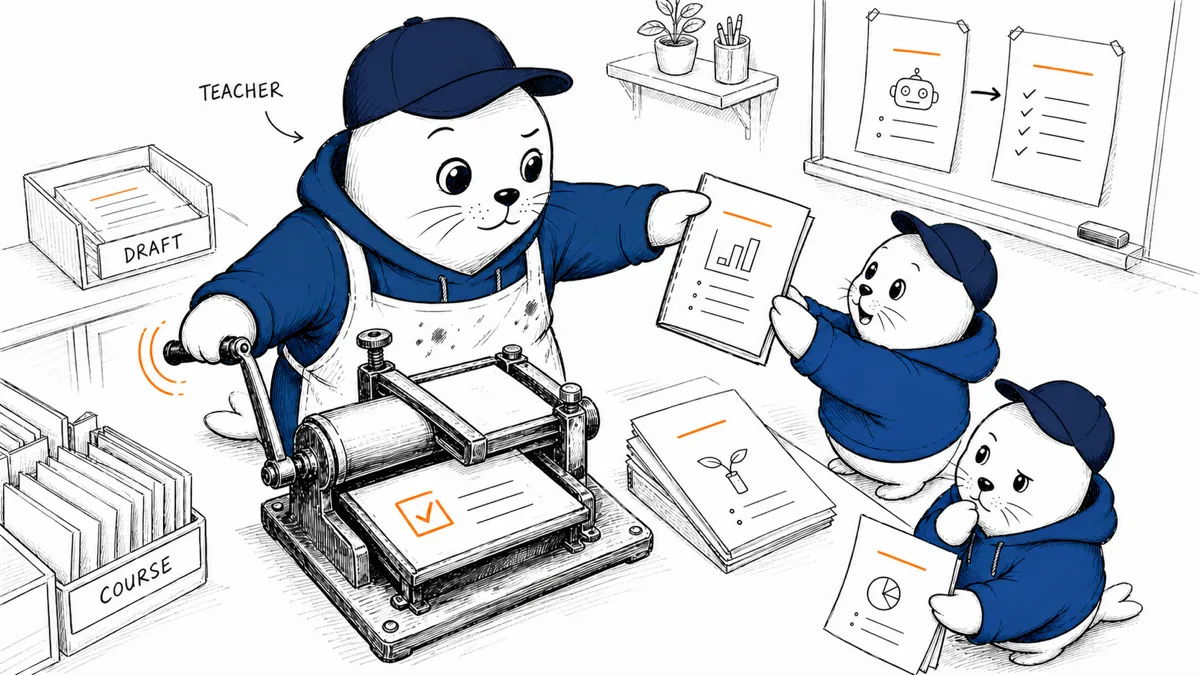
A teacher can now hand ChatGPT a course outline and receive an LMS-ready unit, while a student can turn the same material into a tutor, quiz, and study plan. That sounds efficient. The real educational question is what thinking remains visible after the plugin has done the setup.
August 26 update: district rollout makes governance the product
OpenAI says ChatGPT for Teachers has expanded to 55 school systems across 20 states, adding more than 100,000 educators and staff. Across its wider K-12 work, the company reports more than 100 organizations in 30 states and free access and training for more than 300,000 educators and staff.
The August 26 district announcement also describes a National Data Privacy Agreement covering 16 states, with a separate California agreement. ChatGPT for Teachers remains free to verified U.S. K-12 educators through June 2028.
OpenAI counted more than 1.9 million messages related to time-saving tasks between January 1 and July 16. That is a company analysis of product usage, not an independently audited measure of hours saved or teaching quality. A district should measure preparation time, corrections, rejected outputs, and changes in student work before treating message volume as productivity.
This rollout changes the adoption question. Schools are no longer choosing only a helpful classroom feature. They are choosing identity management, administrator controls, data terms, training, retention rules, and an evidence standard for learning. The related Bocconi classroom experiment shows why assignment quality and independent reasoning need separate measures.
OpenAI education plugins arrive for three different jobs
OpenAI has introduced three OpenAI education plugins for ChatGPT Work and Codex: one for K–12 educators, one for college educators, and one for college students. They are available through ChatGPT Edu and district deployments of ChatGPT for Teachers.
Here, "plugin" means more than a button. OpenAI describes a package of apps, role-specific skills, instructions, and common workflows. The idea is to give a school user a useful starting configuration without asking everyone to become an expert prompt engineer.
Three plugins, three starting points
The roles overlap, but the person responsible for the final decision changes.
K–12 Educator
Differentiated resources, exit tickets, practice tests, visuals, translations, and standards-aligned planning.
College Educator
Syllabi, course sites, assessments, calendars, teaching materials, and LMS packaging.
College Student
Guided tutoring, study plans, quizzes, flashcards, and visual explanations built from chosen sources.
The useful feature is context, not instant worksheets
A generic chatbot starts every request half-blind. These plugins can work from approved course materials, documents, calendars, and connected apps. That lets the system understand the assignment, timetable, standards, and source material before it starts drafting.
The K–12 plugin also integrates with Learning Commons resources intended to connect materials with academic standards and learning progressions. The college educator version can package work for an LMS. The student version is designed to build practice from material the student selects rather than from a random internet summary.
That is a real improvement. It moves the conversation from "write me a lesson about fractions" to "help me adapt this specific lesson for these learners, using this standard and this evidence." Context does not guarantee quality, but it gives a teacher something relevant enough to edit.
The control line should stay easy to see
A healthy classroom handoff
The plugin can accelerate preparation without quietly inheriting the human decision.
1
Human defines the learning goal
The teacher or student identifies what should be understood, not merely produced.
2
Plugin drafts the working material
It can organize, adapt, visualize, question, and format the selected sources.
3
Human checks meaning and difficulty
Claims, examples, accessibility, cultural fit, and cognitive demand get reviewed.
4
Learner shows independent understanding
A conversation, explanation, revision, or closed-resource task makes the judgment visible.
I would be cautious when the output looks finished too early. A polished course site can hide a shallow objective. A beautiful worksheet can rehearse the wrong misconception. A fluent tutor can rescue a student so quickly that the student never practices being stuck.
OpenAI says educators remain in control of pedagogy, grading, and agentic actions. Schools should make that promise operational by deciding which actions require review, which sources are allowed, and what evidence of student understanding must exist outside the chat.
Availability is institutional, not just personal
The OpenAI education plugins are available in managed education products, not simply switched on for every personal ChatGPT account. ChatGPT Edu provides institution-managed workspaces. ChatGPT for Teachers is free for verified U.S. K–12 educators and districts and includes administrative and privacy controls.
That distinction matters. A district deployment can set approved tools and permissions, claim its domain, and apply a data agreement. A teacher using a personal account may not have the same controls or contractual terms. Before uploading student work, I would ask the school which workspace is approved and how retention, connected apps, and human review are handled.
The 20-minute school readiness check
Run this before asking a department to adopt an AI workflow.
1
Use one approved workspace
Confirm account type, admin ownership, data terms, retention, and connected-app permissions.
2
Choose a low-risk lesson
Start with material the teacher knows well and can fact-check quickly.
3
Keep the source packet
Require every generated activity to trace back to assigned documents or approved references.
4
Test the learner, not the output
Ask for an explanation, revision, or transfer task that the student completes independently.
OpenAI is building distribution as well as software
The plugins arrive inside a wider education push. OpenAI says its five-year National Academy for AI Instruction partnership with the American Federation of Teachers aims to reach 400,000 K–12 educators, roughly one in ten U.S. teachers. It also says more than 200 million people ages 18–24 use ChatGPT weekly.
Those are company-reported figures, but the direction is obvious: AI fluency is becoming a curriculum and workforce issue, not an optional campus experiment. Our coverage of the OpenAI Student Collective shows the community side of that push. Our guide to using AI in college without outsourcing judgment deals with the harder part.
My verdict: use the plugin to create practice, not replace it
The best use of these plugins is not producing more educational content. Schools already have mountains of content. The opportunity is turning a teacher’s existing material into better practice, faster feedback, clearer adaptations, and more chances for a student to explain what they understand.
I would start with one recurring task that currently steals preparation time. Let the plugin draft it, make the teacher’s edits visible, and compare the result with the old workflow. If the saved time becomes better discussion, feedback, or individual support, the tool has earned its place. If it only produces more pages, it has not.
Go deeper
- Read OpenAI’s education plugin announcement.
- Review the official ChatGPT for Education overview.
- Explore Learning Commons, which supplies standards and learning-science resources to the K–12 plugin.
What classroom task would you automate first, and what judgment would you refuse to hand over?
Updated August 29, 2026. District, educator, state-coverage, privacy-agreement, access, and message-volume figures are OpenAI-reported. Product availability still depends on institution, country, account type, verification, and administrator settings.