

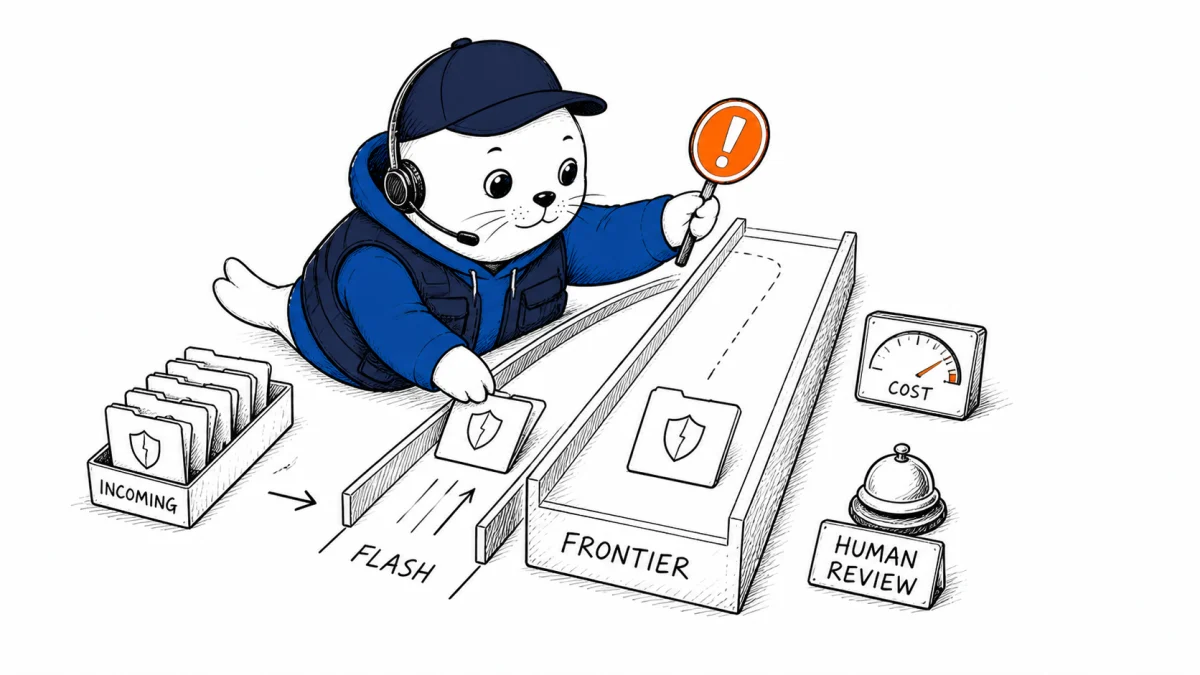
Microsoft’s most interesting new cyber model is not being positioned as the answer to every cyber task. It is being used as one route inside a system that can escalate harder work elsewhere.
That is the practical lesson in Project Perception model routing. Microsoft introduced Project Perception as a multi-agent, multi-model security system, then placed its new MAI-Cyber-1-Flash model inside MDASH for vulnerability-management work. The smaller specialized model handles speed-sensitive tasks; other models and human review remain available when the work demands more.
Microsoft reports strong early numbers: 96% on CyberGym, a 12-point improvement over Mythos, and nearly 50% lower cost than MDASH’s current model configuration. Those are Microsoft measurements, not results Musthave.ai independently reproduced. The architecture is still useful to study even before production evidence arrives.
What Project Perception is
In its security announcement, Microsoft describes Project Perception as a system of specialized red, blue, and green agents. Red agents probe, blue agents defend, and green agents coordinate or evaluate. A routing layer chooses among models using quality, reliability, latency, and cost.
Fast specialist
Handles frequent, bounded work where latency and cost matter.
Frontier model
Takes ambiguous or deeper reasoning when the specialist is not enough.
Verifier
Checks evidence, consistency, and whether another pass is needed.
Human review
Owns consequential decisions and exceptions that cross policy boundaries.
The design matters because "use the best model" is not a complete operating policy. The most capable model may be slower or more expensive than a specialized one on routine work. A cheap model may be the wrong place for an ambiguous finding that can interrupt production. Routing makes that tradeoff explicit.
Why MAI-Cyber-1-Flash is routed, not universal
MAI-Cyber-1-Flash is presented as a fast security model inside MDASH, Microsoft’s automated security-research system. Its name signals the intended role: high-throughput cyber tasks where quick response and lower cost are valuable. Microsoft does not claim that it should replace every frontier model or every analyst.
A route should depend on the consequence of a wrong answer, not only on prompt length. Classifying a familiar vulnerability pattern is different from approving remediation against a production service. The second task needs stronger evidence, tighter permissions, and a named owner even if the first-pass text looks confident.
What the 96% and 50% figures do (and do not) prove
Evidence boundary
Microsoft reports 96% on CyberGym, 12 points above Mythos, and nearly 50% cost savings against MDASH’s current configuration. The company has not published enough independent production data to conclude that every customer will see the same accuracy, cost, or incident rate.
A benchmark can support a model-selection hypothesis. It cannot by itself validate the router, approval policy, data boundary, tool permissions, recovery behavior, or total operating cost. The savings comparison also depends on the baseline configuration, workload, retry rate, and price assumptions.
Before adoption, ask for the denominator behind "96%," the false-positive and false-negative split, performance by task class, the escalation rate, and the cost of cases that require a second model or a human. A fast first pass is only cheaper if the handoff does not create expensive repair work.
A routing policy builders can copy
| Task | Default route | Escalate when | Required control |
|---|---|---|---|
| Known-pattern triage | Fast specialist | Confidence is low or evidence conflicts | Structured output and sampled review |
| Novel or ambiguous finding | Frontier model plus verifier | Models disagree or provenance is incomplete | Evidence bundle retained |
| Action affecting production | Human decision | Always | Named approver and rollback plan |
| Policy exception | Human owner | Always | Reason recorded and time-bounded |
The useful pattern is not specific to security. Route by task class and consequence; verify when uncertainty rises; put irreversible action behind explicit approval. Our analysis of Claude Inference Hooks reaches the same conclusion from the policy side: the control plane belongs in a service that can log and enforce decisions, not inside a model’s prose.
Failure modes before production
Router preflight
- Silent under-routing: difficult cases remain on the cheap path because confidence is miscalibrated.
- Escalation loops: agents repeatedly hand work to one another without a cost or time ceiling.
- Shared blind spots: the verifier uses similar training or assumptions and agrees for the wrong reason.
- Evidence loss: the final answer survives while the tool trace and source record disappear.
- Human rubber-stamping: reviewers receive too much volume or too little context to make a real decision.
Test those failure modes with red-team cases before measuring average throughput. The caution is concrete: our review of an AI containment incident shows why a model’s interpretation of a rule cannot be the rule itself. Long-running systems also need restart and handoff evidence, as covered in our overnight-agent audit guide.
My verdict: route by task, escalate by evidence
Project Perception model routing is more interesting than a single benchmark headline because it treats model choice as an operating decision. Fast specialists, deeper models, verifiers, and people can each have a defined lane.
Microsoft’s reported scores justify testing, not blind deployment. Preserve the task taxonomy, routing reason, evidence trail, approvals, cost ceiling, and fallback for every consequential run. The goal is not to send every prompt to the biggest model. It is to know why each task took its route, and who can stop it.
Go deeper
- Read Microsoft’s Project Perception and MAI-Cyber-1-Flash announcement.
- Ask for task-level results, escalation rates, and production error data before treating a composite score as deployment evidence.
- Write the human-approval and rollback policy before connecting a routed agent to consequential tools.
Which cyber task would you allow a fast specialist to complete without a second model?
Checked August 7, 2026. Performance and cost figures are Microsoft-reported. Musthave.ai did not independently reproduce CyberGym or MDASH results, and public production-adoption evidence remains limited.