

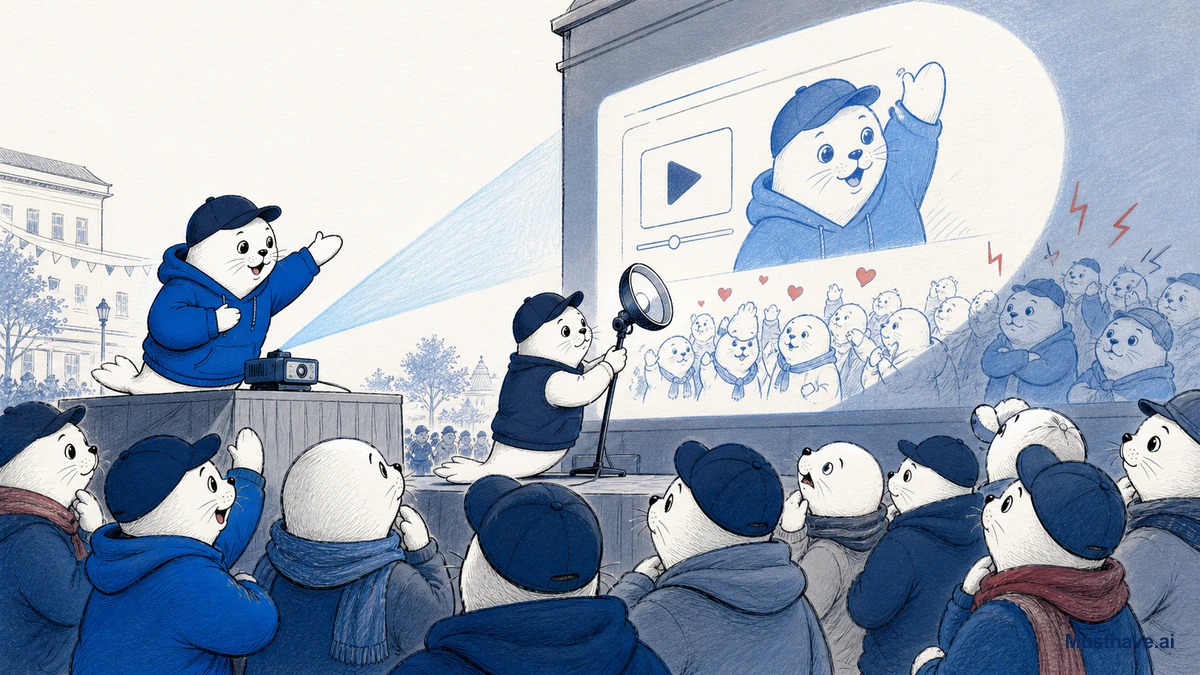
Every other AI video tool has to fight for eyeballs. Meta already owns them. That single fact makes its video features both the most tempting and the most fraught option for creators, because the same reach that could put your clip in front of millions comes with a trust test the smaller tools never face.
What Meta actually offers
Let’s separate the two things people conflate. Vibes is the consumer-facing product, a feed inside the Meta AI app where you create, discover, remix, and share short AI videos, then cross-post them straight to Instagram or Facebook Stories and Reels. Movie Gen is the research engine underneath: Meta’s media foundation models, with a video model that produces 1080p clips up to around 16 seconds, plus a separate audio model that adds synced sound effects, ambient noise, and music.
It’s free, it lives inside apps you already have, and it plugs directly into where you already post. For a lot of creators, that frictionlessness is the entire appeal.
The huge reach part
Here’s Meta’s real advantage, and it’s not the model quality, plenty of rivals match or beat it there. It’s distribution. Meta can drop AI creation tools in front of billions of Instagram and Facebook users, wired directly into Reels and Stories with editing tools, effects, auto-captions, and built-in analytics. No other AI video player has a built-in audience remotely that size.
For a creator, that means the path from “make a clip” to “millions could see it” is shorter here than anywhere else. That’s genuinely powerful if reach is your goal.
The harder trust test
Now the catch, and it’s a big one. Everything Meta ships in AI lands under intense public scrutiny, and it has already been burned. When AI creation happens at the scale of a global social network, questions about consent, deepfakes, authenticity, and “is this real?” stop being theoretical and become front-page backlash fast. Meta has pulled AI features before after users revolted.
So the same reach that’s an opportunity is also a liability. Your audience is increasingly skeptical of obviously AI content in their feed, platform rules can shift under you overnight, and a feature that’s here today can be gone next week. The trust bar on a billion-user platform is simply higher than in a niche tool.
How I’d actually use it
My honest take: use Meta’s AI video for what it’s uniquely good at (fast, casual, social-native short clips aimed at reach) while keeping your standards and your independence intact.
- Great for: quick hooks, remixable trends, and experiments where distribution matters more than polish.
- Be careful with: anything that could read as deceptive, or that uses real people without consent. The scrutiny is real and the backlash is public.
- Never do: build your entire funnel on a free platform feature. Own your email list, keep a primary tool and a backup, and film the moments where your real face builds the trust AI can’t fake.
The bottom line
Meta’s AI video is the reach play, unbeatable distribution, zero cost, native to the feed. But reach at that scale comes taxed with a trust test the smaller tools dodge. Use it as one tool in a deliberate stack, stay honest about what’s generated, and don’t mistake a button on someone else’s platform for a business you control. Your taste and your credibility are still the brand.
How to label AI video without killing trust
The trust tax is real, but you don’t beat it by hiding that content is AI, you beat it by owning it. If a clip is clearly generated, a light, honest touch (“made with AI”) in the caption tends to build more credibility than pretending, especially as audiences get better at spotting fakes anyway. Save the undisclosed stuff for purely decorative B-roll where no reasonable person would think it’s real footage. And never generate anything that puts words in a real person’s mouth or shows an event that didn’t happen. Honesty is cheaper than a backlash, and Meta has shown how fast those come.
Would you post obviously AI-generated video to your own feed, or does the trust risk hold you back? Tell me where you land in the comments.
Verification sources and related guides
Primary reference: Meta AI official site. This is an official provider source. Treat performance, adoption, and product claims as company-reported unless the article identifies an independent check.