

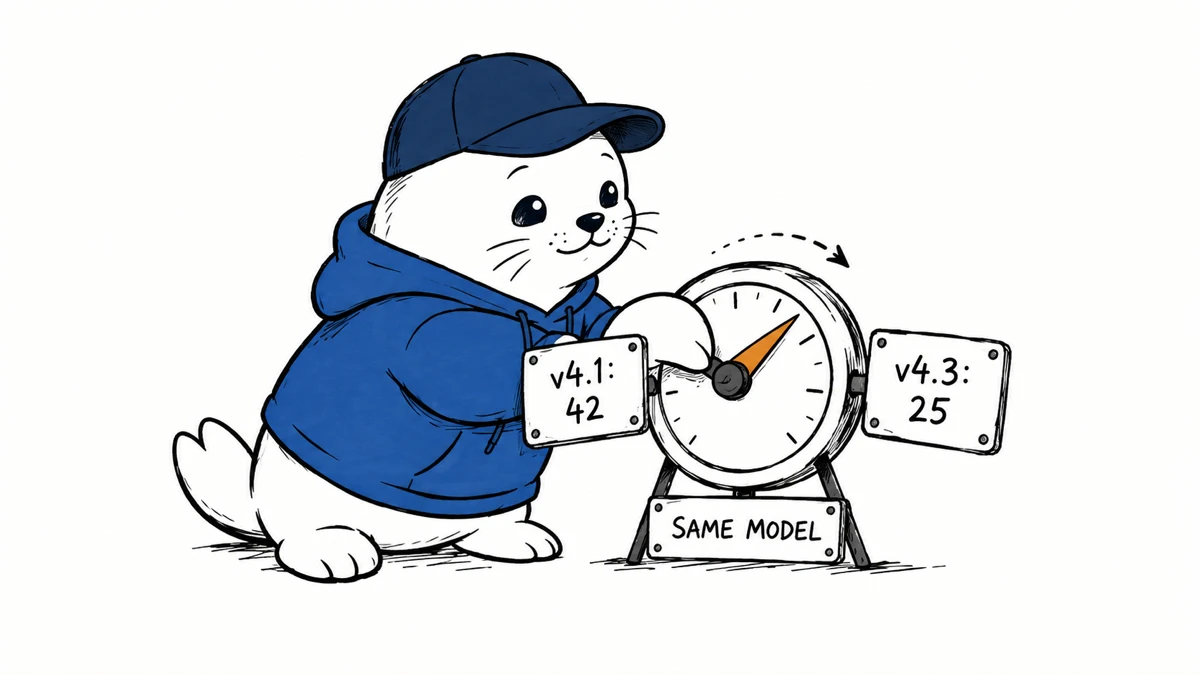
InclusionAI has released Ling-3.0-flash-VL, an MIT-licensed vision-language model with 124 billion total parameters, 5.5 billion active parameters per token and a context window of up to 256K. The most instructive part of the release is not a single score. It is what happened when the benchmark version changed.
The official Ling-3.0-flash-VL model card lists an Artificial Analysis Intelligence Index score of 42 under version 4.1.1. A public model-card discussion records that version 4.3 later showed 25. An InclusionAI account replied that 42 was valid at release under the older index and said the documentation would be updated.
What changed, and what did not
| Item | Published value | How to read it |
|---|---|---|
| Artificial Analysis v4.1.1 | 42 | The score shown on the model card for the release-era benchmark version. |
| Artificial Analysis v4.3 | 25 | A later score cited in the public discussion after the index methodology changed. |
| Model checkpoint | Ling-3.0-flash-VL | The discussion concerns a benchmark-version change, not a newly named checkpoint. |
| Documentation status | Update promised | The model card may lag the current index unless the version is read alongside the number. |
A drop from 42 to 25 looks like a model regression if the version label is omitted. With the version label included, it is evidence that a benchmark is a moving measurement system. The safe citation is not “Ling scored 42” or “Ling scored 25.” It is “Ling scored 42 on v4.1.1 and 25 on v4.3, according to the vendor’s public model-card discussion.”
Ling-3.0-flash-VL is sparse, not small
The model has 124B total parameters and activates 5.5B for each token. That is about 4.4% of the total parameter count. Sparse routing reduces the compute used for a token, but the serving system still needs access to the complete expert pool.
A raw BF16 weight calculation gives roughly 248 GB before caches and runtime overhead. That is a derived lower bound, not a measured deployment. InclusionAI’s own SGLang recipe recommends four 141 GB-class GPUs, while 80 GB GPUs require tensor parallelism across eight devices. The distinction mirrors our GLM-5.3-Flash active-parameter analysis and our Qwen3.8-Flash-Next deployment guide: active parameters describe routed compute, not the download or memory footprint.
The visual stack is native to the model
Ling accepts images and video alongside text. The model card describes a 42-layer hybrid backbone that alternates KDA and Gated MLA attention in a 5:1 pattern, plus a sparse mixture-of-experts design. This matters for teams evaluating long video, document and multimodal-agent workloads because the visual path is part of the released architecture rather than a separate captioning service.
The maximum advertised context is 256K with YaRN scaling. Maximum context is not the same as comfortable production context. Video frames, visual tokens and KV cache can increase memory pressure long before the text limit is reached.
A benchmark needs a version, harness and date
This episode provides a practical citation rule. Every benchmark claim should travel with three pieces of metadata: the benchmark version, the evaluation harness or settings and the date checked. Without them, a ranking can silently change meaning while the article remains unchanged.
- Record the exact benchmark version, not only the benchmark name.
- Separate vendor-published numbers from independently reproduced results.
- Archive generation settings, tool permissions and reasoning budgets where available.
- Recheck high-traffic comparison pages when benchmark methodologies change.
The hardware recipe is more useful than the headline
For an engineering team, the most actionable release details are the SGLang launch configuration, tensor-parallel guidance and context settings. They reveal that Ling-3.0-flash-VL is aimed at multi-GPU deployment despite its 5.5B active count. A team with eight 80 GB GPUs can test the official path; a single-workstation buyer should not interpret the active count as a local-hardware promise.
How to evaluate Ling-3.0-flash-VL responsibly
Start with tasks that reflect the intended workload: long-document question answering, multi-image comparison, video event retrieval and tool-assisted visual reasoning. Measure peak memory, prefill latency, output speed, cache growth and task success at several context lengths. Then compare results with a dense model at the same output budget.
For benchmark reporting, keep both historical scores with their versions rather than replacing one number with the other. That preserves the record and prevents readers from mistaking methodology drift for a checkpoint change.
What remains unverified
The architecture, deployment recipe and score explanation come from InclusionAI-controlled pages. MustHave.ai has not independently reproduced the two Artificial Analysis results or the full multi-GPU configuration. The model is open under MIT, which makes independent testing possible, but the published numbers should remain attributed until that testing exists.
Primary sources and disclosure
- InclusionAI: Ling-3.0-flash-VL model card
- InclusionAI: public discussion of the Artificial Analysis score versions
Checked September 16, 2026. Model specifications and benchmark explanations are company-published. The 4.4% activation ratio and 248 GB BF16 figure are simple calculations from the published parameter counts, not measured runtime requirements.