

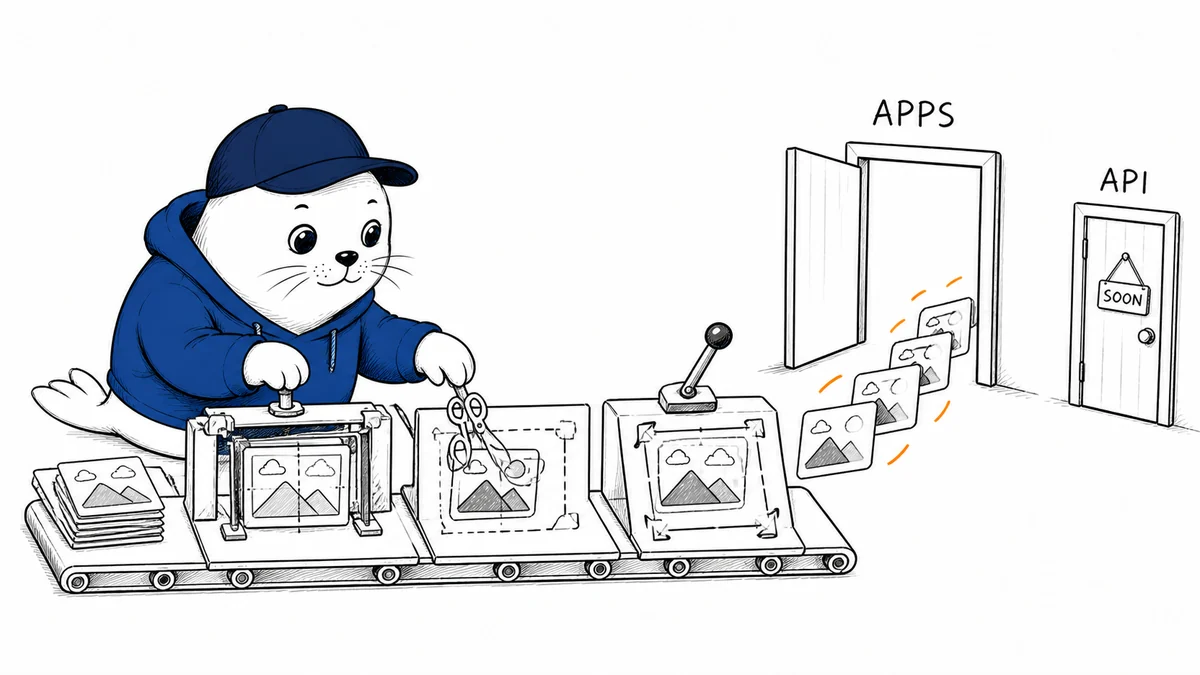
xAI launched a stronger image editor where consumers can touch it today. Developers still have to wait.
Grok Imagine Image 2.0 became generally available on August 7 as the new Quality Mode on grok.com and the Grok apps for iOS and Android. xAI says API access is coming soon.
That split is the story for builders. The consumer surface now supports a broader editing workflow, while production integrations still point at the existing Imagine image API.
The new model is an editing workspace, not only a prompt box
xAI lists region editing with a magic-wand selection, object segmentation, background removal, smart resize, templates, and the ability to work from as many as five input images in the consumer product.
Those controls move the product closer to a lightweight creative workbench. The useful question is no longer only “Can it generate the picture?” It is whether a user can repair, adapt, and export the picture without rebuilding the prompt from scratch.
The current API is still a different contract
xAI’s developer documentation currently describes grok-imagine-image-quality. It supports image generation and editing, up to three reference images, 1K or 2K output, and a listed price of $0.05 per generated image.
| Capability | Grok apps and web | Current Imagine API docs |
|---|---|---|
| Model generation | Image 2.0 Quality Mode | grok-imagine-image-quality |
| Input images | Up to five, according to xAI’s launch post | Up to three reference images |
| Interactive editing | Region selection, segmentation, background removal, resize, templates | Prompt-based generation and editing endpoints |
| Image 2.0 API availability | Not applicable | Coming soon |
Do not code against the consumer feature list. The eventual Image 2.0 API may expose different limits, formats, prices, or editing primitives.
xAI’s leaderboard position is a company-reported claim
xAI says Image 2.0 ranked second on text-to-image and single-image editing leaderboards as of August 7. That is a dated first-party claim. It should not be treated as a permanent quality grade, and it does not answer workflow questions such as consistency across a campaign, typography, policy constraints, or revision cost.
Our AI image and video buying guide uses those workflow questions instead of one score. The Midjourney versus Ideogram comparison shows why a creator’s preferred model can change with the job.
What developers should test while the API is pending
- Reference fidelity: test whether products, people, colors, and layouts survive across multiple edits.
- Region control: check how cleanly the selection boundary preserves nearby objects.
- Background removal: inspect hair, transparent objects, shadows, and fine edges.
- Resize behavior: compare whether added canvas respects composition instead of stretching the subject.
- Repeatability: record prompts and inputs now, then rerun them when the API arrives.
Do not build a production promise around “coming soon”
If you need an API today, use the documented current model and limits. If Image 2.0’s editing features are the reason for choosing xAI, prototype in the apps but keep the integration decision open.
The launch creates a useful evaluation window. Designers can discover the edits that actually save time before engineering commits to an endpoint, schema, or price that xAI has not published.
My verdict: test the workflow, wait for the contract
Grok Imagine Image 2.0 is worth testing now if image repair and adaptation matter more than raw prompt novelty. The app-first release exposes the workflow without pretending the developer surface is ready.
Save a small benchmark set of five-image compositions, region edits, removals, and resizes. When API access arrives, compare output quality, latency, price, reference limits, and policy behavior against that exact set.
Read xAI’s primary sources
- Read xAI’s Grok Imagine Image 2.0 launch post.
- Review the current Imagine API documentation.
- Check the xAI model catalog before integrating.
Which edit would you need to reproduce reliably before using Image 2.0 in production?
Checked August 9, 2026. App availability, editing features, input count, and leaderboard statements come from xAI’s launch post. Current API model, reference-image limit, resolution, and price come from xAI’s developer documentation. Image 2.0 API access remains announced but not yet documented as available.