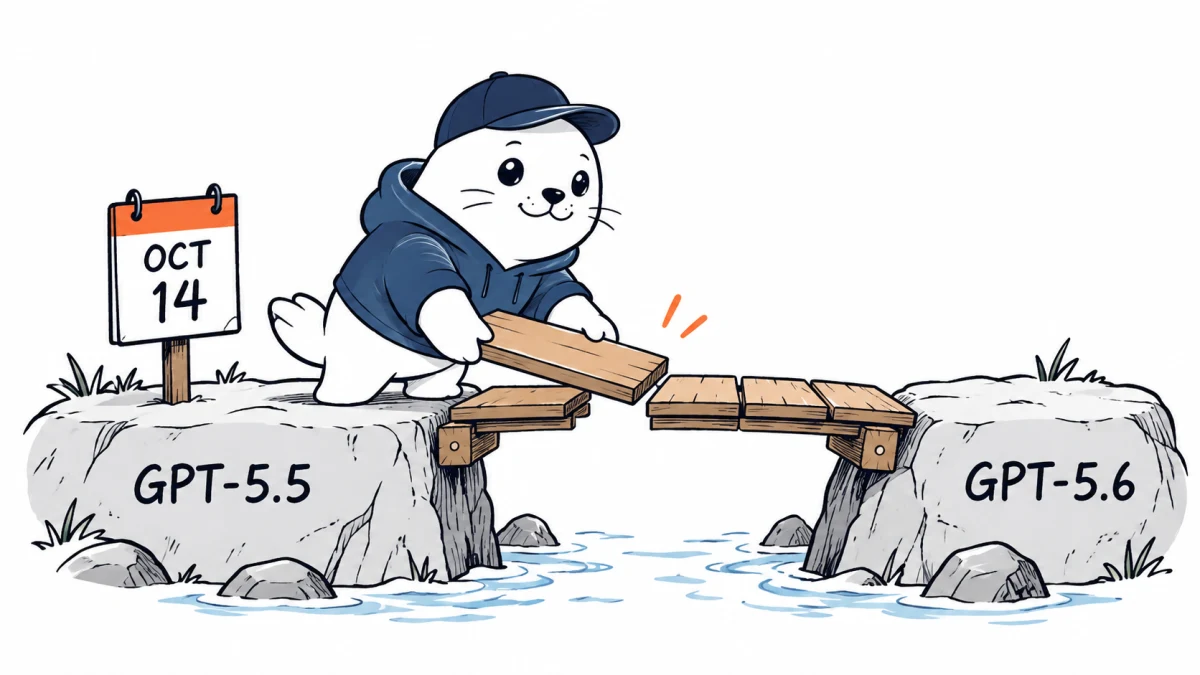
GPT-5.5 has a retirement date in ChatGPT and Codex. The deadline is October 14, 2026, and a model picker change is the smallest part of the migration.
The GPT-5.5 retirement applies to ChatGPT, ChatGPT Work and Codex across consumer, Business, Enterprise and Edu plans. OpenAI says it does not apply to the API. Codex users who authenticate with ChatGPT should move interactive selections toward gpt-5.6-sol and inspect every place where a model can be saved.
The deadline map
| Surface | Action before October 14 | Common hidden dependency |
|---|---|---|
| ChatGPT | Change saved or repeated model choices | Team instructions that name GPT-5.5 |
| ChatGPT Work | Review shared workflows and managed defaults | Workspace templates and internal documentation |
| Codex | Move ChatGPT-authenticated work to gpt-5.6-sol | Agent profiles, scheduled tasks and scripts |
| OpenAI API | Keep the migration separate from this deadline | Assuming the interactive retirement also removes an API model |
Start with an inventory, not a replacement
- Search prompts, runbooks and documentation for
GPT-5.5and model aliases. - Inspect ChatGPT workspace defaults and managed configuration.
- Open each Codex custom agent and verify its selected model.
- Review scheduled tasks, recurring jobs and saved automations.
- Search shell scripts, configuration files and CI variables that may pass a model name.
- List API integrations separately so the October 14 scope is not misapplied.
A direct string search is necessary but incomplete. A user can save a model through a graphical setting, a managed policy or an automation object that is not stored in the main repository. Ask workspace owners and automation owners to attest to the result instead of treating one code search as full coverage.
Migrate Codex work as a behavior change
Changing a model name does not prove that an agent behaves the same. Replay representative tasks against GPT-5.5 and GPT-5.6 Sol before the deadline. Include a routine edit, a long repository investigation, a tool-heavy task, an approval boundary and a task that is expected to fail safely.
- Compare completion rate and reviewer corrections.
- Record tool selection, retries and execution failures.
- Check that output format and structured responses still satisfy downstream parsers.
- Reconfirm permissions for custom agents and connected tools.
- Keep one documented rollback point until GPT-5.5 is no longer available.
Scheduled work is the highest-risk blind spot
Interactive users will notice when a picker changes. A scheduled task may fail when nobody is watching, or it may fall back to a different model and continue with different behavior. Inventory the owner, schedule, model, tools, destination and failure notification for every recurring Codex job.
Run each migrated task manually before allowing the next scheduled execution. If the task publishes, sends messages, changes repositories or touches production, verify the approval step and rollback path again.
Do not confuse ChatGPT retirement with API retirement
OpenAI explicitly excludes the API from this October 14 change. Keep two inventories: interactive ChatGPT and Codex use, and API use. Mixing them can create two opposite errors. A team may rush an API migration that is not required by this notice, or assume an interactive workflow is safe because an API model still exists.
A three-date migration plan
| Target date | Required evidence |
|---|---|
| By September 25 | Complete inventory, owners and criticality ranking. |
| By October 5 | Finish dual-run tests and migrate managed defaults. |
| By October 12 | Run final scheduled jobs, close exceptions and communicate support paths. |
| October 14 | Monitor failures, remove stale documentation and verify no hidden fallback remains. |
Keep a rollback record while the old model still exists
For each critical workflow, save the final accepted GPT-5.5 result, the migrated GPT-5.6 Sol result, the prompt or task version and the reviewer decision. This gives operators a behavioral baseline if quality changes after the cutoff. A rollback record is not a promise that GPT-5.5 will remain available after October 14; it is evidence that helps the team identify what changed and repair the new path.
Communicate the migration by workflow, not only by model name. Owners need to know whether a scheduled report, repository agent or review assistant changed, where failures will appear and who has authority to pause it.
Our guide to manual ChatGPT Thinking selection shows why visible model choice matters. The Custom GPT retirement guide covers a different migration, but the operational lesson is the same: inventories must include instructions, connected tools and ownership, not only model labels.
The migration sign-off
A workspace is ready when every affected model reference has an owner, replacement and test result; critical scheduled work has run successfully; API use is separated from the interactive deadline; and support teams know what to do on October 14. A spreadsheet of names is not completion unless the new path has produced an accepted result.
Primary source
Checked September 18, 2026. The retirement date, product scope, API exception and replacement direction come from OpenAI. The audit and testing sequence is MustHave.ai analysis.