

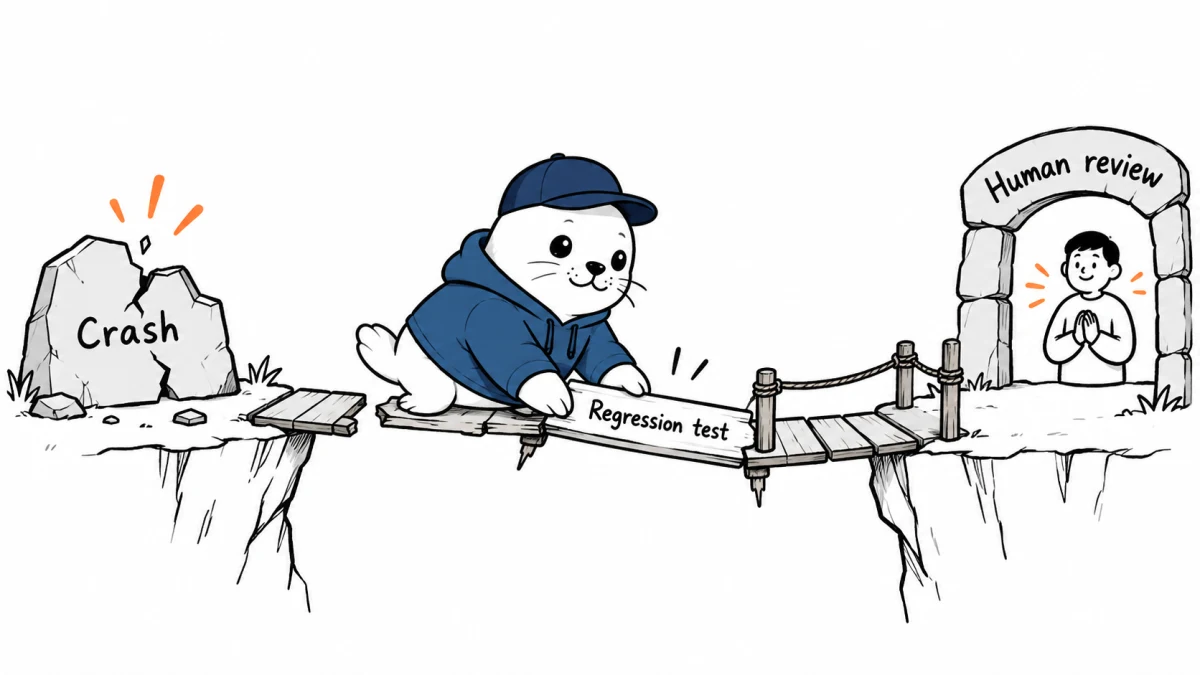
A crash report can now begin inside Sentry and end as a proposed pull request in GitHub Copilot. The dangerous shortcut is treating that path as proof that the right bug was fixed.
The GitHub Copilot Sentry workflow can open Sentry errors, stack traces and related context in a dedicated canvas, help investigate the failure, validate a change and prepare a pull request. GitHub announced the integration in its September 18 weekly release summary. It did not publish a measured fix-success rate.
A crash becomes a mergeable change through six evidence gates
- Production event: preserve the error, timestamp, release, environment and affected scope.
- Sentry context: inspect the stack trace, breadcrumbs, tags and grouped events.
- Repository hypothesis: identify the code path that could explain the observed failure.
- Reproduction: create a failing test or a controlled scenario that demonstrates the bug.
- Fix validation: show that the new change passes the regression test without breaking adjacent behavior.
- Human approval: review code, permissions, risk, rollout and rollback before merge or deployment.
The integration can reduce the handoff cost between monitoring and code. It cannot make missing evidence true. A plausible patch based on one stack frame may suppress the visible exception while preserving the underlying corruption, race or access problem.
Start by challenging the Sentry grouping
Error grouping is useful for incident triage, but one issue can contain multiple causes and one root cause can appear across multiple groups. Before asking Copilot for a fix, check whether affected events share the same release, transaction, device, tenant, feature flag and input shape. Separate first occurrence from the latest recurrence.
| Evidence | Question before coding | Weak substitute |
|---|---|---|
| Stack trace | Does this frame show the cause or only where the failure surfaced? | Assuming the top frame owns the bug. |
| Breadcrumbs | Which prior event changed the state? | Reading only the final exception. |
| Release tag | Did the incident start after a specific deployment? | Editing current code without comparing the deployed revision. |
| Affected users | Is the failure isolated to a tenant, role or input? | Treating one example as the population. |
| Frequency | Did the proposed change reduce the actual event pattern? | Closing the issue when the test passes locally. |
The regression test is the bridge
A pull request should include or reference a test that failed before the fix and passes after it. If the event cannot be reproduced, state that limitation in the PR and use the strongest available evidence: a fixture built from sanitized inputs, a targeted assertion, a canary observation or a monitor that can detect recurrence.
- Name the Sentry issue and relevant event or release.
- Describe the root-cause hypothesis in one falsifiable sentence.
- Include the pre-fix failure and post-fix result.
- Test adjacent cases that could be harmed by the change.
- State what evidence would prove the hypothesis wrong.
- Keep secrets, tokens and personal data out of prompts, code comments and fixtures.
Keep five decisions outside the agent
| Decision | Why it stays human-owned |
|---|---|
| Incident severity | Business impact may not be visible in the trace. |
| Credential access | Debugging convenience does not justify broader secret exposure. |
| Production write | A repair agent should not mutate live state to test a hypothesis. |
| Rollback authority | Rollback can affect customers, data and other releases. |
| Merge and deployment approval | Code correctness, change policy and release timing require accountable review. |
Grant the integration the smallest useful view
Review which Sentry projects, organizations and event fields the integration can read, and which repositories it can access. A support service does not need the payment repository merely because both report to the same engineering organization. Use a test project with synthetic events before exposing production traces.
Sanitize customer data and secrets at the monitoring layer. Waiting until the canvas is open is too late if sensitive fields were already captured. Document retention and revocation behavior for both sides of the connection.
A seven-incident rollout scorecard
- Time from issue selection to a testable hypothesis.
- Share of proposed fixes with a real regression test.
- Reviewer corrections to root-cause analysis.
- Code changes rejected as symptom suppression.
- Post-merge recurrence during the observation window.
- Secrets or restricted data detected in transferred context.
- Total engineer time, including prompt correction and review.
Compare those results with a similar set of manually investigated incidents. Faster PR creation is not the outcome if reviewers spend longer repairing the analysis or if recurrence rises.
Our GitHub Copilot review-effort guide explains why generated-code volume is a weak metric. The same principle applies here: measure accepted fixes and recurrence, not how quickly a canvas produced a patch.
The practical verdict
The Sentry canvas can remove context switching and help an engineer move from an observed crash to a reviewable hypothesis. Its safe boundary is a pull request backed by evidence. Keep production authority, severity, rollback and deployment with accountable humans, and require a regression test or an explicit evidence limitation before merging.
Primary source
Checked September 18, 2026. Feature scope comes from GitHub. GitHub did not publish an independent fix-success rate; the evidence gates and rollout scorecard are MustHave.ai analysis.