

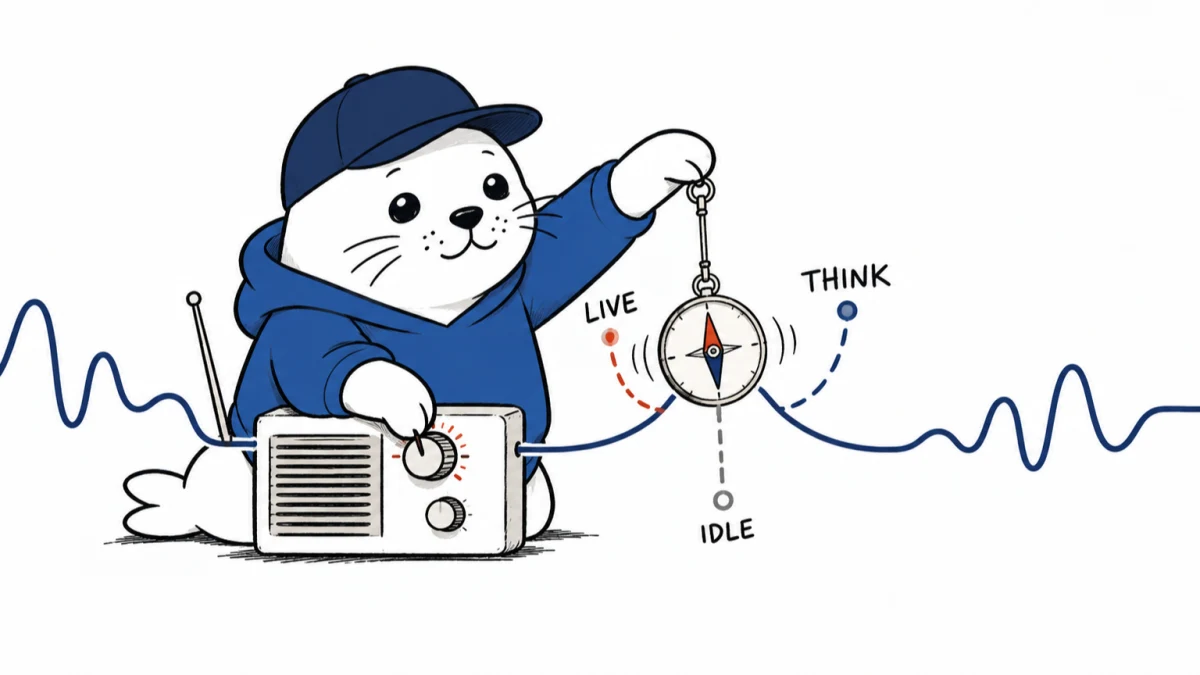
Google has released Gemini 3.8 Live and Gemini 3.8 Live Extended Thinking as generally available audio-to-audio models. The biggest migration risk is not the model name. It is the change in how a client decides that a thinking voice agent is actually idle.
The Gemini API changelog lists both models as GA on September 15, 2026. The standard model is designed for low-latency dialogue. The extended-thinking model can spend more time reasoning between conversational turns. Both accept text, images, audio and video, and can return text or audio.
The two models solve different voice loops
| Model | Best fit | Important constraint |
|---|---|---|
| Gemini 3.8 Live | Fast interactive voice and multimodal sessions | Does not support thinking_level |
| Gemini 3.8 Live Extended Thinking | Voice tasks that need deeper reasoning between turns | Asynchronous mode only |
Google documents a 131,072-token input limit and a 65,536-token output limit for each model. That does not mean a voice session should fill either window. Audio latency, interruptions and application memory still need their own budgets.
turnComplete no longer means the model is idle
In the extended-thinking model, a server message can include turnComplete: true while background reasoning continues. Google directs clients to the interaction_status field, which reports IN_PROGRESS or IDLE. A client that closes the microphone, commits state or starts a new request as soon as it sees turnComplete can interrupt the model’s reasoning path.
- Keep the session open when a response segment completes.
- Wait for
interaction_status: IDLEbefore treating the interaction as finished. - Log state transitions separately from audio chunks and transcript events.
- Test user interruption while the model reports
IN_PROGRESS.
Extended Thinking exposes three reasoning levels
The extended model supports low, medium and high thinking levels. That is an operating trade-off, not a quality guarantee. Teams should measure response latency, task completion and interruption recovery at every level. High reasoning may help a complex planning turn and feel needlessly slow for a short confirmation.
The standard model also removes two old controls
Google says proactive audio is permanently enabled in the standard Gemini 3.8 Live model, while affective dialogue has been removed. Video frames are included by default. Migration tests should therefore cover silent periods, background speech, frames that arrive without an explicit toggle and applications that previously depended on affective-dialogue behavior.
Pricing turns voice design into a measurable budget
| Standard Gemini 3.8 Live input | List price |
|---|---|
| Text | $0.75 per 1M tokens |
| Audio | $3 per 1M tokens, about $0.005 per minute |
| Image or video | $1 per 1M tokens, about $0.002 per minute |
| Text output | $4.50 per 1M tokens |
| Audio output | $12 per 1M tokens, about $0.018 per minute |
For a useful estimate, record input audio minutes, output audio minutes, text tokens, video duration and abandoned sessions separately. A single blended per-minute number can hide expensive output-heavy conversations.
GA model does not erase the API preview notice
There is a documentation nuance worth preserving. The changelog and model pages label the models generally available, while the Live API capabilities page still says the Live API is in preview. The safest reading is that model lifecycle and API-surface status are separate. Procurement and reliability reviews should document both.
A migration test plan for real voice agents
- Compare end-of-turn behavior using both
turnCompleteandinteraction_status. - Replay long pauses, barge-in, noisy rooms and network reconnects.
- Measure latency and completion at low, medium and high thinking levels.
- Audit frames and audio retained by the application.
- Set a cost ceiling for incomplete or abandoned sessions.
Our Gemini 3.8 Flash migration guide covers the text-model side of the release. The Lyria 3.5 API guide shows how to apply the same version, price and output-rights discipline to generated media.
The practical verdict
Gemini 3.8 Live makes Google’s production voice stack more explicit, but Extended Thinking changes the session contract. Teams that migrate the model ID without migrating their idle-state logic may ship a voice agent that cuts off its own reasoning.
Primary sources
Checked September 15, 2026. Model behavior, limits and prices come from Google. Migration risks and test recommendations are MustHave.ai analysis.