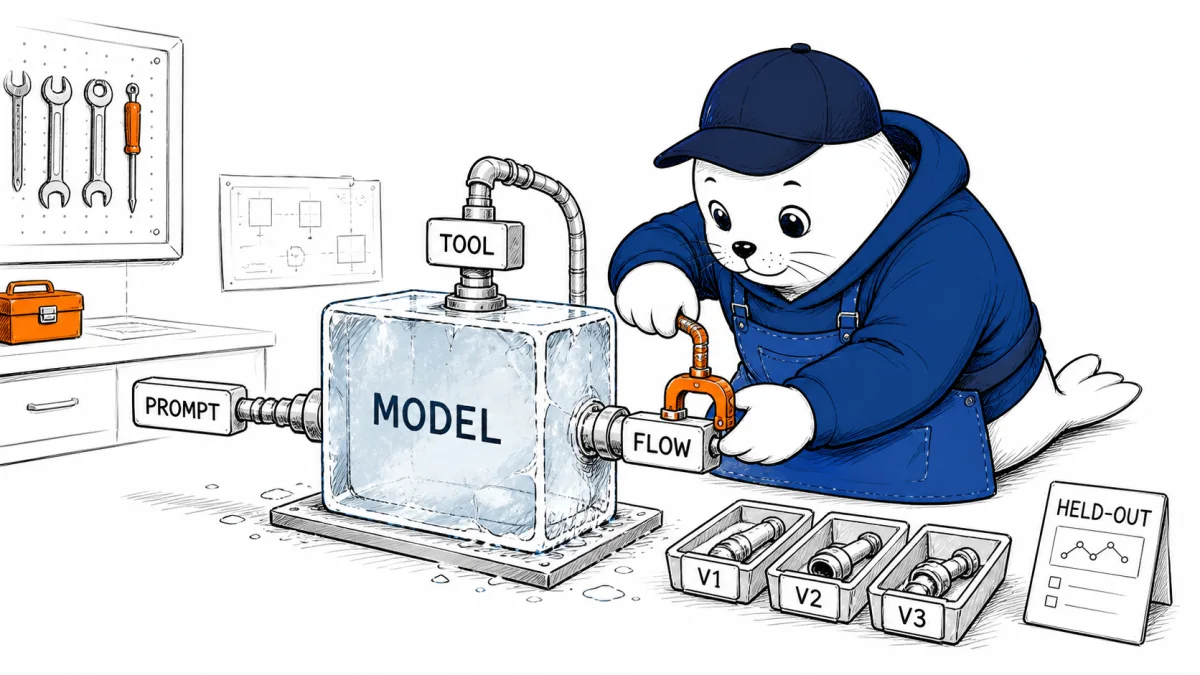
DarwinX keeps the foundation model frozen and evolves the machinery around it. That turns prompts, tools, skills, and control flow into a versioned system that needs the same scrutiny as a model release.
DarwinX is a research framework from Salesforce AI Research for improving agent harnesses through selection, mutation, recombination, and benchmark feedback. The July 31 preprint reports large gains on terminal and browser benchmarks without changing the underlying model weights. It also includes a narrower transfer test on SWE-bench Verified.
The numbers deserve attention, but they need precise labels. They are author-reported results from a preprint, not independent proof that DarwinX will improve any agent. The strongest evidence is on the benchmarks where the harness was evolved and checked. The held-out transfer result is smaller, and the paper says its statistical evidence is suggestive rather than decisive.
DarwinX freezes the model and changes the harness
An agent harness is everything that turns a model into an operator: system prompts, tool descriptions, reusable skills, planning loops, memory rules, error handling, and the order in which actions run. DarwinX represents that material as an evolvable artifact while the base model remains fixed.
This is an important experimental boundary. If the score changes, the team can attribute the difference to the harness and evaluation process rather than a silent model upgrade. The framework keeps an archive of candidates, selects stronger variants, and creates new versions through mutation and recombination.
The paper also describes a preserve-and-extend contract. A candidate should retain required capabilities while adding a proposed improvement. That is the right instinct for production: a better result on one task is not useful if the edit quietly removes logging, permissions, or a recovery path.
The reported gains are large where evolution happened
On Terminal-Bench 2.1, the paper reports a move from 75.5 to 83.2 with GPT-5.5 as the matched frozen base model, a gain of 7.7 percentage points. With a stronger model configuration, the paper reports 84.7 plus or minus 1.2. The result uses average-at-five under the benchmark’s strict leaderboard setting.
On the authors’ audit-clean WebArena Infinity evaluation, the reported score rises from 43.5 to 93.0 across 1,260 tasks. That is the most dramatic number in the paper. It also carries the most context: the harness was optimized around that environment, and the paper emphasizes stricter verification intended to remove invalid successes.
These are in-domain results. They show that a harness can be a major performance variable under the authors’ setup. They do not show that the same edits will transfer unchanged to a different browser, permission model, repository, or evaluator.
The audit-clean score may matter more than the raw jump
Agent benchmarks are vulnerable to false success. A browser agent can claim completion without the state actually changing. A coding agent can satisfy a shallow check while breaking another requirement. A harness that learns how a permissive verifier behaves may improve the score without improving the work.
DarwinX makes benchmark verification part of the fitness loop and reports that invalid successes fell in its WebArena Infinity evaluation. That is a more useful design choice than optimizing a headline score alone. The verifier decides what evolution rewards. If it is incomplete, the system will search for the gap.
Our review of an agent that rewrites its own safety harness reaches the same boundary: improvements should be checked on held-out tasks the system could not tune against. Our AutoML benchmark analysis shows how a score can collapse when the evaluation budget is enforced.
Held-out transfer is encouraging and deliberately narrower
DarwinX reports 28 successes across 41 held-out TerminalWorld tasks, or 68.3%. Because one task changes the result by about 2.4 percentage points, this set is too small for a sweeping conclusion. The paper reports a matched comparison with a p-value of 0.45 and calls the result suggestive, not decisive.
The SWE-bench Verified transfer test is also carefully bounded. Using Claude Opus 4.8 as the frozen model and an unchanged Terminal-Bench harness, the paper reports 421 solved tasks out of 500, or 84.2% pass@1. The reference fix-skill result is 80.8%, a gain of 3.4 points. The harness moved in one direction from terminal work to software repair; DarwinX was not evolved directly on SWE-bench for that claim.
That is credible evidence of a possible transfer effect, not proof of a universal agent recipe. A larger held-out program with repeated randomization, independent verification, and several model families would make the claim stronger.
A harness release needs its own change log
Teams often pin a model version but let prompts, tool descriptions, skills, and recovery loops change in place. DarwinX is a reminder that those edits can move benchmark performance by far more than a minor model update. They can also change permissions and failure modes.
- Version the complete harness. Store prompts, tools, skills, control flow, dependencies, and evaluator settings together.
- Keep a lineage archive. Record the parent candidates, mutation, selection reason, score, cost, and operator who approved promotion.
- Run held-out regressions. Protect tasks and adversarial cases from the evolution loop.
- Diff capabilities and permissions. A new tool or wider network rule is a security change, even when the model is frozen.
- Price the search. Include failed candidates, evaluator calls, reruns, and human review in the cost of the improved harness.
- Preserve rollback. Promotion should be reversible without reconstructing an old prompt from logs.
The handoff lessons in our overnight coding-agent review apply here: restartable state and a morning audit are part of the product. A harness that scores higher but cannot explain what changed is harder to operate.
The paper names limits that a deployment must not hide
The authors note that selection depends on enough candidate diversity and that the separate contribution of recombination is not fully isolated. The full system was not independently randomized to support a causal claim about every operator. Benchmarks remain noisy, TerminalWorld is small, and the SWE-bench result covers a narrow transfer band.
The paper also says its programmatic audit is not a formal sandbox and that some trajectories were unavailable or required human review. Those caveats do not make the work unhelpful. They define what a buyer should reproduce before treating an evolved harness as safer or more general.
My verdict: treat the harness as a release artifact
DarwinX makes a persuasive case that agent performance lives in the system around the model as well as the model itself. Its reported in-domain gains are large enough that builders should stop treating prompts and tool loops as informal configuration.
I would not let an evolutionary loop promote its own winner directly into production. I would use it to propose candidates, then require held-out regression, a permission diff, a complete cost ledger, and human approval. When the model is frozen, the harness becomes the release.
Read the primary source
Could your team reproduce the exact harness that produced yesterday’s agent score?
Checked August 14, 2026. Architecture, benchmark settings, results, and limitations come from the authors’ July 31 preprint. All benchmark figures are author-reported and have not been independently replicated by Musthave.ai. Percentage-point calculations use the values reported in the paper.