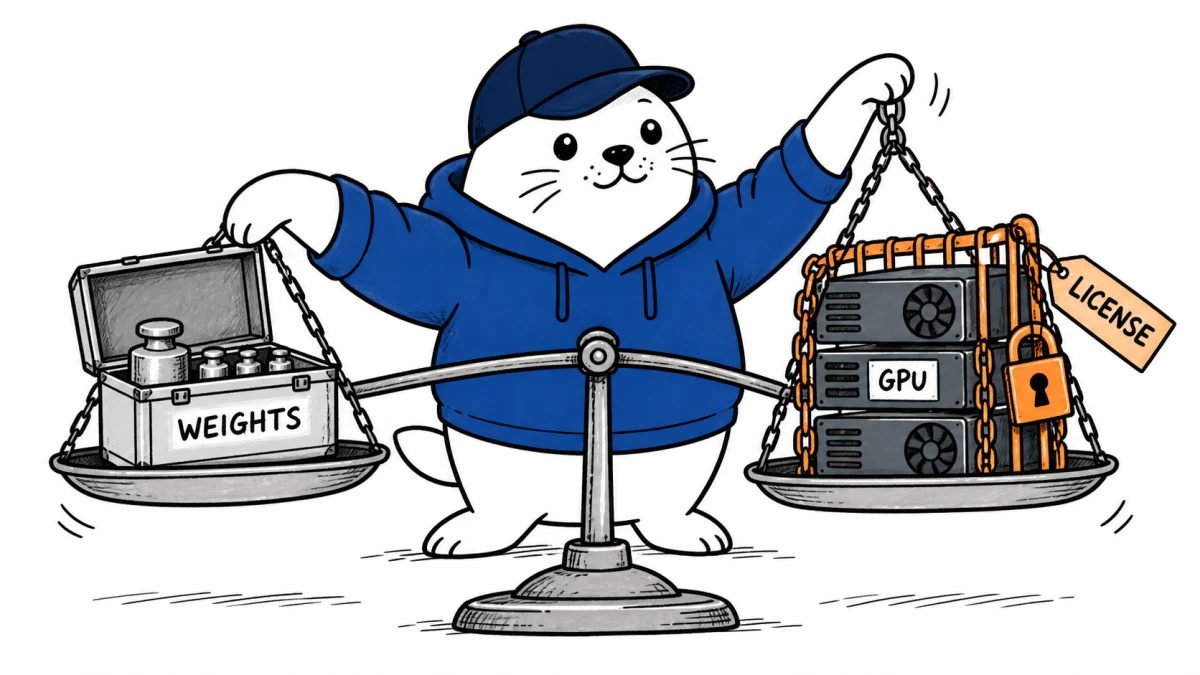
Cohere has released North Small Translate 1.0, a sparse 218-billion-parameter translation model whose weights can be downloaded for research. The practical catch is in the same sentence: the license is non-commercial, access is gated and even the smallest listed quantization needs high-end GPU hardware.
Cohere announced the model on September 10, 2026. The official model card identifies it as a decoder-only mixture-of-experts model with 218B total parameters, 25B active parameters and a 16K-input plus 16K-output context.
The one-minute deployment verdict
| Question | North Small Translate answer | Decision |
|---|---|---|
| Can I inspect and download weights? | Yes, after accepting the gated conditions. | Useful for authorized research and evaluation. |
| Can I use those weights in a commercial product? | Not under the public CC BY-NC 4.0 release. | Contact Cohere or RWS for commercial terms. |
| Can I run it on a typical workstation? | The listed minimum starts at one B200 or two H100 GPUs at 4-bit. | Plan for server-grade infrastructure. |
| Is the benchmark independently verified? | No independent reproduction is supplied. | Treat the results as company-reported. |
Cohere North Small Translate activates 25B of 218B parameters
The model has 128 experts and activates eight per token, alongside shared experts. That sparse design means inference does not use all 218B parameters for every token, but all weights still need to be stored and distributed across the deployment hardware.
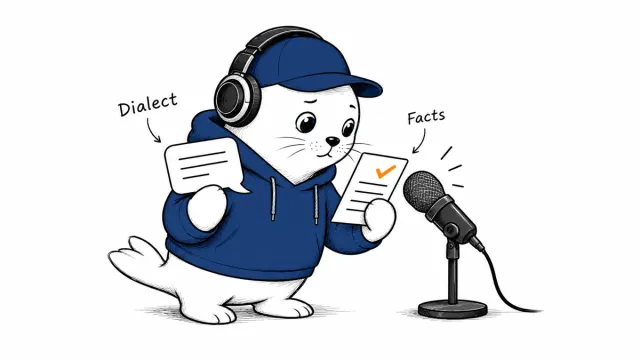
The model card lists 50 supported languages, including Arabic, Bengali, Hindi, Urdu, Traditional Chinese and Simplified Chinese. Cohere’s launch page says 50-plus languages, while the detailed card enumerates 50. The safest description is the model-card count rather than silently expanding the list.
Open weights does not mean commercially open
The public release uses CC BY-NC 4.0 and also requires compliance with Cohere Labs’ Acceptable Use Policy. The Hugging Face repository is public, but users must log in, accept conditions and share contact information before accessing the files.
A research team can evaluate, study and adapt the weights within those terms. A company should not interpret the download button as permission to ship paid translation, internal revenue-generating services or customer-facing products. Commercial users are directed to Cohere or RWS.
The hardware floor is part of the product
| Checkpoint | Blackwell example minimum | Hopper example minimum |
|---|---|---|
| BF16 | 4 x B200 | 8 x H100 |
| FP8 | 2 x B200 | 4 x H100 |
| NVFP4 W4A16 | 1 x B200 | 2 x H100 |
The model card warns that loading near the hardware minimum needs explicit memory headroom. Filling every GPU with weights can leave too little temporary space for mixture-of-experts layer fusion. This is a deployment constraint, not a small installation detail.
The 83.60 benchmark needs its judge attached
Cohere reports an 83.60 score across its WMT26 all-language evaluation and 84.36 for an agentic variant that can find and repair translation errors. The launch material says GPT-5.6 Sol served as the judge. Cohere also reports stronger averages than the comparison systems in that evaluation.
These results are useful evidence of Cohere’s test, not a universal ranking. A buyer should reproduce quality on its own language pairs, document types, terminology and error costs. Human bilingual review is especially important for legal, medical, financial and safety-critical content.
A six-test evaluation before requesting commercial terms
- Choose production language pairs, not an all-language average.
- Build a blind set of real document formats and approved terminology.
- Score omissions, added claims, numbers, named entities and formatting separately.
- Compare standard and agentic modes for quality, latency and compute.
- Measure human correction time per thousand words.
- Confirm that the intended deployment and derived artifacts are covered by the negotiated license.
Who should test it now
North Small Translate is best suited to research groups, sovereign-AI programs and enterprises that already operate multi-GPU inference and can negotiate commercial rights if the test succeeds. It is a poor fit for a developer seeking a permissively licensed model that runs on one ordinary consumer GPU.
Our guide to open weights versus closed APIs explains why control and operational responsibility arrive together. For another current example of a model whose serving claims depend on B200 infrastructure, see our Nemotron 3 Ultra NIM analysis.
The practical verdict
Cohere North Small Translate is a substantial research release with broad language coverage and unusually explicit deployment notes. Its most important lesson is not the top-line benchmark. It is that weights, license, hardware and evaluation method are four separate parts of model availability.
Primary sources
Checked September 14, 2026. Benchmark and throughput claims are Cohere-reported. MustHave.ai has not independently reproduced them. Review the current license before any deployment.