Cohere Labs counted 696,291 published tools across 123,069 public MCP server listings. That sounds like broad workplace automation until the researchers apply a strict test: only 2.6% of the tools could fully perform a recognized occupational task rather than merely help a person do it.
The new Agentic Task Ecosystem dataset, or ATE, gives builders a useful map of what public agent tools are being built. It does not measure adoption, private enterprise systems, reliable production use, or jobs eliminated. Its value is narrower and more practical: it separates a huge tool inventory from evidence of end-to-end task coverage.
What the Cohere agent tools dataset contains
Cohere says it aggregated seven public directories in May 2026. The resulting corpus covers roughly 696,000 published tools across 123,000 public MCP servers. Researchers matched tool descriptions to task statements from the U.S. Department of Labor’s O*NET system.
The key classification asks whether a tool could carry out an occupational task, not simply return information that might assist the work. Under that stricter standard, 2.6% cleared the bar. That is about 18,100 tools if the percentage is applied to 696,291, but the paper’s reported percentage should remain the authoritative result because classification details and rounding affect the exact count.
| ATE finding | What it supports | What it does not prove |
|---|---|---|
| 696,291 tools | Large public supply of agent functions | Unique, maintained, or adopted products |
| 123,069 MCP listings | Broad public registry coverage | Active servers in production |
| 2.6% strict task match | Few tools claim full occupational-task execution | Reliability or economic substitution |
| 419 of 923 occupations with no activity | Coverage is uneven across recognized jobs | Those occupations cannot be automated privately |
The denominator problem changes the story
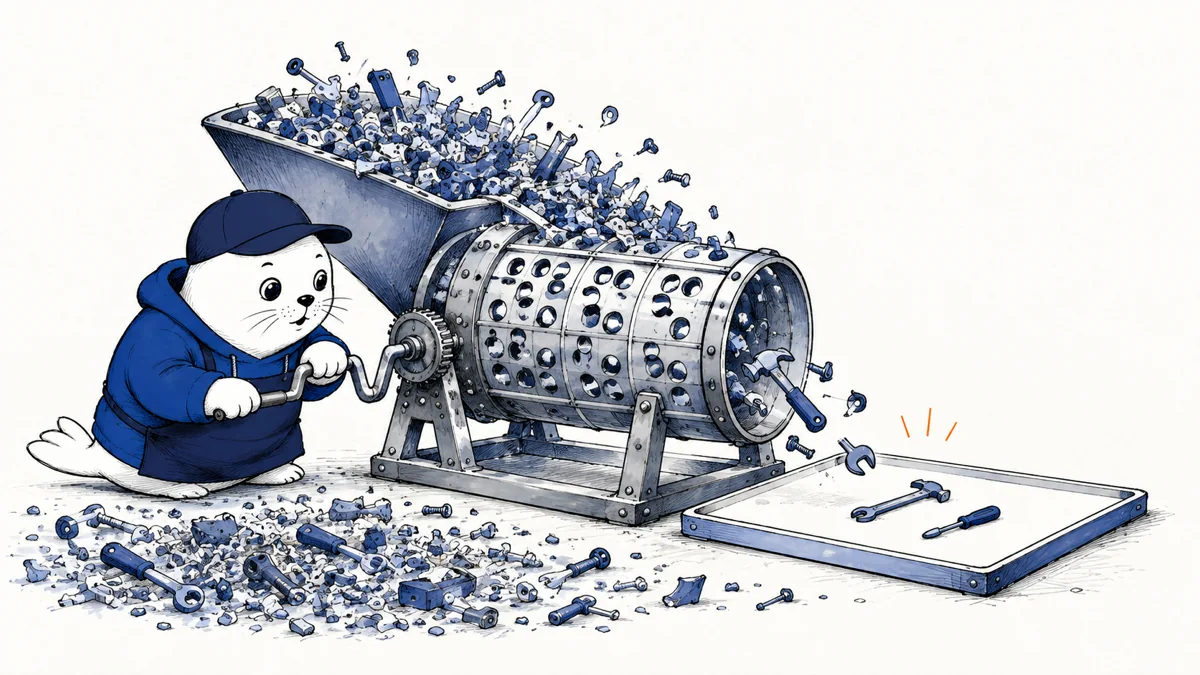
A marketplace can contain hundreds of tools that perform variations of the same narrow action. Search, file conversion, database queries, and software operations fragment easily into separate endpoints. Counting each endpoint makes the ecosystem look broad even when many tools cluster around a small set of digital tasks.
Cohere reports tool matches to 1,380 O*NET task statements, about 15% of the tasks considered software-performable in the study. That is more informative than the raw tool count because it asks how many distinct pieces of work are represented. Even then, a description match is not a passed execution test.
Nearly half of occupations had no public agent footprint
Of 923 occupations in the analysis, 419 had no public agentic tool activity. Physical and interpersonal work is difficult to represent through a software endpoint. Digital occupations receive more public tooling, but the pattern within jobs is not uniform.
The study found that tools sometimes target specialized work while leaving routine tasks to people, particularly when the specialized task is already performed through software. In other fields, public tools remain around routine edges while humans keep the specialized core. “AI automates the routine” is therefore not a sufficient planning rule.
Exposure predicts supply better than worker preference
Cohere reports a 0.54 correlation across occupations between technical exposure estimates and realized MCP coverage. It found no relationship between public tool supply and workers’ reported preferences about which tasks they wanted automated.
This is a supply-side signal. Developers tend to build what existing software, APIs, and permissions make feasible. The result does not show that employers will adopt those tools, that workers reject them, or that the tools complete work safely. It does suggest that interface availability can shape automation faster than workplace demand does.
A small slice represents genuinely new work
The researchers grouped unmatched tools into 35 categories and estimate that about 3% of those categories represent genuinely new work rather than finer-grained old work or infrastructure. Much of that new work involves managing agents: coordinating, observing, routing, evaluating, and controlling other automated systems.
This is an important builder signal. The opportunity may not be another generic action endpoint. It may be the control plane around agents: identity, policy, testing, cost accounting, tracing, recovery, and evidence that a task actually finished.
Use ATE to find validation gaps, not startup answers
- Choose one occupation and list the tasks that already happen entirely in software.
- Check whether public tools perform the complete task or only expose a supporting action.
- Measure how many human decisions, credentials, and external systems still sit between start and accepted outcome.
- Run the task with real failure cases, permission limits, and a verifier.
- Price the product around a completed unit of work, not the number of tool calls.
Our guide to agent tool registry discovery explains why metadata quality and availability checks matter before selection. Our analysis of AI agent cost controls shows how a tool-rich workflow still needs budget gates and routing.
Four metrics that make a tool inventory useful
- Distinct tasks: collapse duplicate endpoints and variants into the actual work they support.
- Verified completion: count cases that reach a defined acceptance test without hidden manual repair.
- Operational coverage: include authentication, permissions, retries, rollback, and audit evidence.
- Adopted volume: separate public availability from active use by real teams.
A tool directory can be an early indicator. It becomes an economic indicator only when supply is connected to adoption, reliability, time saved, quality, and who remains responsible for the outcome.
My verdict: 696,000 tools is a map of supply, not automation
ATE is valuable precisely because it makes the giant number less seductive. Public agent infrastructure is expanding quickly, while full occupational-task coverage remains a small fraction under Cohere’s strict definition. Nearly half of occupations show no public tool activity at all.
For builders, the strongest opportunity is to close the gap between a callable function and a verified business outcome. Pick one task, define the acceptance test, and count every human intervention. If the system still needs a person to assemble five partial tools and repair the final result, you have found the product work that the registry count hides.
Read and inspect the dataset
- Read Cohere Labs’ Automation’s Early Footprint.
- Inspect the Agentic Task Ecosystem dataset linked by the researchers.
- Review O*NET database documentation for the occupational task framework.
Checked September 4, 2026. Dataset scope, percentages, occupation counts, and reported correlations come from Cohere Labs. The approximate 18,100 calculation and product guidance are Musthave.ai analysis.