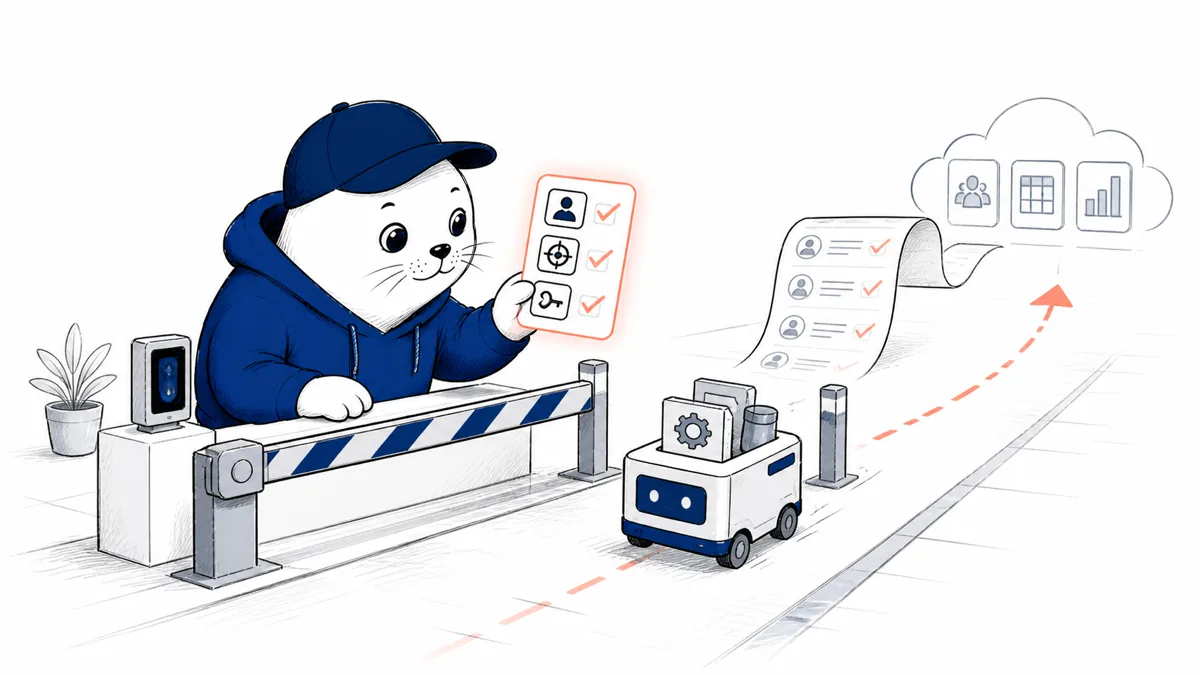
Broadcom has put a checkpoint in front of the moment that makes an AI agent dangerous: the tool call. AgentMinder is generally available, and its useful idea is simple enough to test this week. An agent should have to prove who it is, what job it is doing, and why this specific action belongs to that job before a tool receives the request.
Broadcom AgentMinder sits between agents and enterprise resources. The company says it authenticates each tool call, evaluates policy against the user and agent context, routes approved requests to authorized backends, and records the result through OpenTelemetry.
This is more concrete than an AI governance dashboard that only counts agents after deployment. It is also narrower than the full security story implied by Broadcom’s VMware Explore launch. AgentMinder is available now. Several protections announced around VMware vDefend and Avi Load Balancer are described as planned enhancements. Procurement teams should not put both columns into one box marked shipping.
The control happens before the tool receives the call
Broadcom describes four decisions inside the gateway. First, an identity is bound to the agent. Second, that identity carries a mission, permitted intents, approved tools, and authorized resources. Third, a cloud-native gateway evaluates each request against current user context and risk. Fourth, the action enters an audit trail.
| Checkpoint | What AgentMinder says it evaluates | Evidence to demand |
|---|---|---|
| Identity | Which agent and user initiated the request | Short-lived identity, issuer, expiry, and delegation chain |
| Mission and intent | Whether the requested action fits the declared job | Recorded task, allowed intent, and reason for the decision |
| Tool and resource | Whether this agent may call this backend | Exact tool, method, tenant, data scope, and denied alternatives |
| Runtime risk | Whether current context changes the policy result | Policy version, signals used, and fail-closed behavior |
| Audit | A chain of custody for the action | Immutable event, trace ID, decision latency, and reviewer access |
The row most teams will miss is mission and intent. A valid token proves that software has an identity. It does not prove that deleting a record, sending a payment, or opening a support ticket belongs to the assignment. AgentMinder is trying to make that second question a runtime policy decision.
The numbers show operational scale, not security effectiveness
Broadcom says deployments of its identity technology already handle nearly 36 million customer-related and 7 million workforce-related API calls per day, covering more than 20 million customer identities and 72,000 workforce identities. Those figures establish that the underlying identity layer operates at scale. They do not tell us AgentMinder’s false-allow rate, false-deny rate, decision latency, or resistance to a compromised policy service.
Ask for those four measurements in a pilot. A gateway that blocks dangerous actions but adds unpredictable seconds to every tool call will be bypassed. A gateway with a permissive fallback during an outage is not a control. A policy engine that cannot explain which facts changed the decision will make incident review slower, not faster.
Broadcom avoids one useful architectural trap
AgentMinder integrates with OpenID AuthZEN, a standard for connecting applications to authorization services. Broadcom says this avoids making one SaaS control plane the only path to every authorization decision. The product can run beside LLMs on premises, in a virtual private cloud, or in public cloud environments, including Kubernetes.
That deployment choice matters for latency, resilience, and regulated data. It also creates work: policy versions must stay consistent across locations, telemetry must reach the same investigation path, and an offline site needs an explicit fail mode. “Runs anywhere” is not the same as “behaves identically everywhere.”
Do not treat the whole VMware security stack as GA
Broadcom placed AgentMinder inside a larger VMware Private AI Cloud story. The new VMware AI Factory packages infrastructure, models, Tanzu services, monitoring, and agent controls. Broadcom lists more than 150 open and commercial models and describes token, GPU, and vGPU monitoring.
The launch also discusses future vDefend and Avi security capabilities. The wording matters. AgentMinder is generally available. Some surrounding protections are things Broadcom says it will add. SiliconANGLE’s independent overview confirms the breadth of the platform announcement, but buyers still need a dated bill of materials that separates available components, previews, and roadmap items.
Authorization still leaves four failure paths
- An approved action can still be wrong. A payment may be authorized but use the wrong amount. Keep application limits and human review for consequential transactions.
- A tool can interpret parameters unsafely. Validate schemas, destinations, and data ranges at the tool boundary.
- Secrets can leak before the call. Put credentials in a brokered store and issue them only after authorization.
- A successful call can create damage later. Use idempotency keys, compensating actions, and tested rollback paths.
Our investigation of AI cyber tests that reached real people showed why prompt boundaries are not enough. The network, credentials, public accounts, and shared infrastructure must enforce the same scope. Our AI agent security scorecard adds recovery, data movement, and ownership checks that a gateway alone cannot answer.
A one-hour acceptance test for AgentMinder
- Create one harmless task with two approved tools and one forbidden tool.
- Change only the user, tenant, or mission and verify that the same call produces a different decision.
- Replay an expired token, a valid token with an altered mission, and a request to an unlisted backend.
- Disconnect the policy service and confirm that consequential calls fail closed.
- Trace one allowed and one denied request from agent prompt to policy decision, tool response, and final application state.
If the team cannot reconstruct those five runs without searching several dashboards by hand, the governance claim is not ready for production.
My verdict: use the gateway as an enforcement point, not a security story
Broadcom AgentMinder addresses a real gap. An autonomous agent should not inherit every permission of the person who launched it, and a valid API token should not make every intent legitimate. A gateway that checks identity, mission, tool, resource, and current risk before the call is a sensible control point.
I would pilot it against denied actions first, not a polished happy path. Measure decision latency, false allows, false denies, outage behavior, and audit completeness. Then keep authorization beside transaction limits, secret isolation, monitoring, and rollback. The product can decide whether a call is allowed. Your application still has to survive what happens after an allowed call goes wrong.
Read the source material
- Review Broadcom’s AgentMinder product page.
- Read the general-availability announcement.
- Compare the VMware Private AI Cloud announcement.
- Check the independent SiliconANGLE report.
Checked September 1, 2026. Availability, architecture, integrations, deployment options, and scale figures are reported by Broadcom. Musthave.ai’s acceptance tests and control recommendations are editorial analysis.