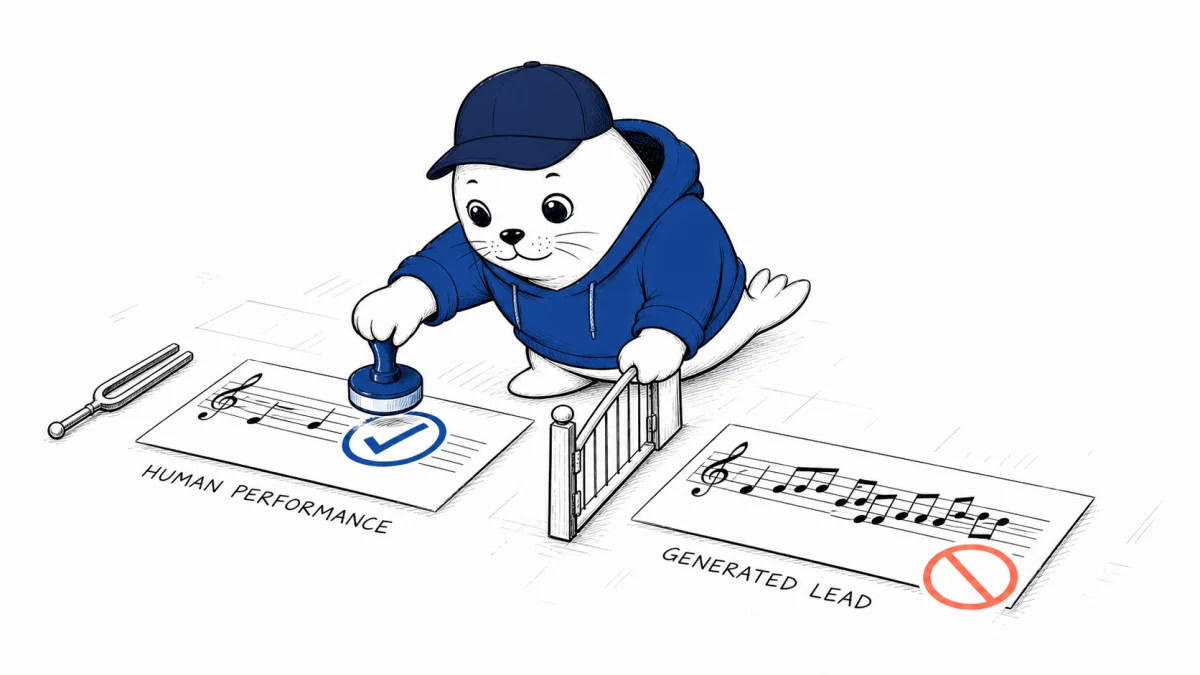
Australia’s music chart has drawn a line that the loudest headlines keep smudging. Using AI during production does not automatically disqualify a song. Letting a model perform the lead vocal or the primary instrumental part does.
The new ARIA AI music rules begin with the chart dated August 31, 2026. The Australian Recording Industry Association says recordings generated by AI are ineligible for its charts. AI-assisted recordings can still qualify.
That distinction matters to musicians, labels and tool makers. A human performance can pass through AI mastering, stem separation or a modest generated backing element without becoming an AI-generated recording under ARIA’s test. Replace the lead performance, however, and the result falls outside the chart.
The test follows the primary performance
ARIA’s FAQ asks who performed the recording’s primary creative elements. A generated lead vocal makes a track ineligible. So does a generated primary instrumental performance. The rule is concerned with the recording that listeners hear, not simply whether an AI tool appeared somewhere in the workflow.
| Production choice | Likely chart status | Why |
|---|---|---|
| Human lead vocal with ordinary digital production | Eligible | The primary performance remains human |
| Human performance with minor generated backing | Eligible | AI assistance does not replace the lead element |
| AI mastering, stem separation, reverb or drum machine | Eligible | These tools modify or support a human performance |
| Generated lead vocal | Ineligible | The model performs a primary creative element |
| Generated main instrumental performance | Ineligible | The primary instrumental performance is not human |
The edge cases will still need evidence. A background texture may be minor in one arrangement and central in another. The rule gives ARIA a decision framework, not a perfect audio detector.
A declaration starts the review
Rights holders submitting recordings now have to declare generative-AI use. If ARIA questions a recording, the submitter can provide evidence. Disputes can move through the ARIA Chart & Marketing Committee and, ultimately, the ARIA Board.
That process is more important than pretending an automated classifier can settle authorship from a waveform. Session records, vocal stems, project files, performer agreements and tool logs may become the practical audit trail. Anyone planning a chart campaign should preserve those materials before release day.
What the rule does not do
- It does not ban AI music in Australia.
- It does not stop a platform from distributing an ineligible recording.
- It does not decide copyright ownership or royalty entitlement.
- It does not prohibit radio play or listener access.
- It does not treat every AI-assisted production step as generation.
ARIA says an ineligible recording can lose chart positions, accreditations, number-one awards and ARIA Awards eligibility. Those are meaningful consequences, but they are chart consequences. Our analysis of Suno’s terms and download limits covers a different layer: what the service allows users to make and export. The two rulebooks should not be collapsed into one.
The missing training-data test
The International Federation of the Phonographic Industry has also discussed whether an AI service was authorized to train on music. ARIA has not applied that test yet. Its FAQ says licensing arrangements remain unsettled.
That leaves two independent questions. First: did a human perform the primary creative elements in this recording? Second: was the system used to create or assist it trained and licensed lawfully? ARIA is answering the first question for chart eligibility. It is not declaring the second one resolved.
A release checklist for artists and labels
- Name the lead performers. Record who sang or played each primary part.
- Document the AI role. Separate generation from editing, mixing, mastering and restoration.
- Keep stems and project history. Save enough evidence to answer an eligibility challenge.
- Check every market. One chart’s rule does not automatically govern another country, platform or award.
- Review tool terms. Chart eligibility does not cure a licensing or commercial-use problem.
Adobe’s approach to commercial AI music and indemnity shows why provenance and product terms matter even when the output remains chart-eligible. A clean workflow needs both a human-performance record and a defensible tool chain.
Build the evidence file while the session is open
A useful release file should identify the human lead performer, the instrument or vocal takes used in the master, and every generative tool that contributed audible material. Export dated stems and keep the project version that produced the final mix. If a generated backing part is minor, note where it appears and who decided its role.
That record does more than answer an ARIA query. It helps a distributor, publisher or collaborator separate performance, production and licensing questions without guessing months later. A checkbox saying “AI used” is too broad to explain whether the system cleaned noise, separated a stem or performed the hook.
- Keep performer credits tied to the final audio, not an early arrangement.
- Save tool names, plan type and material settings at the time of use.
- Preserve written approvals for generated backing elements.
- Assign one person to answer an eligibility evidence request.
My verdict: preserve the performance evidence
ARIA chose a workable boundary: AI may assist production, but it cannot replace the recording’s lead performance and still enter the chart. The rule will not remove every grey area. It does tell creators what evidence will matter when a song lands near one.
If a release depends on chart eligibility, do not wait for a dispute to reconstruct the session. Keep the stems, credits and tool history while the work is being made.
Read the source record
- Read ARIA’s rule announcement.
- Use the ARIA chart-changes FAQ for examples and appeals.
- Compare the Associated Press report for independent context.
Could you prove who performed the lead part six months after release?
Checked August 29, 2026. Eligibility examples and process details come from ARIA. The distinction between chart consequences and broader legal or platform consequences is Musthave.ai’s analysis.