

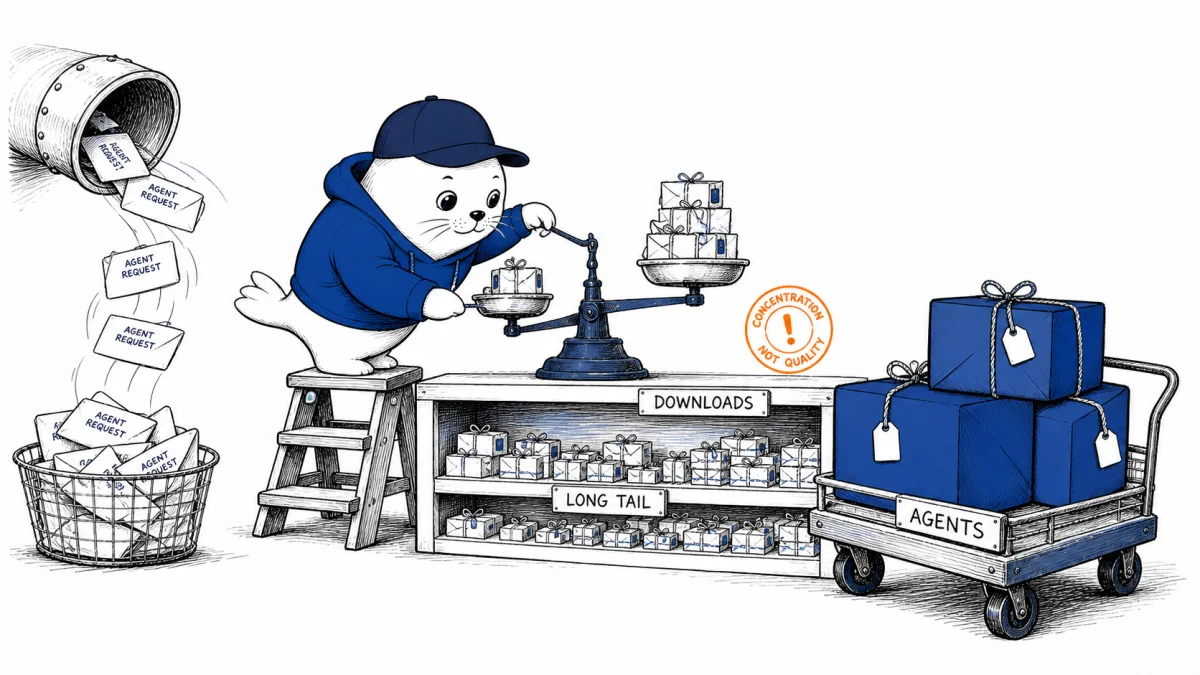
Hugging Face says software agents have become the Hub’s number-one user. The same report shows why that sentence needs a careful denominator: a small group of repositories still captures almost all recorded downloads, and many agent clients never identify themselves.
Hugging Face open model downloads grew alongside the public repository catalog in the first seven months of 2026. Hugging Face reports that public model repositories rose from 2.43 million to 2.96 million between January and July. The count is evidence of supply and publishing activity. It is not a quality score.
The distribution is sharply concentrated. Hugging Face says 85.6% of model repositories have fewer than 200 lifetime downloads, while 1.5% of repositories account for 99.2% of downloads. That long tail matters for discovery, but the headline catalog size does not describe where use occurs.
The Hub added about 530,000 public model repositories
The increase from 2.43 million to 2.96 million is about 530,000 repositories, or roughly 21.8% over the period. That calculation uses Hugging Face’s rounded endpoint figures, so it should not be read as a precise daily growth rate.
Repository count also includes forks, quantizations, checkpoints, adapters, conversions, experiments, and variants of the same base model. More repositories can improve access to formats and hardware targets. It can also make duplicate detection, model lineage, and evaluation harder. A buyer needs a family map, not a raw search-result count.
Downloads are concentrated, and downloads are not quality
A download can be triggered by a developer, a CI job, a mirror, a cloud cache, or an agent. It does not prove the model was deployed, retained, purchased, or accepted for production. Repeated downloads may come from the same user or automated workflow.
| Metric | Reported signal | Do not infer |
|---|---|---|
| Public model repositories | 2.43M in January; 2.96M in July | 2.96M distinct production-ready model families |
| Repositories under 200 downloads | 85.6% of repositories | Those repositories are low quality |
| Top concentration | 1.5% produce 99.2% of downloads | Download share equals revenue or deployment share |
| Declared models under 1B parameters | 83% of all-time downloads among declared sizes | Small models win every quality or business task |
| Agent-tagged July traffic | Claude Code 44.4%; Codex 20.8% | Global agent market share |
The report is most valuable as a map of Hub activity. It cannot settle model quality, commercial adoption, revenue, enterprise share, or the number of unique deployments. Those questions require benchmark results, evaluation traces, user counts, retention, and buyer evidence.
Small models dominate the declared-size download mix
Among repositories that declare model size, Hugging Face says models under one billion parameters account for 83% of all-time downloads. This is consistent with a world in which developers increasingly need local inference, edge deployment, fast tests, embeddings, rerankers, classifiers, and narrow components.
It does not mean an under-1B model is the best general assistant. Download share combines many tasks with very different quality floors. The deployment question is whether the smallest model that passes the acceptance test gives better latency, privacy, reliability, and total cost.
Agents are visible only when they identify themselves
Hugging Face’s July agent analysis covers requests that carry an identifiable client tag. Within that tagged activity, Claude Code accounts for 44.4% and Codex for 20.8%. Nearly a quarter of agent-related activity is unregistered, according to the report.
This is not a global market-share table. It excludes agents that omit or disguise their identifier, and it measures Hugging Face interactions rather than total agent use across code hosts, model APIs, local caches, and private registries. A client’s habit of identifying itself can move the share.
What "agents became the number-one user" changes
Even with those limits, machine-driven discovery changes how model publishers should package a release. An agent needs structured metadata, a clear license, architecture and size fields, deterministic file names, checksums, example code, dependency versions, and a model card that exposes limitations without relying on a promotional screenshot.
Repository owners should also separate human-facing popularity from machine-facing reliability. A highly liked page can still fail an automated install. A modest repository with clean metadata, stable artifacts, and a reproducible evaluation may be easier for an agent to select responsibly.
A model-selection checklist for builders
- Group variants by base model, license, architecture, and intended task before comparing counts.
- Check whether downloads are recent, automated, mirrored, or concentrated in one artifact.
- Verify license, training-data disclosures, model card, file hashes, and security scanning.
- Run a fixed task set with an explicit quality floor and failure review.
- Measure memory, latency, concurrency, energy, and cost at the deployment target.
- Record the exact revision and avoid unpinned "latest" downloads in production.
- Keep a fallback and rollback path when an agent chooses or upgrades a model.
Our analysis of Fable 5’s 811-experiment speedrun shows why a trace and search budget reveal more than a rank. Our guide to local and hosted model routing explains how cost, trust, and data boundaries enter after discovery.
My verdict: optimize the repository for evidence
Hugging Face’s report captures a real shift: agents now discover and retrieve model artifacts at a scale that changes the audience for repository metadata. Publishers should assume their next evaluator may be software, not a person browsing a leaderboard.
The corrective is not to chase automated downloads. Publish better evidence: lineage, license, exact revisions, structured limits, reproducible tests, and deployment requirements. Downloads tell you where traffic concentrates. They do not tell you whether the model deserves the next production request.
Read Hugging Face’s report
- Read The State of Open Models: Summer 2026.
- Use the report’s definitions and time window before comparing repository, download, size, or agent-client figures.
If an agent selected your next model from repository metadata alone, which missing field would create the largest risk?
Checked August 24, 2026. Repository, download, size, concentration, and agent-client figures are Hugging Face measurements covering the periods defined in its report. The 21.8% repository-growth figure is Musthave.AI’s calculation from rounded endpoints.