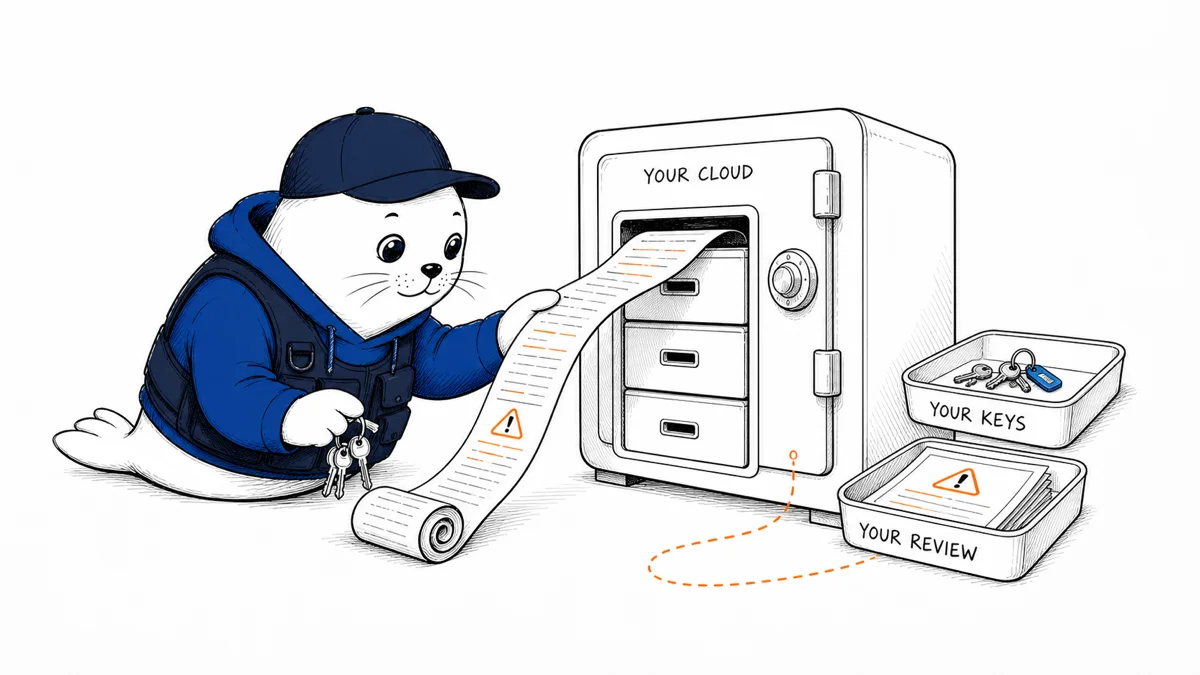
Anthropic wants enterprises to monitor frontier Claude use without sending the underlying activity to Anthropic employees. Its proposed answer is Enterprise Frontier Safeguards, or EFS: automated monitoring that writes data into cloud storage controlled by the customer.
That architecture improves ownership, access control, and auditability. It does not prove the monitor catches dangerous activity, avoids flooding reviewers, or keeps working during a storage or model outage. Anthropic EFS solves the location of the logs more clearly than it solves the quality of the detection.
EFS separates monitoring from Anthropic human access
Anthropic says EFS uses automated rolling-window monitoring to identify potentially harmful activity. Activity data is stored in the customer’s own Amazon S3, Azure Blob Storage, or Google Cloud Storage environment. Customers control access, auditing, and encryption keys.
When the system flags activity, the alert goes to the customer. Anthropic says its staff do not need to inspect the underlying data. That design aims to provide monitoring compatible with customers that would otherwise require zero-data-retention treatment.
Customer-owned storage changes the trust boundary
A normal provider-side abuse system asks the customer to trust the provider’s retention, staff access, incident response, and deletion controls. EFS moves more of that boundary into the customer’s cloud account. Existing identity policy, key management, audit logging, legal hold, and data-location controls can apply.
The responsibility moves too. A misconfigured bucket, overly broad role, missing lifecycle rule, or unstaffed alert queue becomes the customer’s problem. Customer control is useful only when someone owns the configuration and the response.
That boundary also changes procurement. Security teams can evaluate the storage account, access policy, key rotation, regional replication, and audit trail with controls they already understand. Privacy teams can define retention without waiting for a provider ticket. The unresolved part is the monitoring component itself: what the automated reviewer sees, how it scores risk, and what evidence accompanies a flag.
Zero retention and monitoring are not opposites anymore
Anthropic says eligible customers can remain under zero-data-retention arrangements until EFS is ready for them. The company presents the new architecture as a way to preserve privacy while adding stronger safeguards for frontier capability. The data exists, but it resides in customer-controlled storage rather than Anthropic’s general retention path.
Buyers should still ask which content is written, whether prompts and outputs are stored in full, how identifiers are handled, what metadata the monitor sends elsewhere, and how deletion propagates. The phrase “equivalent to zero data retention” needs a field-level data-flow diagram.
Free EFS still creates a cloud and review bill
Anthropic says it will not charge a separate fee for EFS. Customers pay their cloud provider for storage, write and read requests, retrieval, egress, replication, key operations, and any security tooling connected to the logs. They also pay the people who investigate alerts and tune policy.
The right budget unit is not dollars per gigabyte alone. Track cost per reviewed alert, reviewer minutes per thousand model interactions, escalation rate, and time to contain a confirmed case. Cheap storage can support an expensive queue.
The public audit sheet is incomplete
| Audit field | Public status | Question to ask |
|---|---|---|
| Detection recall | Not published | Which harmful behaviors are measured, and how often are they missed? |
| False positives | Not published | How many normal workflows enter the review queue? |
| Alert latency | Not published | Can the system stop an action, or only report it later? |
| Failure behavior | Not published | Does Claude fail closed when storage or monitoring is unavailable? |
| Independent assessment | Not announced | Will a third party test privacy and detection claims? |
A phased rollout is the right time to test failure
Anthropic says the rollout begins in phases later in fall 2026. Planned coverage includes Claude Code, Claude Enterprise, the Claude Platform, Amazon Bedrock, Google Agent Platform, and Microsoft Foundry. The exact timing and capability may vary by surface.
- Map every stored field, identifier, encryption key, and retention rule.
- Replay known-safe and known-dangerous workflows to estimate alert precision and recall.
- Disconnect storage and monitoring to observe whether the model fails open or closed.
- Measure reviewer load, escalation time, and the evidence supplied with each alert.
- Run the same test after model, policy, and connector updates.
Our AI cyber-evaluation incident review shows why asynchronous discovery is not enough when an agent can create accounts, contact people, or touch public systems. A control must match the speed and consequence of the action.
The customer still needs an incident owner
An alert is not containment. Enterprises need a named owner, severity rules, evidence capture, credential revocation, network isolation, legal notification, and a return-to-service decision. EFS can become one sensor in that system. It should not be the system.
Axios reports that the safeguards were part of a broader Anthropic release covering new models, cost changes, and enterprise privacy controls. The independent coverage confirms the product announcement, not its detection performance.
My verdict: better custody, unproven detection
EFS is a thoughtful answer to a real enterprise conflict. Customers want frontier capability and abuse monitoring, but they do not want sensitive activity sitting in another provider-controlled review system. Keeping logs under customer keys is a meaningful architectural improvement.
I would not call it an effective safeguard until the detection and failure evidence is visible. Pilot it as a sensor. Keep independent identity, network, tool, and approval controls around the agent. Ask Anthropic for recall, false-positive, latency, and outage results before EFS becomes a policy dependency.
Read the source material
- Read Anthropic’s Enterprise Frontier Safeguards announcement.
- Compare Axios’s independent release overview.
- Use our AI agent security scorecard to test controls beyond monitoring.
Checked September 1, 2026. Architecture, rollout, product eligibility, and pricing statements are reported by Anthropic. Missing-field analysis and the pilot checklist are Musthave.ai analysis. No independent EFS assessment was public at review time.