

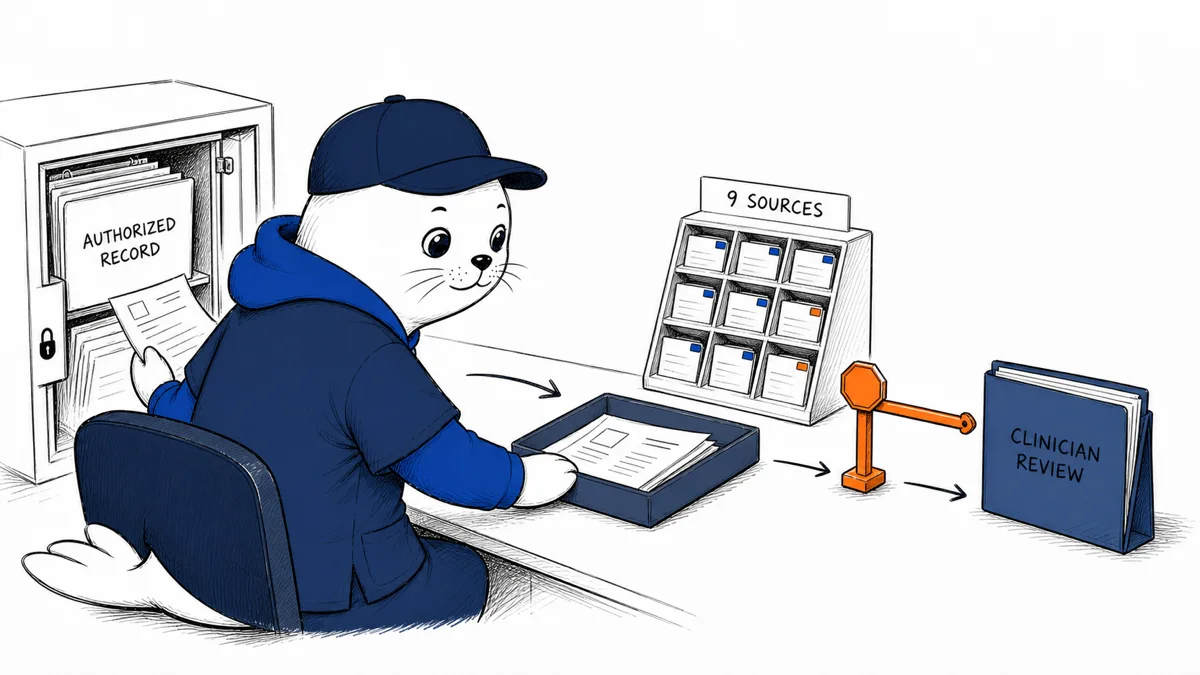
A clinician can now bring authorized Epic chart context into ChatGPT for Healthcare, ask what changed since a prior visit, and trace the summary back to supporting information. OpenAI also reports that physicians rated 99.1 percent of 4,363 evaluated responses safe. The integration is important. The percentage is narrower than it looks.
A safety rating is not a diagnosis-accuracy score, a patient-outcome study, or proof that the system will never omit a relevant detail. The useful reading is operational: ChatGPT Epic records now share a governed workspace with official healthcare data, while clinicians still own verification and action.
Epic records can enter ChatGPT in two ways
OpenAI announced two supported experiences. In one, authorized EHR context is brought into ChatGPT for Healthcare. In the other, ChatGPT is embedded in a supported EHR layout so staff can use AI-assisted workflows without leaving the patient chart.
The example tasks are synthesis jobs: review changes, surface recent lab results, find medication changes, and identify unresolved follow-ups. OpenAI says responses point back to supporting chart information. The announcement does not claim that ChatGPT independently updates the record, orders medication, or makes a final clinical decision.
The public-data plugin adds nine official sources
The Healthcare Public Data plugin supplies structured connectors to nine official sources. OpenAI names ClinicalTrials.gov, CMS Coverage, RxNorm, DailyMed, and PubMed among them. A team can work with specific identifiers, versions, fields, and records instead of relying on a general web answer.
That source constraint is valuable when the job depends on the current medication label, the exact version of a coverage policy, or trial eligibility criteria. It also creates a clearer audit trail. A cited record can still be misunderstood, but a reviewer has somewhere concrete to check.
The connection also reduces a subtle source-mixing problem. A general answer can blend an old label, a current trial record, and an uncited summary without showing where each statement began. Structured connectors make identifiers and versions available to the workflow. Administrators should still test whether citations survive summarization, whether a stale record is marked clearly, and whether the system tells the reviewer when two official sources disagree.
What the 99.1 percent safety result measured
OpenAI says physicians evaluated connected-EHR responses across 27 clinical use cases, including pre-visit review, timelines, medication review, and handoff summaries. Across 4,363 ratings, 99.1 percent were judged safe. In a separate two-round evaluation involving five connected public data sources, more than 93 percent of responses for each source were rated good or better for accuracy.
Those are company-run evaluations with physician raters. They tell us the tested responses rarely crossed the evaluators’ safety threshold and usually handled the selected source questions well. They do not tell us the sensitivity for rare omissions, performance in every specialty, real-world override behavior, or whether use improves care.
Do not turn one percentage into four claims
| Claim | Supported? | Why |
|---|---|---|
| Most tested responses were rated safe | Yes | 99.1 percent across 4,363 ratings in 27 use cases |
| Every tested response was correct | No | Safety and accuracy were reported as separate measures |
| Patient outcomes improved | Not established | No clinical outcome trial is described |
| The system can replace clinician review | No | The workflows are positioned for review and preparation |
The enterprise controls matter as much as the model
ChatGPT for Healthcare includes role-based access, single sign-on, and audit logs. OpenAI says an applicable Business Associate Agreement can support HIPAA-compliant workflows across ChatGPT Work, Codex, apps, and plugins. HIPAA support is a configuration and operating responsibility, not a property that attaches automatically to every account or prompt.
The EHR integration is not available to individual accounts. Eligible U.S. ChatGPT for Clinicians users can install the public-data plugin, but organizational administrators control the EHR connection. That boundary should stop a common misunderstanding: a personal ChatGPT subscription does not become an approved route into a hospital record system.
A deployment needs a chart-review scorecard
- Select representative records, including long charts, contradictory notes, and important facts buried in older documents.
- Define required facts and dangerous omissions before anyone sees the model answer.
- Score citation fidelity, omission rate, unsupported statements, review time, and escalation behavior.
- Test role boundaries, audit logs, revoked access, and what happens when a source connector is unavailable.
- Keep every consequential output behind an identified clinician or staff owner.
The same principle applies outside healthcare. Our explanation of ChatGPT in controlled government environments shows why approved infrastructure, identity, and data boundaries must be evaluated separately from model quality.
The independent report adds one useful boundary
TechCrunch describes the Epic connection as read-only. OpenAI’s announcement emphasizes reviewing authorized context and does not describe write-back. Until technical documentation states the exact permissions for each deployment, administrators should verify read and write scopes directly rather than relying on a press summary.
My verdict: useful for synthesis, unsafe as an authority
Bringing chart context, official public data, and business sources into one controlled workspace can reduce search and synthesis time. The integration is especially promising when every summary points back to evidence and the reviewer has a defined checklist.
Do not let the 99.1 percent safety number turn the assistant into the authority. Treat it as a fast preparer whose output is inspected by the person accountable for the decision. The deployment succeeds when it reduces review work without hiding uncertainty, not when it produces the most confident paragraph.
Read the source material
- Read OpenAI’s healthcare integration announcement.
- Compare TechCrunch’s independent product report.
- Review our guide to testing AI on your own workflow.
Checked September 1, 2026. Evaluation counts, source connectors, access, and controls are reported by OpenAI. The read-only description is attributed to TechCrunch. Evaluation interpretation and deployment tests are Musthave.ai analysis. This article is not medical advice.