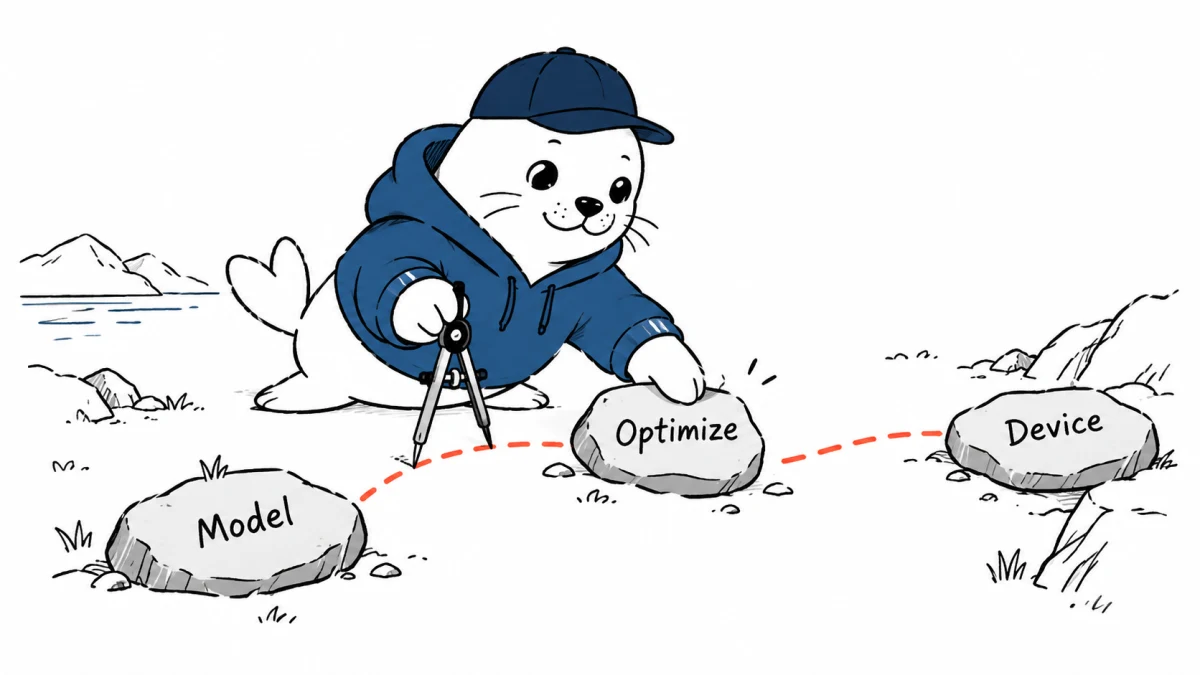
Arm AI Portal is a new catalog and workflow layer for finding AI models that have already been optimized for Arm hardware. Its most interesting feature is not another download page. It is the attempt to give developers and coding agents the same machine-readable route from model choice to device deployment.
Arm launched the portal on September 8, 2026. At launch, it lists optimized models from Alibaba Qwen, Google Gemma and Ultralytics YOLO, with paths using ExecuTorch, LiteRT and ONNX Runtime. Arm says the resources cover cloud, edge and physical AI.
What is available now
| Layer | Status on September 8 | What to verify |
|---|---|---|
| Portal catalog | Available | Target hardware, model revision and runtime |
| Optimized model resources | Available for selected Qwen, Gemma and YOLO models | Artifact provenance and exact quantization |
| Performance data | Published for selected targets | Thread count, precision, baseline and device conditions |
| MCP access | Portal resources accessible to coding agents | Which resources and actions the server exposes |
| Agent-ready resources | Early access | Account access and behavior may change |
| Bring your own model tools | Coming soon | No production availability date announced |
Why MCP changes the usefulness of the catalog
A human can browse a portal and compare model cards. An agent needs structured, discoverable facts about targets, runtimes, memory and deployment steps. MCP can expose that context inside a coding workflow instead of requiring the developer to copy details manually.
That does not mean an agent should automatically choose a model or run unreviewed deployment commands. Treat the portal as a source of candidate artifacts and instructions. Keep the decision about acceptable licenses, accuracy, memory and permissions in your own policy.
If you are standardizing agent integrations, our MCP stateless migration guide explains why session state, credentials and retries should remain explicit.
Read the benchmark claims correctly
Arm reports more than a four-times speedup for Qwen3-TTS on a vivo X300 using single-thread execution and mixed quantization. It also reports more than 40% improvement for YOLO26n on a vivo X300 and Raspberry Pi 5 under specific precision and acceleration settings.
These are Arm’s benchmark claims. They are useful starting points, not universal gains. A fair reproduction needs the exact model, precision, runtime, device, thread count, compiler and baseline. Compare accuracy as well as latency, especially when quantization changes.
A reproducibility checklist
- Record the model repository, revision hash, license and any remote code requirement.
- Record the runtime version, delegate or execution provider, compiler flags and quantization scheme.
- Use the same input set for baseline and optimized runs.
- Measure warm and cold latency, peak memory, package size, power behavior and output quality.
- Repeat on the exact target device and on one second Arm target if portability matters.
- Keep the agent transcript or command log so another developer can reproduce the setup.
The model-to-device test I would run
Choose one small model that appears in the portal and one representative task. Run the unoptimized or standard runtime path first, then the Arm-optimized artifact. Use at least 100 fixed inputs and save outputs, latency and memory.
Next, move the same test among a phone-class target, a Raspberry Pi-class edge device and an Arm cloud CPU where supported. The goal is not to prove one artifact wins everywhere. It is to learn how much of the workflow, evaluation and packaging survives the move.
What is still missing
The launch post does not provide a universal support matrix for every model, runtime and Arm target. It also does not promise that bring-your-own-model optimization is generally available today. Agent-ready resources are explicitly early access.
Licensing remains model-specific. A portal can simplify discovery and optimization without changing the original model’s license, acceptable-use rules or data obligations. Review each artifact before putting it into a product.
My take: the metadata may be more valuable than the catalog
Optimized binaries are useful, but the durable asset is a consistent description of performance, memory, accuracy and deployment steps across targets. If Arm keeps those fields comparable and machine-readable, developers can build repeatable selection tests instead of relying on hardware slogans.
The strongest first use is a bounded experiment with one model and one device. Do not start by asking an agent to optimize an entire application. Prove that the portal’s artifact, measurements and instructions reproduce on your hardware.
Primary sources and related reading
- Arm AI Portal launch announcement
- Musthave.ai guide to useful AI GitHub repositories
- Musthave.ai AI agent cost-control guide
Checked September 8, 2026. Availability and performance statements are attributed to Arm. The test design and interpretation are Musthave.ai analysis.