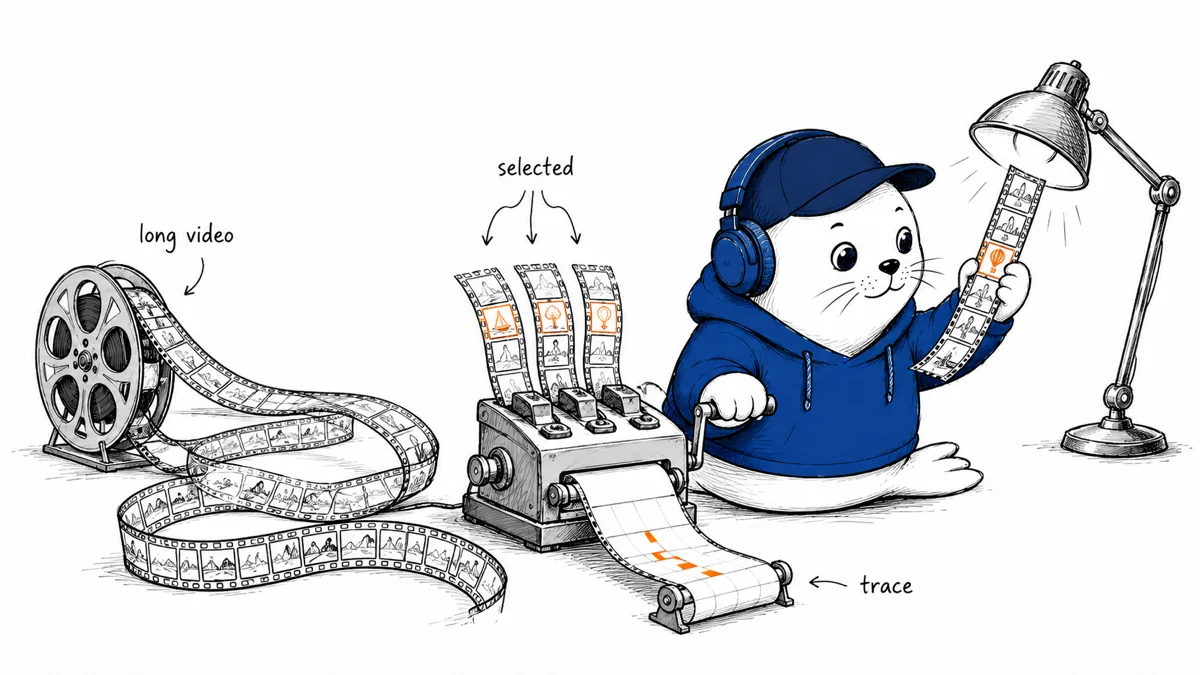
A two-hour video does not always need two hours of attention. Google’s new agentic video mode lets Gemini choose the moments, frame rate, resolution, and modality it needs for the question. That can save tokens, but it also changes what developers must audit.
The model is no longer only answering from a fixed video encoding. It is planning an inspection. If the result matters, you need evidence that it looked in the right places.
Google introduced Gemini agentic video understanding on September 1, 2026 for the Gemini API, Google AI Studio, and Gemini Enterprise Agent Platform.
Static and agentic processing solve different jobs
| Job | Better starting mode | Why |
|---|---|---|
| Short clip under five minutes | Static | Lower planning overhead and predictable latency |
| Frame-by-frame compliance check | Static | Every part of the clip must be represented |
| Find one event in a long recording | Agentic | The model can inspect likely segments selectively |
| Summarize a long lecture or meeting | Agentic pilot | Selective multimodal processing may reduce waste |
| Repeated follow-up questions | Agentic with state | Stateful continuation avoids rebuilding video context |
Google recommends agentic processing for long-form work and search for moments inside a clip. Static processing remains useful for short, latency-sensitive videos and tasks that require uniform frame coverage. Selectivity is an advantage only when the skipped material is truly irrelevant.
The efficiency figures need the company-reported label
Google reports up to 88% fewer tokens, 66% lower cost, and 7% higher accuracy with agentic processing. The feature uses standard token pricing and carries no separate surcharge. Those results come from Google’s evaluation, not an independent benchmark across your videos.
The phrase “up to” matters. A video with one obvious answer buried near the end can benefit dramatically. A safety review that needs every second may save nothing and should probably stay static.
Verify the processing steps, not just the answer
Developers enable the mode with processing: "agentic" through the Interactions API. The response can include processing_call and processing_result entries in interaction.steps. Those steps are the first proof that the model used the feature.
Store the selected time ranges, modalities, token use, latency, and final answer beside your verifier result. If a factual answer is wrong, the trace helps distinguish two failures: the agent inspected the wrong segment, or it misread the right one.
Stateless follow-ups can quietly rebuild the bill
Stateful conversations can continue with previous_interaction_id. A stateless client must replay the agentic processing steps, or the next request loses the processed video context. Google says replayed steps count as input tokens.
This is a billing trap for systems that treat every question as a fresh request. Ten cheap follow-ups are not cheap if each one resends the expensive context. Measure a whole question session, not the first answer.
YouTube support is useful and still preview
The API can accept public YouTube URLs in preview. Google lists a free-tier limit of eight hours of video per day, while paid tiers have no stated length limit. Models from Gemini 2.5 onward can receive up to ten videos in one request.
Preview status is enough for experiments, not a dependency you promise forever. Keep a file-upload path for critical workflows, log the exact video revision, and do not assume private or access-restricted videos will work.
A fair benchmark needs answer coverage and search cost
- Create 20 questions across short, medium, and long videos with known answer timestamps.
- Run static and agentic modes with the same model and answer format.
- Record selected segments, input and output tokens, latency, and answer correctness.
- Add questions whose answer depends on two distant moments so selective processing cannot win by luck.
- Repeat the test with follow-up questions and include replayed context in total cost.
Compare the result with our coverage of Gemini Omni 1.1 Flash, Wan 3 video cost, and Visko Orbis long-video tradeoffs. Generation, streaming, and understanding use different cost units. Put each model on the job it actually performs.
Negative evidence is the hard case
Questions such as “Did anyone reveal a password?” or “Was this warning visible anywhere?” are harder than finding one known event. A selective agent can return “no” after inspecting only likely segments. That answer is not equivalent to exhaustive coverage.
For absence claims, require a coverage policy. You might force static processing, divide the video into verified windows, or set a minimum inspected duration. The trace should show enough coverage to justify the conclusion, not merely that processing ran.
Cache policy must match evidence policy
If the underlying video can change, store its content hash or immutable version beside the interaction. A trace against yesterday’s upload does not support today’s edited clip. Reuse processed context only when the source identity and access policy still match.
For regulated or contractual review, keep the source, question, selected segments, model version, processing mode, answer, and human decision in one record. That turns a clever API feature into evidence someone else can reconstruct.
My verdict: trust selective viewing only with a trace
Gemini agentic video is a sensible response to long clips. Encoding everything at one fixed rate wastes money when a question depends on a few moments. Dynamic inspection can be cheaper and more accurate.
The feature also moves a decision into the model: what to watch. Keep the trace, test answer coverage, and include follow-up context in the bill. Selective attention is useful when you can audit the selection.
Read the primary documentation
- Read Google’s agentic video announcement.
- Review the Gemini API video-understanding guide.
Gemini can analyze and transform video, but creator control depends on the surrounding workflow. Our YouTube Gemini creator workflow explains the new conversational editor, archive thumbnail tests and staged safety rollout.
Checked September 2, 2026. Availability, implementation details, limits, and efficiency figures come from Google. The efficiency figures are company-reported. The test protocol and session-cost analysis are Musthave.ai work.