AIContenfy’s founder did not make the company easier to sell by adding more AI. He made it easier to operate without him.
The AIContenfy exit is an unusually useful founder case study because the sale price remains undisclosed. That removes the temptation to copy a valuation multiple and puts the attention on the work that preceded the transaction.
Acquire.com reports that AIContenfy reached $1 million in annual recurring revenue within two years, documented operations in English, implemented the Entrepreneurial Operating System, reduced founder dependency, split into three listings, received more than 100 letters of intent, and completed an all-cash sale. These details come from the platform and founder; they are not an audited financial record.
The sale price is private, the preparation is visible
| Reported step | Why a buyer cares |
|---|---|
| Operations documented in English | The buyer can inspect and transfer the work |
| EOS implemented | Roles, metrics, meetings, and accountability become legible |
| Founder dependency reduced | Revenue is less likely to leave with the seller |
| Business split into three listings | Different buyer types can evaluate clearer asset boundaries |
| 100+ LOIs | Competitive interest can improve selection and negotiating leverage |
| All-cash sale | Consideration reportedly did not depend on an earn-out |
Documentation is a product for the buyer
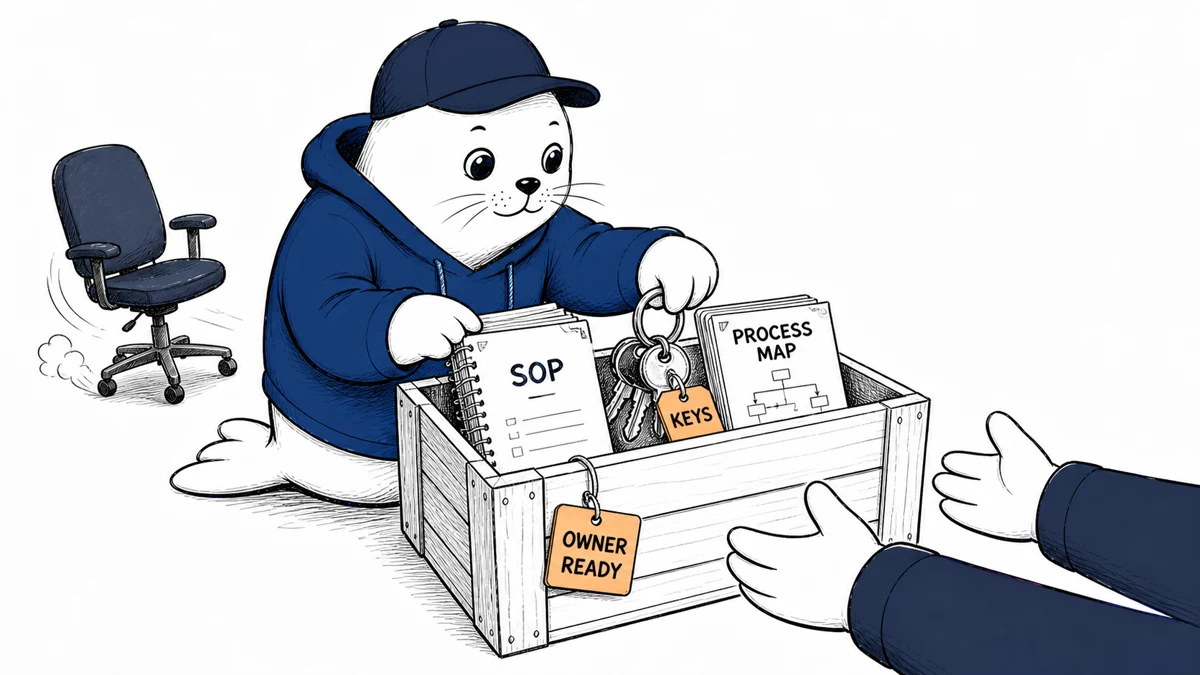
A standard operating procedure should let a competent stranger complete the task, identify the failure state, and know when to escalate. A folder of screenshots without owners, inputs, outputs, and exceptions is not an operating system.
- Purpose: what result the process creates and for whom.
- Owner: the role responsible for the outcome.
- Inputs and access: systems, credentials, data, and approvals required.
- Normal path: the repeatable sequence with acceptance criteria.
- Exceptions: common failures, alert thresholds, and rollback.
- Evidence: last run, metric, or artifact proving the process works.
For an AI product, that also includes the model, evaluation set, prompt or policy versions, routing rules, data rights, and cost limits. The business cannot be transferred cleanly if the operating logic lives inside one founder’s chat history.
Founder independence needs a live test
The simplest test is a planned absence. Can the team acquire customers, deploy changes, resolve support, close the books, and recover from a model-provider failure while the founder stays out of the operating channel?
Do not treat a quiet week as proof. Trigger a controlled failure, rotate a key, change a vendor limit, and hand an angry-customer scenario to the documented owner. Record where the team still needs the founder.
Why splitting the business can clarify value
Acquire.com says AIContenfy was divided into three listings. Splitting a company is not automatically better. It can help when assets have different customer bases, operating models, or buyer profiles. It can hurt when the separation destroys shared distribution, data, or product economics.
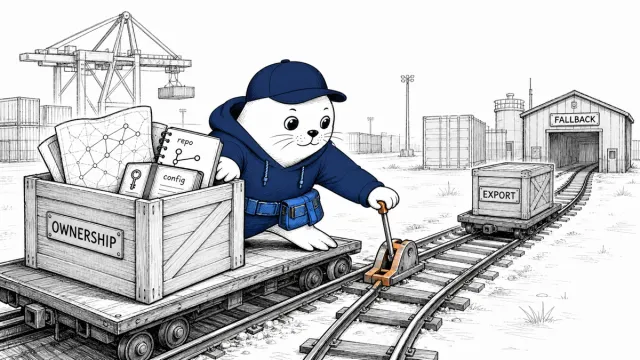
Before separating anything, map which contracts, staff, domains, data, code, and vendor accounts belong to each asset. A buyer should not discover after the offer that the supposedly independent product depends on another listing’s database or founder-owned API key.
More than 100 LOIs are not 100 equivalent offers
A letter of intent can differ in price, cash at close, financing, earn-out, transition period, warranties, exclusivity, and working-capital assumptions. High interest creates options, but the founder still needs to compare risk-adjusted outcomes.
| Offer term | Question to ask |
|---|---|
| Cash at close | How much is certain on completion? |
| Earn-out | Which metrics, decisions, and buyer actions affect payment? |
| Transition | How many hours and which responsibilities remain with the founder? |
| Financing | What happens if the lender or investor withdraws? |
| Representations | Which claims can create liability after closing? |
Our article on what buyers inspect in AI business exits expands the diligence side. If you are reading this article immediately after publication, that link points to the companion case study released in the same verified batch.
A 90-day owner-independence plan
- Weeks 1–2: list every recurring founder task and rank it by revenue or operational risk.
- Weeks 3–4: assign owners and document the five highest-risk processes.
- Weeks 5–6: move shared work out of personal accounts and rotate credentials.
- Weeks 7–8: run the business without founder intervention for five working days.
- Weeks 9–10: repair the failures and create evidence for each process.
- Weeks 11–12: repeat the absence test and assemble a buyer-readable data room.
This work is useful even without a sale. Our practical AI income map argues for building a repeatable outcome. Removing founder dependency is how that outcome becomes a business rather than a demanding job.
My verdict: the operational handoff is the real case study
The AIContenfy exit does not give founders a price target. It gives them a preparation target: documented operations, legible metrics, clean asset boundaries, reduced founder dependence, and enough buyer interest to compare terms.
The strongest exit work improves the company before anyone buys it. If the business cannot run without the founder, the first buyer is likely to notice.
Read the primary case study
- Read Acquire.com’s AIContenfy founder case study.
Which operating decision still lives only in your head?
Checked August 14, 2026. ARR, timing, documentation, EOS use, business separation, LOI count, and all-cash structure are attributed to Acquire.com and the founder. The sale price was not disclosed and is not estimated here.