
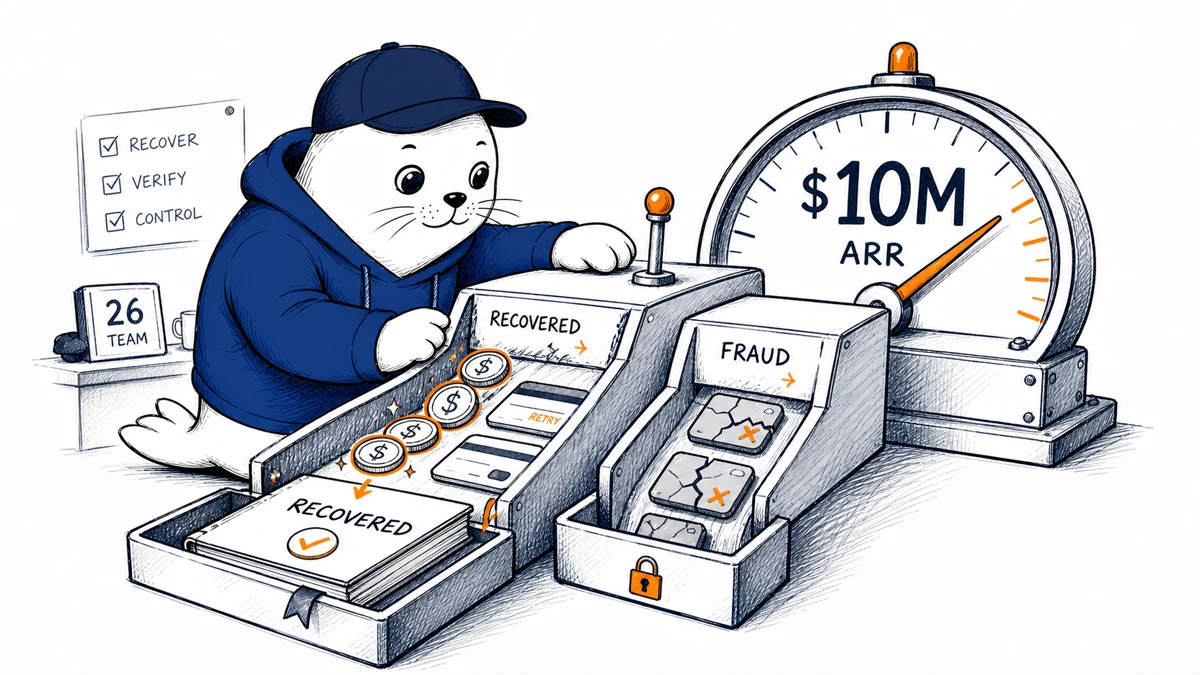
Chatbase’s $10 million ARR headline is impressive. The more useful number for a smaller founder is the money its billing system recovered after cards failed.
Chatbase revenue operations became part of the product as the AI support platform grew. Stripe’s customer story says Chatbase reached $10 million in annual recurring revenue by March 2026 in under three years, with a team of 26. It also reports more than $870,000 in recovered revenue and a 37% reduction in fraudulent payments.
Those are company-reported results in a vendor case study. They do not prove that billing tools caused Chatbase’s growth. They do show why payment recovery, fraud controls, and pricing experiments deserve attention before a company reaches eight figures.
The headline numbers and what they mean
| Reported result | What it indicates | What it does not prove |
|---|---|---|
| M ARR by March 2026 | Large recurring revenue run rate | Profit, cash flow, or audited annual revenue |
| 26 employees | Relatively compact reported team | Automation alone caused the team size |
| 0K+ recovered | Failed-payment recovery became material | Every recovered account stayed retained |
| 37% lower fraudulent payments | Fraud controls changed payment outcomes | No legitimate customer was affected |
Revenue can disappear after the sale
A subscription is not finished when the checkout succeeds. Cards expire, banks decline renewals, customers change accounts, and fraud creates disputes. If the product has already paid model and support costs, a failed renewal can turn a seemingly healthy account into a loss.
That makes involuntary churn a separate operating problem from customers who choose to cancel. The recovery system needs well-timed retries, clear customer messages, an easy payment-update path, and a record of which recovered accounts remain active.
The first paying customer arrived in 30 minutes
Stripe’s case study says Chatbase received its first paying customer about 30 minutes after the founder posted a demo. That is a useful lesson in speed to demand, not permission to skip product quality. A payment proves that one buyer wanted the result enough to pay once. It does not establish retention, margin, or a repeatable channel.
Founders should preserve that early signal. Record what the customer was trying to accomplish, why the existing options failed, how much support the sale required, and whether the account renewed. A viral post is less useful than a small cohort that stays.
A compact revenue-operations stack
- Instrument checkout. Track visit, plan selection, payment attempt, failure reason, and activation.
- Separate cancellation from failure. Voluntary and involuntary churn need different fixes.
- Measure recovery quality. Count recovered cash, subsequent retention, refunds, and support burden.
- Control fraud by segment. Use risk signals without blocking countries or customer types blindly.
- Connect cost to account. Pair revenue events with model, tool, and human-review cost.
- Review the exceptions. A small team should know why high-value accounts fail or dispute.
Our honest map for AI income recommends selling a narrow result first. Chatbase’s early payment story fits that pattern; the later recovery figures show the operational layer required to keep the revenue.
Recovered revenue is not automatically good revenue
A recovery dashboard can reward the wrong behavior if it counts every retried charge but ignores refunds, disputes, and churn. The better measure is retained recovered contribution margin: cash successfully collected from recovered accounts, minus direct service costs and later reversals, over a defined period.
Fraud reduction needs the same discipline. A lower fraud rate looks excellent until legitimate customers cannot pay. Review false positives, manual-review time, geography, payment method, and plan level.
Why a 26-person team still needs manual judgment
Automation can retry payments and score risk. It cannot decide every exceptional case without business context. A long-term customer changing countries, an enterprise card with a new issuer, and a burst of anonymous trials do not deserve the same response.
This is the same reason our AI research service guide keeps a human review layer around the deliverable. Automation should compress routine work and surface decisions, not hide the cases that can damage a customer relationship.
My verdict: build revenue operations before the milestone
Chatbase’s story is not a template that guarantees $10 million ARR. It is evidence that billing recovery and fraud control can become financially material in a fast-growing AI product.
A founder at $10,000 MRR should already know the failed-payment rate, recovery rate, dispute rate, false-positive rate, and contribution margin by account. Those numbers become harder, not easier, to reconstruct at scale.
Read the primary case study
- Read Stripe’s Chatbase customer case study.
How much recurring revenue did your product lose to payment failure rather than customer choice last month?
Checked August 14, 2026. ARR, team size, recovered revenue, fraud reduction, and first-customer timing are reported by Stripe and Chatbase. Musthave.ai did not audit the financials and does not attribute Chatbase’s overall growth to Stripe alone.