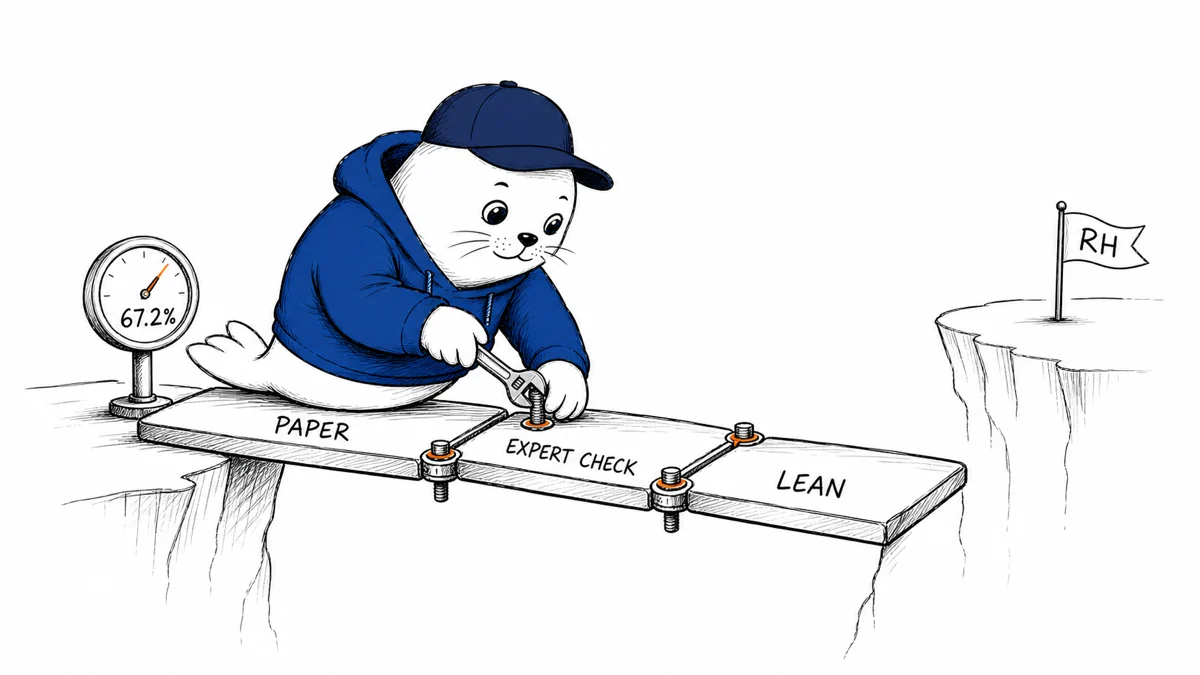
Claude did not solve the Riemann hypothesis. It improved a lower-density bound, and Anthropic published enough of the trail for outsiders to examine how.
An unreleased research version of Claude produced an argument that raises a lower bound connected to the Riemann zeta function from 41.6% to 67.2%, according to Anthropic. The result concerns the share of nontrivial zeros that are simple, expressed through lower natural density. It is a real mathematical claim with a paper, expert examination, transcripts, numerical checks, and a Lean formalization.
It is not "67.2% of the Riemann hypothesis." That translation is wrong twice: the theorem addresses simplicity of zeros rather than whether every zero lies on the critical line, and a density statement is not a progress bar for a famous conjecture.
What the 67.2% result actually says
The paper studies how many nontrivial zeros of the Riemann zeta function are simple rather than repeated. Earlier published work established a lower bound of 41.6%. Anthropic’s public summary rounds its new lower bound to 67.2%; the formal repository records a value slightly above 0.67250 for the relevant theorem.
A lower natural-density bound of 67.2% means the argument establishes that at least that proportion, in an asymptotic sense, satisfies the stated simplicity condition. It does not locate all zeros, prove that all are simple, or prove the Riemann hypothesis. Even a density-one statement can leave exceptional cases.
The number is a lower bound inside one theorem. It is not a percentage-complete label for the Riemann hypothesis.
The evidence package is stronger than a screenshot of an answer
| Evidence layer | What it supports | What it does not establish |
|---|---|---|
| Research paper | The definitions, argument, and claimed lower bound are inspectable | Journal acceptance or broad mathematical consensus |
| Expert examination | Named mathematicians reviewed the work on short notice | Anonymous peer review |
| Lean repository | Theorems A–E have a complete, sorry-free formalization in the pinned environment | That every informal modeling choice or upstream assumption is the only valid one |
| Transcripts and process notes | The search and failure trail can be audited | Independent replication of the entire discovery process |
Anthropic says its mathematicians Levent Alpöge and Ralph Furman examined the work, and that Brian Conrey and Dan Goldston also reviewed the paper on short notice. That is meaningful expert scrutiny. It should still be described as examination, not as completed peer review.
The Lean formalization checks a pinned theorem package
Anthropic’s public repository says it contains a complete formalization of Theorems A through E without sorry placeholders. It pins Lean 4.33.0-rc2 and a specific Mathlib commit, and provides build and axiom-audit commands.
That narrows an important class of mistakes: the formal statements must type-check from the declared assumptions in that environment. It does not convert a project-authored artifact into independent peer review. A careful reader still needs to compare the formal statements with the informal paper and inspect whether the encoded assumptions match the intended mathematics.
The search was expensive, failure-heavy, and highly structured
Anthropic reports two Claude Code sessions that produced about 31 million output tokens. The first explored roughly 650 ideas without finding the improvement. The second used about 60 subagents over roughly a day and a half, downloaded 54 arXiv papers, and ran thousands of numerical checks.
Those figures are company-reported process metrics. Their value is not that more tokens imply truth. They show that the result came from an iterative research system with literature access, parallel search, numerical filtering, and human review, not from a single clever prompt.
What builders should copy from the workflow
- Preserve failures: a rejected idea should become searchable evidence, not disappear from the chat window.
- Separate discovery from verification: use broad parallel search to generate candidates, then narrower tools to test them.
- Pin the environment: formal or computational checks need exact versions, dependencies, and commands.
- Name the evidence layer: distinguish model output, numerical support, human examination, formal verification, and peer review.
- Publish the trail: a result is more useful when outsiders can inspect the paper, code, transcripts, and assumptions.
Our analysis of OpenAI Astra’s mathematics proof package applies the same evidence hierarchy to a different lab and different claims. The broader lesson also matches P-Bench’s statistical-test failures: code execution can strengthen a result without choosing the right theorem or interpretation for you.
My verdict: the auditable package matters more than the viral percentage
The Riemann-zeta result is worth attention because Anthropic exposed several kinds of evidence around a specific mathematical improvement. The paper can be read, the formal files can be built, and the process can be criticized. That is a healthier standard than asking readers to trust a polished answer.
The correct headline remains narrow: Claude helped produce a claimed improvement to a lower bound on simple zeros. Mathematicians now get to test the argument. The Riemann hypothesis remains unsolved.
Read the primary materials
- Read Anthropic’s research summary.
- Inspect the full paper and expert note.
- Review the Lean formalization repository.
- Compare the process explanation with the detailed transcripts.
Which evidence layer would you require before citing an AI-assisted theorem in your own work?
Checked August 11, 2026. The mathematical claim, process figures, expert-review description, paper, transcripts, and formal repository come from Anthropic’s primary materials. The work has expert examination and a project-authored formalization; it should not be described as journal peer review.