

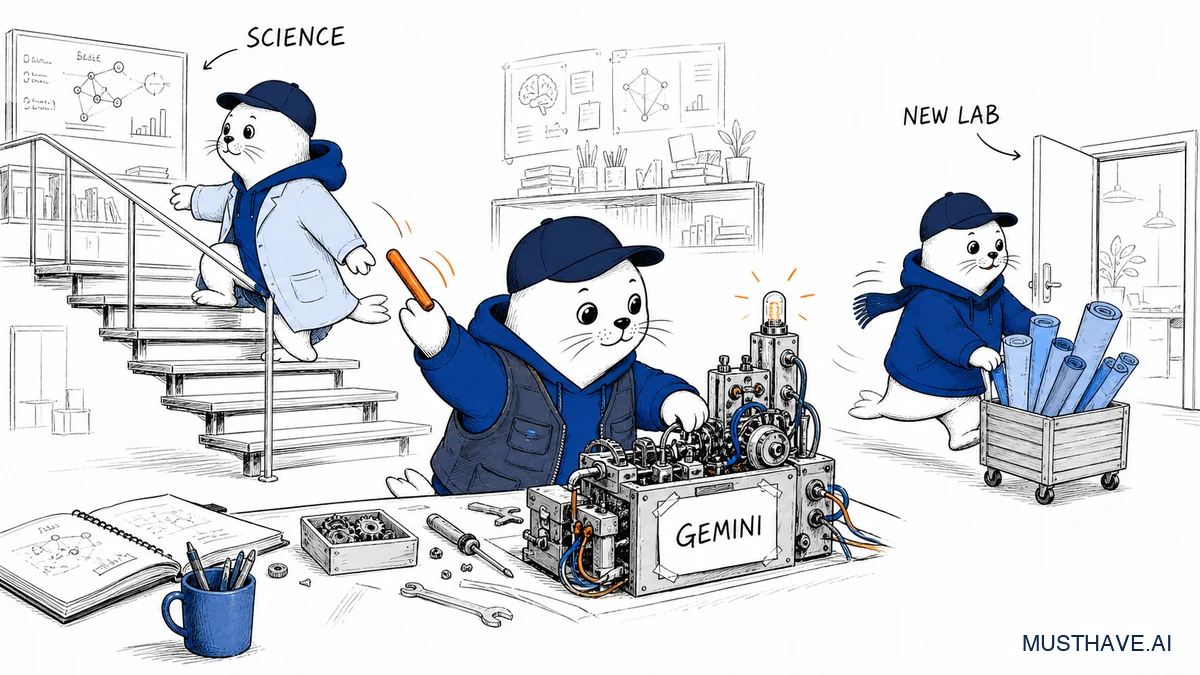
Google did not replace one AI chief with another. It split the job into three: long-range science, day-to-day Gemini execution, and a new outside research company.
Google DeepMind leadership has been reorganized. Demis Hassabis is giving up daily operational control to become chair of Google DeepMind and chief scientist of Alphabet. Koray Kavukcuoglu will lead Google DeepMind as a senior vice president, reporting to Sundar Pichai. Jeff Dean and Sanjay Ghemawat are leaving to form an independent public-benefit corporation, with Google as a founding investor and Cloud partner.
Those details are now confirmed in an official Google announcement published August 5. The memo also contains a surprise product signal: Hassabis named Gemini 4 as one of the models in progress. Google did not announce a release date, API, pricing, benchmarks, or a model card.
This is a three-way split, not a simple CEO swap
The cleanest way to read the change is by responsibility. Hassabis moves toward company-wide science and AGI strategy. Kavukcuoglu receives the operating remit for models, research, the Gemini app, and developer products. Dean and Ghemawat take a systems-and-science agenda into a separate company that will still work with Google.
One detail matters: Google did not name Kavukcuoglu CEO of DeepMind in the announcement. His title is senior vice president of Google DeepMind, and he reports to Pichai. The work moves to him even though the old title does not.
Three destinations for one leadership structure
Demis Hassabis
Google DeepMind chair, Alphabet chief scientist, and continued leader of Isomorphic Labs.
Koray Kavukcuoglu
Operational lead for Gemini models, frontier research, the Gemini app, and developer teams.
Jeff Dean + Sanjay Ghemawat
Independent public-benefit company for machine learning, science, engineering, and systems research.
Koray now owns the shortest path from model to product
Kavukcuoglu was already Google DeepMind’s chief technology officer and Google’s chief AI architect. His new remit puts model development, frontier research, the consumer app, and developer teams under one operating leader. That is a much shorter chain between a research result and something a builder can use.
He has spent 13 years at DeepMind and worked on projects including WaveNet and DQN, according to Google. The biography matters less than the reporting line. Kavukcuoglu now reports directly to Pichai, while Hassabis remains available as chair and adviser.
For builders, this can reduce a familiar Google problem: impressive research arriving before the product story is clear. We saw that tension in Gemini Robotics 2, where a real technical advance still left practical deployment questions. A single operating owner can make the handoff cleaner. It cannot make the research easy.
How the structure arrived here
2011
Google Brain begins as a research team inside Google.
2023
Google Brain and DeepMind combine under Hassabis as Google DeepMind.
August 5, 2026
Science strategy, Gemini operations, and the new outside company separate.
Demis is moving toward AGI strategy and science
Hassabis will keep a formal connection to Google DeepMind as chair and will advise its model and research teams. As Alphabet chief scientist, he says he will work with Pichai on AGI strategy and global questions. He also remains in charge of Isomorphic Labs, the Alphabet-backed drug-discovery company.
This is a shift away from schedules, staffing, and shipping decisions. It is not a departure from Google. The new role gives Hassabis room to work across Alphabet and spend more time on the scientific questions he has made central to DeepMind’s identity.
The organization is also much bigger than it was when Google merged Brain and DeepMind in 2023. Pichai says the Gemini app has more than 950 million monthly users and Gemma models have passed 900 million downloads. Both are company-reported numbers, not figures independently audited for this article. They still explain why one person carrying research vision and product operations had become an unusually broad job.
Jeff Dean and Sanjay Ghemawat are taking a different route
Dean and Ghemawat are launching an independent public-benefit corporation focused on machine learning, science, engineering, and the systems underneath that work. Google says it will invest at formation, provide Cloud services, and collaborate on a research framework for ML systems and related infrastructure.
The announcement does not give the company’s name, financing amount, ownership structure, launch date, or initial product. That is worth saying plainly. The confirmed news is the founders, the public-benefit structure, Google’s backing, and the intended research area. Everything else should wait for the new company to introduce itself.
Dean joined Google in 1999 and helped build core distributed systems, Google Brain, TensorFlow, Pathways, and Gemini. Ghemawat worked with him on foundational infrastructure such as MapReduce and other large-scale systems. Their exit removes two people with rare knowledge of how Google’s AI research connects to its computing stack. Google’s investment keeps a bridge open, but it does not make the new company an internal team.
Gemini 4 appeared in the memo, not in a launch
This is the line most likely to outrun the evidence. Hassabis said progress is being made on new models, including Gemini 4. That confirms the name inside Google. It does not tell us when Gemini 4 ships or what it can do.
There is no Gemini 4 model card, developer documentation, API identifier, benchmark table, context limit, price, or availability list in the announcement. Builders should keep using the models Google actually documents. Our guide to Gemini 3.6 Flash covers the current shipping family; the leadership memo does not replace those specifications.
The same restraint applies to product changes. Google did not announce new Gemini app limits, Google AI plan prices, Cloud terms, or a revised timeline for the Google Assistant transition to Gemini.
What builders should watch over the next 30 days
Separate an org-chart change from a product change
- Role pages: watch whether Google updates DeepMind and Research profiles to match the new structure.
- Gemini documentation: treat Gemini 4 as a name, not a release, until an official model page appears.
- Decision cadence: look for shorter gaps between model research, developer access, and product availability.
- The new company: wait for its name, charter, team, funding, and first research program.
- Talent movement: track whether more senior researchers follow Dean and Ghemawat or remain with Kavukcuoglu.
I would add one practical rule: do not rewrite a production roadmap because an executive title changed. Change your plan when an API, price, model card, deprecation notice, or service-level commitment changes. Leadership news tells you where to look next. Product documentation tells you what to build.
My verdict: the operating handoff is the real story
The most consequential part of the Google DeepMind leadership reset is not Hassabis moving to a grander title. It is Kavukcuoglu receiving the whole path from frontier models to the Gemini app and developer products. Google is putting one operator closer to both the lab and the customer.
That arrangement could make Gemini faster and more coherent. It could also concentrate a difficult set of tradeoffs in one office: research quality, model safety, product deadlines, developer reliability, and competition. We will know whether it works by watching release quality and documentation, not the first round of congratulations.
Dean and Ghemawat’s new company is the second story to follow. Google gets to support a fresh research organization without keeping it inside the same management structure. The founders get independence without severing access to Google’s capital and Cloud. The unanswered question is what they will build.
Go deeper
- Google: the official leadership messages from Sundar Pichai and Demis Hassabis
- Google DeepMind: organization history and current research overview
- Google Research: Jeff Dean’s research profile and project history
- Google: the 2023 merger of Google Brain and DeepMind
- Axios: the first developing report on the leadership change
AI research companies ultimately need measurable scientific outcomes. The Enveda clinical evidence guide separates discovery-platform claims from Phase 1 and later-trial proof.
Checked August 5, 2026, after Google’s primary announcement was published. Gemini 4 was mentioned as work in progress, not released as a product. Company-reported usage and download figures have not been independently audited here.