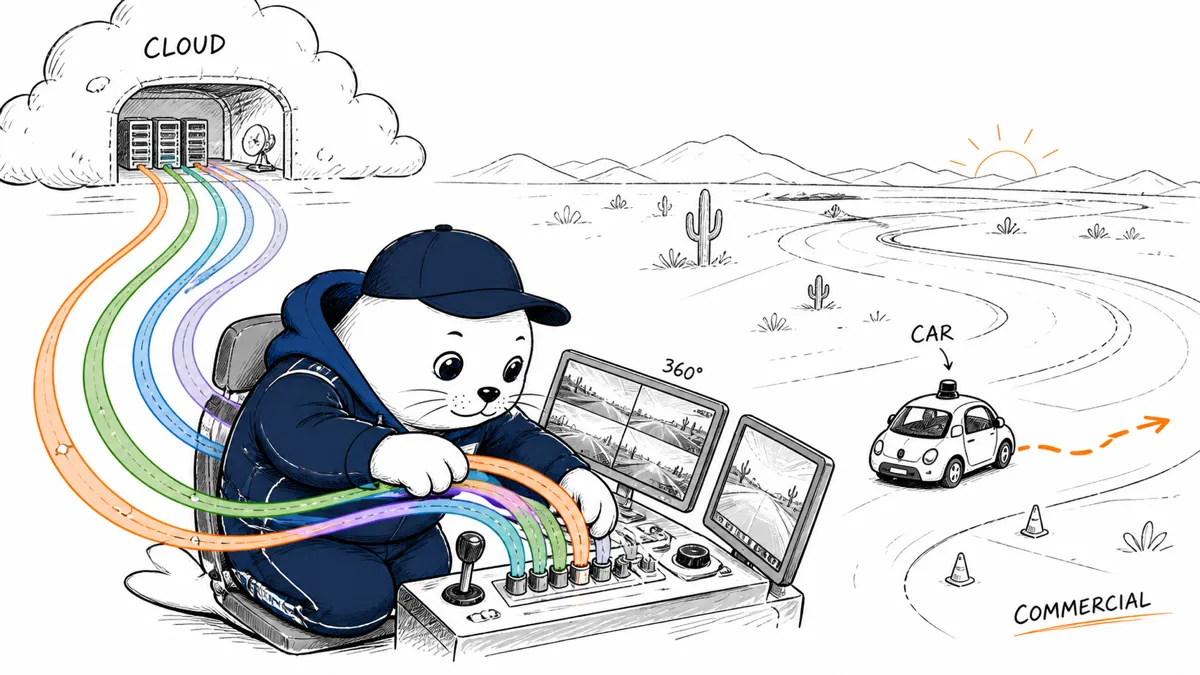
A robotaxi model can be impressive in a research demo and still be unusable in a commercial fleet. NVIDIA just removed one of those barriers for Alpamayo 2 Super, but the new license is an invitation to test, not a certificate that the car is ready for passengers.
The important update is permission, not another demo
NVIDIA says NVIDIA Alpamayo 2 Super and the rest of the Alpamayo family are now available for commercial use under its Open Model Development and Work license. Earlier releases were positioned for research and development. That change matters because carmakers, robotaxi teams, and suppliers can now evaluate the model inside work that may become a product.
The model itself is a 34-billion-parameter vision-language-action system designed for Level 4 autonomous-driving development. It takes a 360-degree view of the road, reasons about what is happening, and can produce a planned trajectory plus an explanation of the events that shaped that plan.
I would not translate "commercial use" into "commercially ready." A license answers whether a team is allowed to build with the model. It does not answer whether the system is safe enough, fast enough, insurable, supportable, or lawful in a particular city.
What changed, and what did not
The release removes a legal-use barrier. The engineering evidence still has to be built.
Now permitted
Commercial development across the Alpamayo family under the OpenMDW license.
Still required
Vehicle-specific validation, safety cases, runtime controls, documentation, and regulatory approval.
Not promised
A turnkey robotaxi driver or proof that one benchmark predicts road safety.
Cloud-to-car is the architecture to understand
Alpamayo 2 Super is not meant to sit alone in a vehicle and think slowly about every turn. NVIDIA describes a cloud-to-car workflow. The larger model works as a teacher in the cloud, generating reasoning traces, synthetic training material, and supervision. Smaller models then learn from those outputs and run in real time inside the vehicle.
That split is sensible. Expensive reasoning can help create and label difficult scenarios without forcing the car to carry the whole cloud model. The hard part is preserving the teacher’s useful judgment when it is compressed into a faster driving policy.
The cloud-to-car handoff
NVIDIA’s release describes a teaching pipeline, not one giant model dropped into a dashboard.
1. Cloud teacher
Alpamayo 2 Super reasons over rare and complicated driving scenes.
2. Training material
It produces trajectories, causal traces, meta-actions, labels, and grounded questions and answers.
3. Vehicle student
A distilled policy runs with the latency and hardware limits of the car.
The benchmark lead is useful, with a large asterisk
NVIDIA reports that Alpamayo 2 Super ranks first on LingoQA among nearly 40 models. Using its Lingo-Judge evaluator, the company says the model leads Qwen2.5-VL 72B by 17.0 points, Gemini 2.5 Pro by 15.1 points, and GPT-4o by 23.2 points.
NVIDIA-reported LingoQA advantage
Percentage-point lead reported by NVIDIA using Lingo-Judge. These are deltas, not independent road-safety measurements.
vs. GPT-4o
+23.2
vs. Qwen2.5-VL 72B
+17.0
vs. Gemini 2.5 Pro
+15.1
The useful reading is narrow: the model appears stronger at answering questions about driving scenes on this evaluation. The unsafe reading is that a 23.2-point lead over a general model proves safer driving. It does not. A fleet team still needs closed-loop simulation, hardware-in-the-loop tests, rare-event coverage, intervention rates, latency measurements, and controlled road validation.
Five outputs make the model more than a steering predictor
NVIDIA lists five output types: a driving trajectory; a chain-of-causation trace; a high-level meta-action; automatic reasoning labels; and visual question answering with two-dimensional grounding. That combination could be useful for training, debugging, and reviewing why the system preferred one maneuver.
Explanations need the same skepticism as trajectories. A fluent reason can be a helpful diagnostic and still fail to describe the mechanism that truly caused the action. Teams should compare explanations with sensor evidence, policy activations, and the final vehicle behavior instead of treating readable text as an audit log.
My commercial-readiness test for Alpamayo 2 Super
If I were evaluating the release, I would run one deliberately boring pilot before celebrating the model. Pick a handful of messy intersections from your own operating domain, define the safe behavior in advance, and compare the large teacher with the distilled vehicle policy.
- License: have counsel map OpenMDW obligations to the intended product and redistribution path.
- Evidence: record scenario coverage, interventions, false confidence, latency, and recovery behavior.
- Distillation: measure where the smaller policy disagrees with the teacher, not only its average score.
- Operations: define the minimum-risk maneuver when perception, connectivity, or the model fails.
- Change control: pin model, dataset, evaluator, and vehicle software versions so a successful test can be reproduced.
This is the same discipline behind our guide to reading robotics benchmarks without confusing one skill for the whole job. It also connects to our practical model-selection framework: start with the workflow and failure cost, then look at the leaderboard.
The license opens the garage door
NVIDIA Alpamayo 2 Super is more consequential now because teams can move from academic curiosity toward a product program. The combination of a larger teacher model, commercial-use terms, 360-degree context, and a cloud-to-car training path gives autonomous-driving teams something concrete to examine.
The next proof will not be another polished traffic clip. It will be a documented chain from license to training, distillation, simulation, intervention, and safe fallback. That is where a model release becomes a vehicle system.
Go deeper
- Read NVIDIA’s Alpamayo 2 Super commercial-use announcement.
- Review the official Alpamayo platform overview.
- Compare NVIDIA’s earlier Alpamayo 2 Super launch details.
Which evidence would you need before allowing an open driving model into a commercial fleet pilot?
Checked August 5, 2026. Benchmark rankings and download figures are NVIDIA-reported; commercial permission is not a safety certification.