Design Arena AI is trying to measure the thing image and web benchmarks usually flatten: whether a human actually likes the result. Investors now value that preference stream enough to put $7.9 million into the company behind it.
Intelligence, the company that operates Design Arena, announced a seed round led by Index Ventures. TechCrunch reports 5.3 million people have used the arena, where models produce anonymous alternatives and users choose between them. Those pairwise choices become a live ranking and, potentially, valuable training or evaluation data for AI labs.
The consumer product looks like a model router. The business underneath it is a taste-measurement system. That distinction is why a free comparison site can claim a much larger enterprise opportunity.
How a free comparison becomes evaluation data
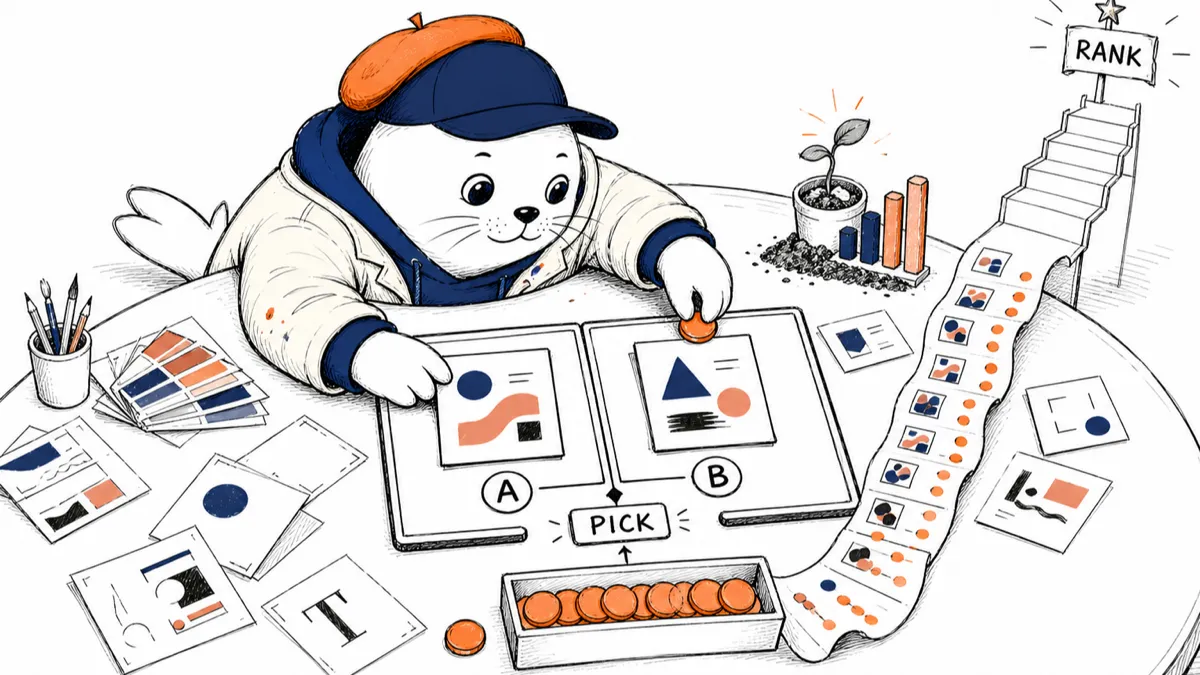
The basic Design Arena AI loop.
- 1. Prompt: A user asks for a website, image, video, or other creative output.
- 2. Blind pair: Model identities stay hidden while alternatives appear together.
- 3. Human vote: The user chooses the result they prefer.
- 4. Ranking signal: Pairwise results update leaderboards and reveal preference patterns.
Design Arena AI measures preference beyond compliance
A conventional benchmark can ask whether code runs, an answer matches a key, or an image includes requested objects. Design is harder. Two outputs can satisfy the prompt while one feels calmer, clearer, more trustworthy, or simply more useful.
Design Arena’s methodology uses anonymous head-to-head comparisons and a Bradley–Terry strength model converted into Elo-like ratings. Every pairwise vote is weighted equally, and low-sample models are filtered or flagged. The company says rankings update every two hours.
Blinding reduces brand bias. It does not make the vote objective. The result measures the preferences of people who used the arena, for the prompts they submitted, under the interface and model-selection rules the company chose.
That is still valuable. Our Midjourney versus Ideogram comparison reaches a similar conclusion: the “best” model changes with the job and the evaluator’s priorities.
The numbers are impressive, and not directly comparable
Three figures around the business
Reported company metrics and adjacent funding context.
- 5.3M: Design Arena users reported by TechCrunch.
- $7.9M: New seed round led by Index Ventures.
- $60M: Annual recurring revenue claimed by the company’s co-founder.
The $60 million ARR figure is a company claim, not an audited result published with customer count, contracts, or revenue recognition detail. Dividing it by 5.3 million reported users gives about $11.32, but that is not average revenue per user. Consumers are not necessarily the paying customers, and “users” may be cumulative rather than active.
The rough ratio is useful for one reason: it shows the claimed enterprise value does not depend on charging each voter. Labs may pay for evaluation access, preference datasets, geographic trend analysis, or insight into why outputs win.
The market is not automatically durable. Yupp reportedly shut down after raising $33 million and reaching 1.3 million users. LM Arena raised a $150 million Series A for a related text-response evaluation model. Capital is available; sustainable data quality and repeatable buyers remain the test.
Human taste data has biases worth paying to understand
Design Arena requires users to log in, which lets the company observe how preferences vary across time and geography. That can help a model lab avoid treating one design culture as universal. It can also turn a useful benchmark into a powerful behavioral dataset.
Questions to ask before trusting a taste leaderboard
A benchmark can be useful and still have a point of view.
- Who voted?: Countries, languages, skill levels, repeat users, and paid acquisition.
- What was shown?: Model pool, prompt categories, latency, failures, and output order.
- What counted?: Ties, skipped votes, low-sample models, suspicious activity, and moderation.
- What was optimized?: Immediate visual preference, task success, accessibility, conversion, or long-term use.
- What can buyers access?: Raw votes, aggregates, segments, prompts, and personally linked behavior.
- Can results be reproduced?: Published methodology, timestamps, model versions, and stable test sets.
A pretty page can win a two-second vote and fail accessibility or conversion. An unusual design can lose to familiar patterns even when it solves the problem better. Labs need several measures: preference, task completion, usability, accessibility, latency, and reliability.
Creators should also resist choosing a tool from one global rank. Use our guide to what creative AI is worth paying for, then test with your own prompts and audience.
The strongest product may be the prompt distribution
Model labs already run internal evaluations. What they struggle to manufacture is a changing stream of real creative intent. Users ask for odd businesses, specific aesthetics, local conventions, and half-expressed ideas. The distribution of those prompts can expose weaknesses a polished benchmark never sees.
Pairwise choice also produces a clean signal without requiring the voter to explain taste. That simplicity creates scale. It can hide reasoning, however. A lab may know output A won without knowing whether the deciding factor was typography, color, familiarity, speed, or a broken element in output B.
The next valuable layer is structured follow-up on a small sample: “What decided your vote?” One extra reason code can distinguish aesthetic preference from obvious failure and make training data less mysterious.
My read: taste is measurable, not universal
Design Arena AI is compelling because it accepts that aesthetic quality is behavioral. People reveal preference by choosing, not by agreeing on a definition of good design.
The company’s opportunity is to turn those choices into reliable evaluation without pretending the resulting number is neutral truth. Publish demographic coverage, model inclusion rules, fraud controls, and outcome-specific leaderboards. Keep the blind vote, but add enough context for labs and users to know what it means.
If Intelligence can maintain that trust, the $7.9 million seed is funding more than another model directory. It is funding a measurement layer for the creative-model race.
Go deeper
- Read the official Design Arena methodology.
- Explore the live Design Arena leaderboards.
- Compare our practical AI image-tool tests.
Reporting checked August 4, 2026. User, funding, and ARR figures are attributed to TechCrunch and the company. The $11.32 ratio is a Musthave calculation and is explicitly not ARPU.