

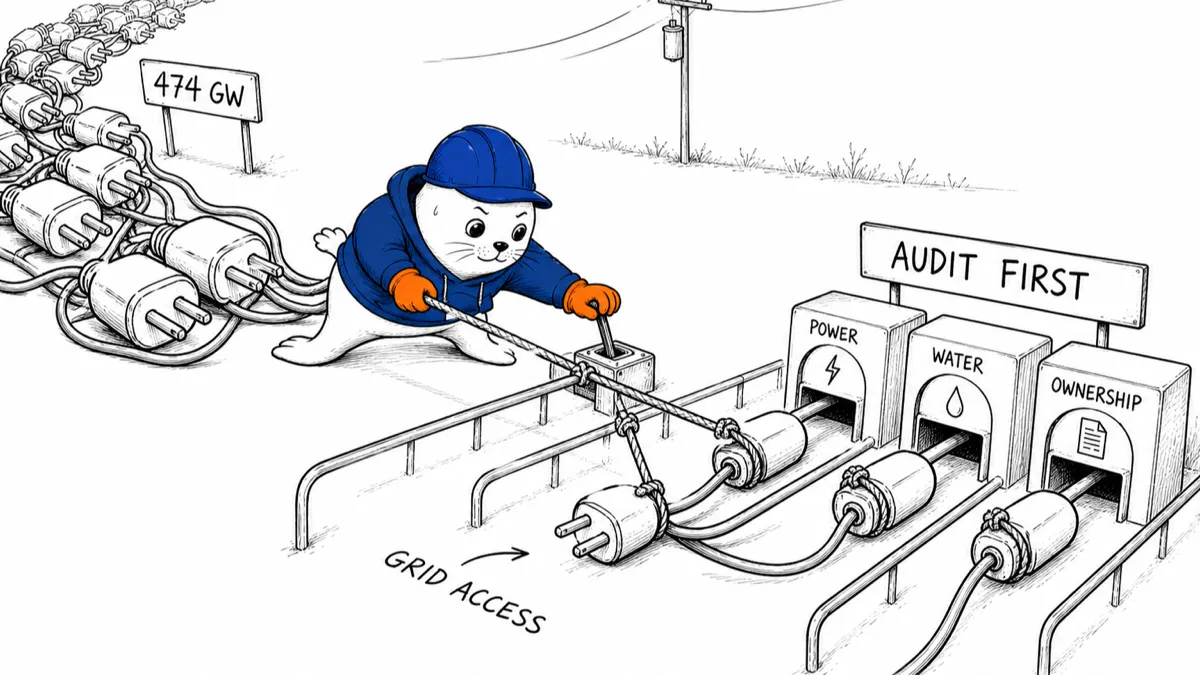
Texas did not ban AI data centers. It did something more precise: it stopped projects in the ERCOT connection queue from moving forward until the state checks whether their power, water, incentives, ownership, and community-impact claims are real.
Governor Greg Abbott ordered the Public Utility Commission of Texas and ERCOT to audit every data-center project advancing through the grid interconnection process. A project that does not provide the required information can be denied a Texas grid connection.
The number behind the order is hard to ignore. ERCOT is considering more than 474 gigawatts of new connection requests, over five times the grid’s record peak demand. The governor’s office says roughly 90% of those requests are data centers.
Texas’s connection queue more than doubled
Queue figures reported for January and early August 2026.
- January: 233 GW
- August: 474 GW
What the Texas data center audit changes today
Projects already waiting in ERCOT’s process do not get to advance on the strength of a queue position alone. Regulators must first verify their resource plans and public claims. The directive does not say every project will be rejected, and it does not order operating facilities to shut down.
That distinction matters. “Texas halts data centers” is a tempting headline, but the action is an audit-and-connection gate. Compliant projects can still move. Projects that cannot document their numbers, or refuse to do so, risk losing grid access.
Interconnection queues also contain speculative projects. Developers often apply early because the wait is long; many proposals never secure land, financing, equipment, or customers. The 474 GW is therefore a demand signal and a planning problem, not a forecast that 474 GW will be built.
The queue grew 103%, but the composition matters more
Three ways to read 474 GW
Official figures plus clearly labeled Musthave calculations.
- 103.4%: Calculated growth from 233 GW to 474 GW.
- ≈426.6 GW: Calculated data-center share if the reported 90% applies to 474 GW.
- <94.8 GW: Implied record peak because 474 GW is more than five times that demand.
The estimated 426.6 GW data-center share is not an ERCOT project total published to the decimal. It is 90% of 474 GW, included to show the scale. Likewise, “more than five times” only tells us the comparison peak is below 94.8 GW.
This is useful information gain because it exposes the planning gap. Even after discounting paper projects, the requested load can be many times larger than the system Texans use on its hardest days. Regulators need probabilities and milestones, not one giant queue total.
Our report on temporary turbines powering AI infrastructure shows what happens when computing demand reaches the physical world before permanent systems are ready.
The audit asks the questions communities usually ask too late
The governor directed PUCT and ERCOT to collect projected annual and peak electricity use, on-site generation plans, water consumption and supply, cooling technology, public tax support, noise and light controls, emergency coordination, and ownership or controlling interests.
The proof-before-grid-access checklist
Five disclosures that can separate a buildable project from a place in line.
- Power: Peak load, annual use, on-site generation, and demand reduction.
- Water: Source, peak use, reuse, and air-cooled or closed-loop design.
- Public money: Tax abatements, grants, incentives, and who carries infrastructure cost.
- Community impact: Noise, lighting, emergency response, and neighboring properties.
- Ownership: The people and entities controlling the project.
- Delivery evidence: Land, equipment, financing, customers, and a credible construction schedule.
The last item is my addition, not a quoted requirement. Texas needs it because a queue audit should measure readiness as well as resource appetite. A project with a power request but no credible path to construction should not distort the same planning model as a financed site with equipment ordered.
Water-efficient cooling does not make power disappear
Closed-loop systems can reduce water withdrawals, and on-site generation can reduce immediate grid dependence. Neither makes a project impact-free. A gas plant still has emissions. A one-megawatt inference pod still consumes up to 24 megawatt-hours in a full-load day. Transmission, backup generation, noise, land, and local emergency capacity still count.
This is why the Texas data center audit should publish standardized summaries. Residents should not have to compare one project’s annual water figure with another project’s peak-day claim or decode whether “self-powered” means continuous generation or backup capacity.
The forthcoming story on Runware’s portable infrastructure looks at the same issue from the opposite direction: whether smaller, faster deployments can reduce buildout friction without hiding their local power footprint.
My read: Texas is auditing the queue, not rejecting the industry
The directive is a response to exaggerated demand signals and public pressure, but its core idea is sound. Grid access is scarce. A company asking for hundreds of megawatts should prove the project, disclose who benefits, and show how local systems will carry it.
The audit becomes much more valuable if Texas publishes aggregate results: how many gigawatts were verified, how many requests were withdrawn, how much water and public subsidy remain attached, and which projects can reduce demand during emergencies.
That would turn a dramatic queue number into a usable plan. Without published results, the state will know which proposals survive while Texans are left with another headline.
Go deeper
- Read the Texas governor’s audit directive.
- See why AI systems need operational controls beyond model promises.
- Follow our guide to infrastructure tradeoffs behind open and closed AI.
Reporting checked August 4, 2026. The 426.6 GW, 103.4%, and sub-94.8 GW figures are Musthave calculations from the published 474 GW, 90%, 233 GW, and “more than five times” inputs.