A high agent score is interesting. A tool loop you can inspect, budget, and stop is useful.
OpenAI’s August 13 builder guide for GPT-5.6 turns the launch into a practical routing problem. The family supports programmatic tool calling, multi-agent workflows, retained reasoning, compaction, and longer-lived prompt caches. Each feature can improve a different failure mode. Combining all of them by default can make a workflow harder to understand and more expensive to operate.
The builder guide starts with the smallest model that passes
OpenAI recommends matching the model and reasoning effort to the job. The company reports that GPT-5.6 Sol at low reasoning outperformed GPT-5.5 at high reasoning on Agents’ Last Exam. It also reports a browsing result where Luna at XHigh reached 84.04% for $1.33, compared with GPT-5.5 XHigh at 84.36% for $33.27.
Those are OpenAI measurements, not a guarantee for every agent. Their practical value is the direction: test smaller models and lower reasoning levels before paying for the largest configuration.
Programmatic tool calling compresses a predictable middle
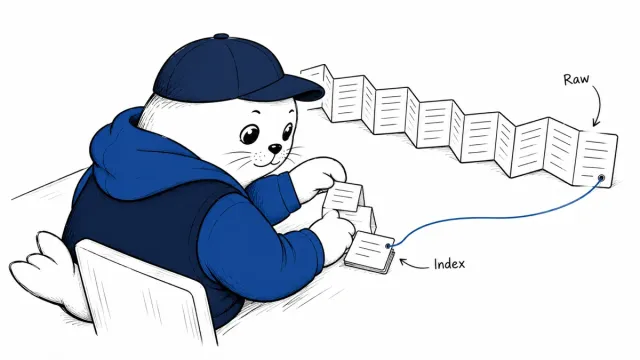
Programmatic tool calling lets the model write code that invokes tools inside an execution environment instead of returning every intermediate result to the model one step at a time. This is useful when a task has a bounded loop: search several records, normalize them, filter them, and return only the relevant evidence.
The feature is a bad fit when each step needs a human decision, when tool side effects are consequential, or when an operator must inspect every intermediate result. Compression saves context, but it also hides detail unless the execution log remains available.
Multi-agent work belongs on independent branches
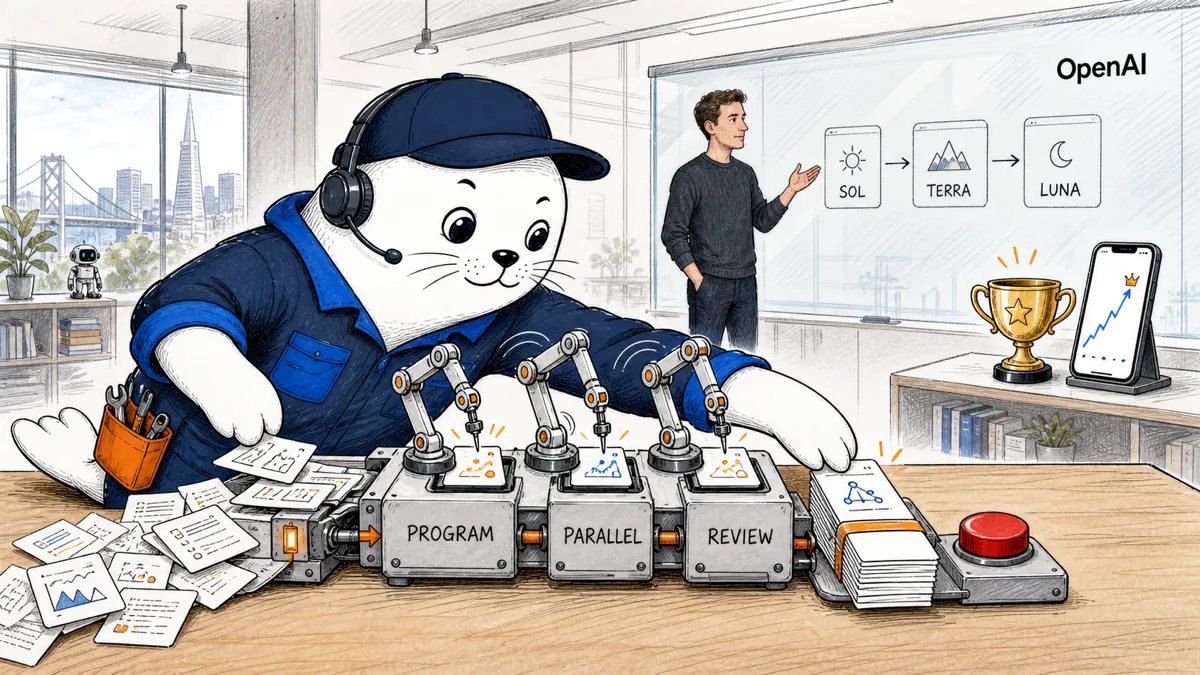
Subagents help when work can be divided cleanly: one agent checks documentation, another examines code, and a third validates tests. They help less when every branch depends on the same unsettled assumption. In that case, parallelism multiplies the mistake.
| Mode | Use it for | Main risk |
|---|---|---|
| Direct tool calls | Short, consequential steps | More model round trips |
| Programmatic tool calling | Bounded search, filtering, and reduction | Hidden intermediate failures |
| Multi-agent workflow | Independent research or implementation branches | Duplicated work and shared bad assumptions |
| Retained reasoning plus compaction | Long-running tasks with durable state | Stale context surviving too long |
Retained reasoning changed one OpenAI harness by 25 points
In OpenAI’s ARC-AGI-3 Responses API harness, GPT-5.6 Sol scored 13.3% with a standard setup. Retained reasoning plus compaction raised the reported score to 38.3% while using about six times fewer output tokens. That is a 25-point improvement in one company-run harness.
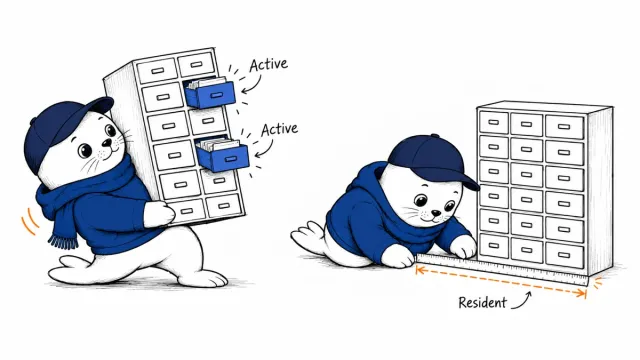
The result does not prove that compaction improves every task. It does show why long-horizon agents should be tested with the state mechanism they will use in production. Resetting the model on every step and then deploying it with retained state measures two different systems.
Prompt caching can fail on a tiny prompt change
OpenAI says the GPT-5.6 family uses a minimum prompt-cache time to live of 30 minutes and supports deterministic cache breakpoints. Stable instructions and tool definitions should stay at the front of the prompt, while changing user data belongs later. A small change before the cache boundary can turn a warm request into a cold one.
Cache hit rate should therefore be a dashboard metric, not an assumption. Record the prompt version, breakpoint, cached-token count, and cost for every deployment.
A competitor brief needs different modes at different stages
Imagine an agent producing a competitor brief. A coordinator can split official documentation, pricing, and repository research into independent branches. Each branch can use programmatic tool calling to search and reduce its own source set. The coordinator can retain reasoning about the user’s goal, compact the growing history, and ask a person to approve the final claims.
That design is more defensible than one giant loop because the boundaries are visible. It also follows the permissions-first approach in our guide to agentic AI in plain English.
Test the loop, not the launch demo
- Start with Sol at low reasoning and a direct tool loop.
- Add programmatic tool calling only to a bounded, reversible section.
- Add subagents only when branches are independent and their outputs can be checked.
- Compare fresh-session and retained-reasoning runs on the same long task.
- Record accepted-task rate, total tokens, cache hits, tool errors, latency, and reviewer time.
Then compare the result with the current GPT-5.6 pricing and latency tiers. A sophisticated loop is only useful if its accepted work justifies the added complexity and cost.
My verdict: earn complexity one feature at a time
GPT-5.6 gives builders more ways to compress, parallelize, and preserve agent work. The safe default is still a small model, a visible tool loop, and a clear stop condition. Add programmatic calls, subagents, retained reasoning, and compaction only after a measured failure mode justifies them.
Read the primary record
- Read OpenAI’s builder’s guide to GPT-5.6.
- Review the OpenAI tools documentation.
- Check the prompt caching guide before setting cache boundaries.
Updated August 13, 2026. Benchmark, token-reduction, and cache statements are attributed to OpenAI. The routing recommendations are Musthave.ai’s editorial analysis.