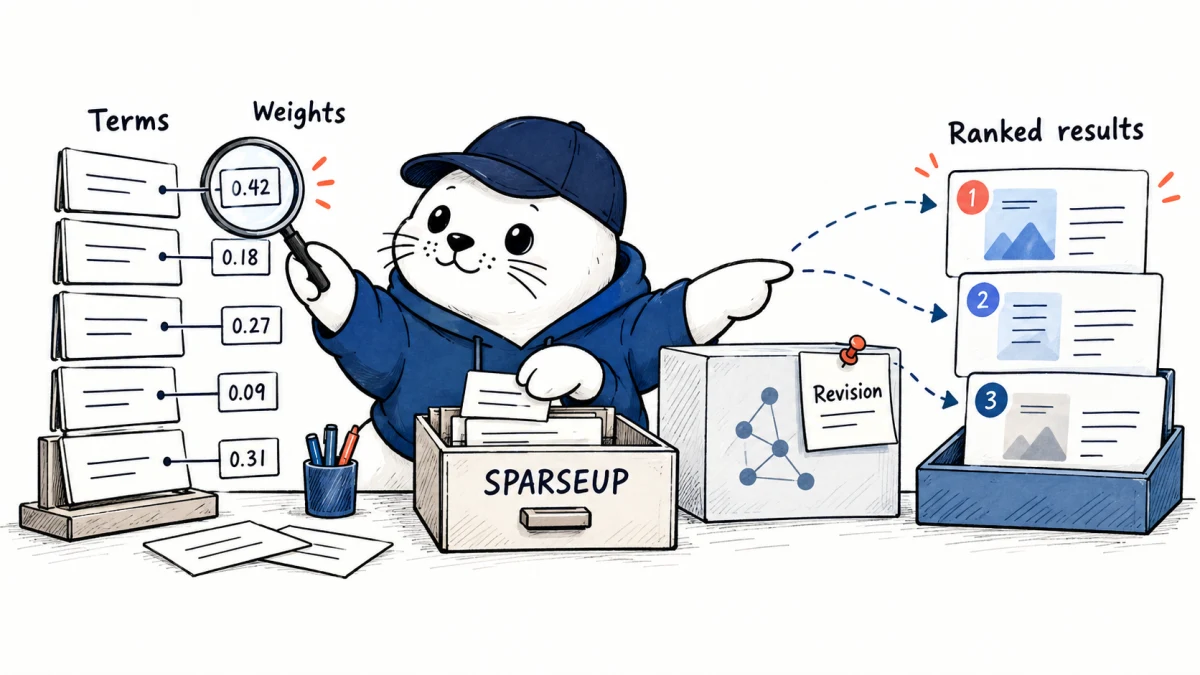
Dense retrieval can tell you that two passages are close. A vocabulary-based sparse model can also show which weighted words made them close, including the bad expansion that sent search in the wrong direction.
The SPARSEUP sparse retriever is Linkup Research’s new 149-million-parameter English model for learned lexical search. It converts a query or document into a sparse bag of weighted vocabulary terms, supports dot-product scoring and exposes functions for rendering and highlighting the terms that fired.
Why readable term weights matter
In a dense embedding, a document becomes one fixed-length vector whose dimensions have no simple human label. In SPARSEUP, an active dimension maps back to a vocabulary token. A team can inspect terms, weights and the source token that contributed the maximum value.
- Debugging: find irrelevant expansions that caused a false match.
- Rare entities: preserve exact lexical evidence for names, codes and domain terms.
- Filters and hybrid search: combine weighted terms with inverted-index infrastructure.
- Auditing: retain an interpretable trace of why a candidate entered the result set.
- Training analysis: inspect model behavior before and after a data or loss change.
Interpretability is not correctness. Linkup publishes examples where a useful expansion appears, but also cases where numbers or weak entities trigger unrelated terms. The advantage is that the failure is visible enough to study.
The model card in one table
| Property | Published value | Deployment consequence |
|---|---|---|
| Backbone | ModernBERT family | Use the supplied custom model code and tokenizer behavior. |
| Parameters | 149 million | Small enough for straightforward GPU evaluation and possible CPU study. |
| Language | English | Do not infer multilingual quality from English results. |
| License | Apache 2.0 | Review model and dependency terms before distribution. |
| Query prefix | [Q] | Omitting the prefix changes the evaluated input format. |
| Document prefix | [D] | Index documents with the matching documented format. |
| Evaluation lengths | 128 query, 512 document | Longer production text needs an explicit chunking test. |
Three changes keep the representation sparse
SPARSEUP starts from a late-interaction checkpoint, reattaches ModernBERT’s masked-language-model head and fine-tunes a SPLADE-style encoder. Linkup describes three modifications that improve the effectiveness and efficiency tradeoff.
- Logit shifting: subtracts a constant before the ReLU so the output does not begin as a dense field of weak positive terms.
- Per-position top-k expansion: limits each input token to its strongest vocabulary expansions before pooling. Linkup uses
k=12. - Vocabulary folding: merges case and word-start variants onto one canonical surface form, reducing the output space from roughly 50,000 to roughly 34,000 forms.
Folding is important for a byte-level BPE vocabulary. Without it, variants such as lowercase, uppercase, word-initial and non-word-initial forms can split the weight of the same visible word across several dimensions.
The headline benchmark needs two cautions
Linkup reports 56.4 average nDCG@10 on BEIR-13 excluding MS MARCO and calls SPARSEUP the strongest public vocabulary-based sparse encoder it knows below 150 million parameters. This is an author-run, company-reported comparison, not an independent MustHave.ai reproduction.
| Comparison | Published result | How to read it |
|---|---|---|
| SPARSEUP on BEIR-13 | 56.36 to 56.4 nDCG@10 | A strong sparse result in the stated size class. |
| DenseOn | 57.88 | 1.52 points above SPARSEUP in Linkup’s controlled comparison. |
| LateOn | Higher overall | Late interaction remains the stronger architecture in this comparison. |
| MS MARCO latency | About 380 microseconds at more than 97% recall versus exact search | Reported with approximate Seismic retrieval on the author’s setup. |
The search method is not uniform across every number. SPARSEUP results use approximate Seismic retrieval, while some dense and late-interaction comparisons use exact search. A buyer should reproduce every candidate with the same corpus, hardware, candidate depth and approximation target.
Where sparse, dense and late interaction differ
| Workload | Sparse hypothesis | Required test |
|---|---|---|
| Rare product code or legal citation | Exact term matching can help. | Measure recall for unseen identifiers and spelling variants. |
| Paraphrased semantic question | Expansion may help but can miss the concept. | Compare with the same-size dense model. |
| Long technical passage | Truncation or chunking can remove key evidence. | Vary chunk size and the 512-token document limit. |
| Multilingual corpus | An English vocabulary is a poor default assumption. | Break out every language and script separately. |
| Audit-sensitive retrieval | Readable weights improve diagnosis. | Store the term-weight trace with each result. |
Our Tencent EVIE guide shows a different retrieval tradeoff for visually rich pages. EVIE preserves page-image evidence with multi-vector search, while SPARSEUP focuses on readable lexical expansion for text.
A fair RAG evaluation plan
- Freeze one corpus, relevance set and train-evaluation boundary.
- Index SPARSEUP, a comparable dense model and a late-interaction model.
- Use the same document segmentation and metadata filters.
- Measure nDCG, recall, latency, index bytes and peak memory.
- Separate rare-entity, semantic, numerical and multilingual query slices.
- Inspect SPARSEUP’s top weighted terms for every false positive and false negative.
- Repeat exact and approximate search at matched recall targets.
- Evaluate final answer quality only after retrieval metrics are stable.
The evaluation projects in our 50 AI GitHub repositories guide can help automate these retrieval and answer-quality checks.
Treat remote model code as executable code
The published usage examples require trust_remote_code=True. That setting allows repository-provided Python code to load with the model. It is convenient for custom sparse outputs, but it also means a production team should review the code and pin an immutable revision instead of executing whichever commit is current.
- Resolve and record the model commit hash.
- Inspect custom modeling files and dependency changes.
- Run the model in an isolated environment with limited credentials.
- Mirror approved artifacts for reproducible deployment.
- Repeat the retrieval suite before changing the pinned revision.
The practical verdict
SPARSEUP is compelling as an open, inspectable sparse baseline. Its weighted terms can expose retrieval logic that a dense vector hides, and its reported latency is attractive for candidate generation. The release does not beat dense or late-interaction retrieval across the board. Teams should value the model for its distinct failure modes and debuggability, then prove quality, cost and security on their own corpus.
Primary sources
Checked September 20, 2026. Benchmark and latency figures are reported by Linkup Research and have not been independently reproduced by MustHave.ai.