Qwen-Drive 1.0 is a compact open research stack that combines visual understanding, bird’s-eye-view perception and driving-plan generation around a 4B vision-language model. The repository is unusually complete for inspection. It is not a production autonomy claim.
The Qwen-Drive 1.0 repository publishes code, model links, evaluation instructions and a demo under Apache 2.0. The accompanying technical paper describes it as an initial step toward a vision-language foundation model for autonomous driving.
What is in the release
| Component | Role | Approximate download size |
|---|---|---|
| Qwen3.5-4B base | Vision-language foundation | 9.1GB |
| Planner SFT expert | Supervised planning behavior | 2.1GB |
| Planner RL expert | Reinforcement-tuned planning behavior | 2.1GB |
| Perception head | Bird’s-eye-view perception output | 0.5GB |
The repository recommends a GPU with 24GB or more of memory and Python 3.10. That recommendation makes local inspection possible on a high-memory workstation or rented GPU, but it does not guarantee every evaluation path will fit under every precision and batch setting.
How perception and planning connect
The vision-language base interprets multi-camera driving context. A BEV head produces a structured view around the vehicle. Specialist planning experts generate driving decisions. This split matters because a fluent explanation is not the same as a geometrically consistent world model or a safe trajectory.
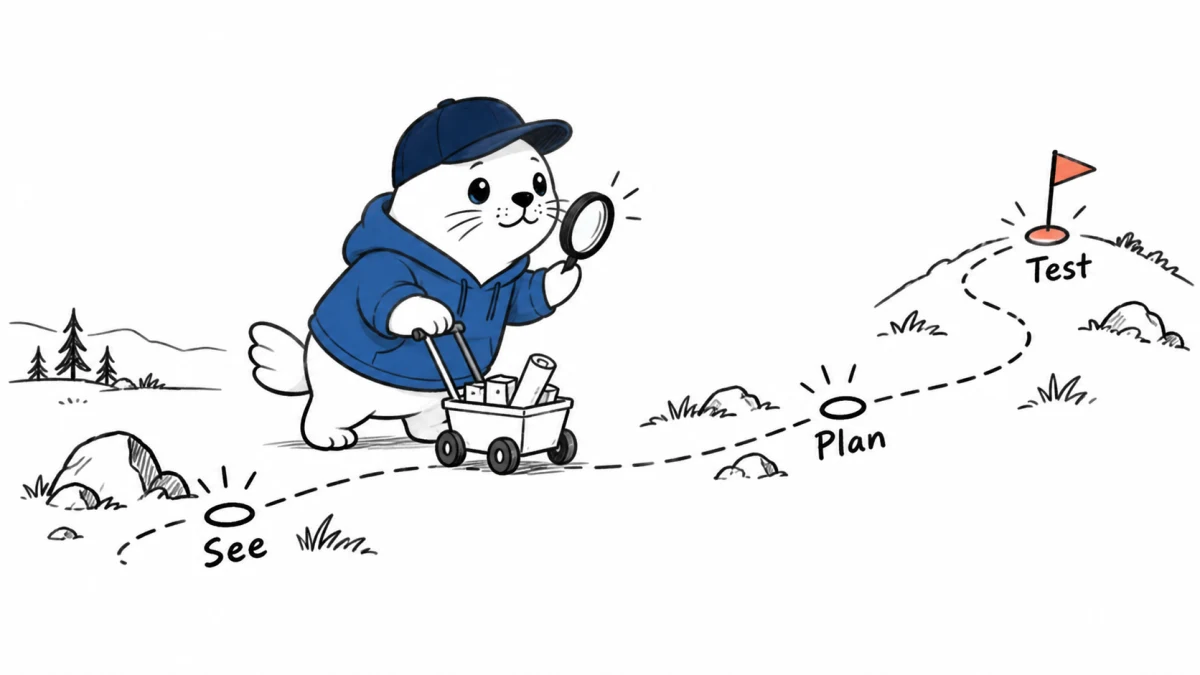
Treat each output layer as separately testable. Inspect perception against annotated objects and lanes. Inspect plans against route, comfort and rule constraints. Then test how perception errors propagate into plans.
What the open license gives you
Apache 2.0 permits broad reuse of the repository under its terms and includes an express patent license. It does not certify the model for a vehicle, transfer responsibility for safety validation or grant rights to unrelated datasets and third-party assets.
Pin the repository commit and every downloaded artifact. Record model hashes, configuration, dependency versions and any dataset license. An open repository can still become irreproducible if the exact weights or evaluation data move.
How to reproduce the bundled demo
- Clone the repository and create the documented Python 3.10 environment.
- Install the package without build isolation only after reviewing its dependencies and setup files.
- Download the exact base, planning and perception artifacts you intend to test.
- Run the smallest bundled demo before attempting the full benchmark suite.
- Save GPU model, driver, CUDA stack, peak memory, runtime and output artifacts.
- Repeat from a clean environment using the pinned commit and recorded hashes.
Read the benchmarks as research evidence
The authors report competitive results across perception, reasoning and planning benchmarks. Those numbers are useful for comparing the submitted configurations, but they are author-reported and depend on dataset, judge and evaluation choices.
The repository notes a judge change for LingoQA. That is exactly the kind of detail a reference article should preserve, because benchmark scores can move when the evaluator changes even if the underlying model does not.
The closed-loop safety gap
Offline accuracy asks whether a stored answer or trajectory matches a benchmark target. Closed-loop evaluation asks what happens after the system acts, changes the scene and receives new observations. Road safety also requires latency bounds, sensor-failure behavior, localization, control, redundancy and a validated operational design domain.
Do not collapse these claims: an open driving model, a strong offline score and a deployable autonomous-driving system are three different things.
For comparison, our NVIDIA Alpamayo 2 analysis also separates model access from the system-level work required for a real vehicle.
A practical evaluation matrix
| Test | Evidence to collect | Stop condition |
|---|---|---|
| Perception | Per-class accuracy, distance bands, weather and occlusion slices | Material degradation in a safety-relevant slice |
| Planning | Rule violations, collision proxies, comfort and route completion | Unsafe or irreproducible trajectory |
| Coupling | Plans generated from controlled perception perturbations | Small perception error causes unstable plan |
| Runtime | Peak memory, end-to-end latency and dropped frames | Missed real-time budget |
| Recovery | Sensor loss, corrupt frame and out-of-domain scene behavior | No bounded fallback |
My take: a useful inspectable baseline
Qwen-Drive 1.0 is valuable because researchers can inspect more than a paper score. The modular artifacts, demo and evaluation instructions create a practical baseline for studying how language, geometry and planning interact.
The smartest first use is controlled research on recorded data. Do not use a public benchmark or a successful demo as permission to operate a vehicle. Production autonomy needs a much larger evidence and safety case.
Primary sources and related reading
- Qwen-Drive 1.0 repository
- Qwen-Drive 1.0 paper
- Musthave.ai guide to AI GitHub repositories
- Musthave.ai Qwen3.8-Max test guide
Checked September 8, 2026. Architecture, license, file sizes and hardware recommendations come from the Qwen repository and paper. Safety boundaries and the evaluation matrix are Musthave.ai analysis.