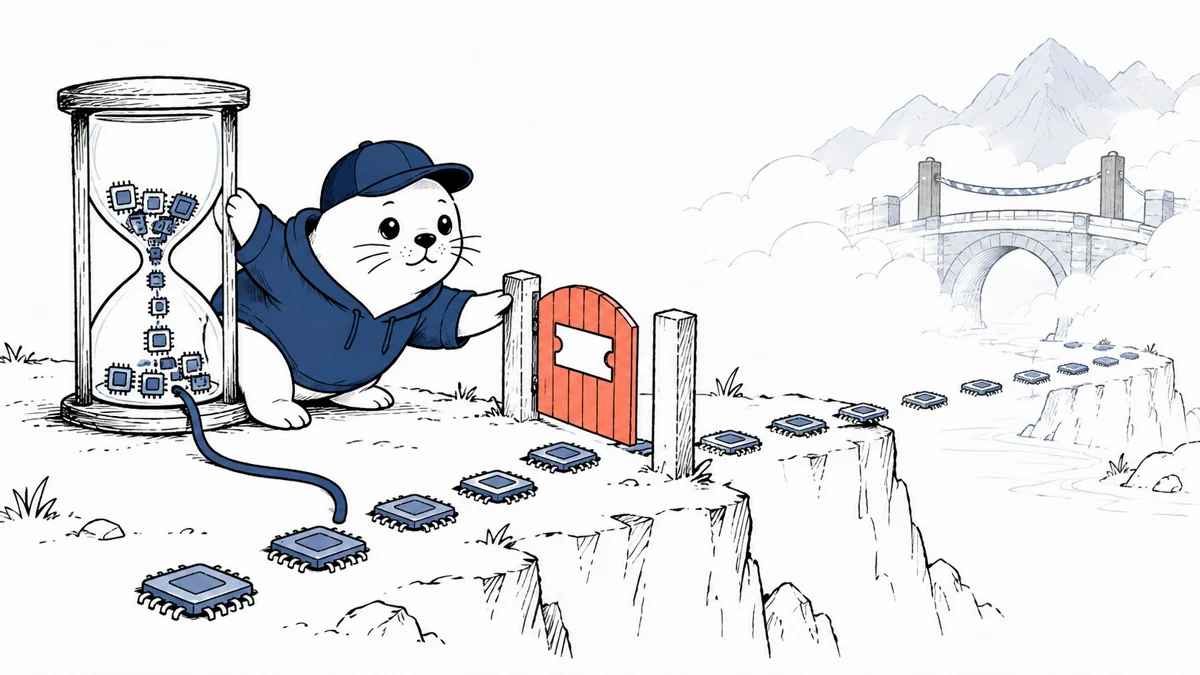
A compute grant becomes useful only when developers know how to apply, what hardware they receive and which workloads fit the allocation.
The Huawei 100 NPU-Hour Program is part of a new developer initiative announced at Huawei Connect on September 19, 2026. Huawei says it will open a shared platform designed around 10,000 NPUs and give every participating developer a baseline allocation of 100 NPU-hours. The announcement also commits CNY5 billion over three years to Ascend-based AI development.
What Huawei confirmed
| Announcement | Confirmed wording | Open question |
|---|---|---|
| Shared compute | 10,000-NPU-scale platform | Exact accelerator models and scheduling tiers |
| Developer allocation | Baseline 100 NPU-hours | Application, renewal and geographic eligibility |
| Investment | CNY5 billion over three years | Annual distribution and program recipients |
| Software | Four named open-source agent projects | Repository locations, licenses and release maturity |
| Ecosystem | Partners and developers on Ascend | Commercial terms after the initial grant |
The investment figure is a forward-looking commitment, not CNY5 billion already disbursed. The 10,000-NPU figure describes platform scale, not an allocation available to one developer. Those distinctions keep a large announcement from becoming an inaccurate promise.
What 100 NPU-hours can mean in practice
An NPU-hour is one accelerator used for one hour. The same 100 NPU-hours could be scheduled as one NPU for 100 hours, four NPUs for 25 hours or eight NPUs for 12.5 hours if the platform permits those shapes. These are arithmetic planning examples, not Huawei scheduling guarantees.
- Profile inference latency and memory for a model already ported to Ascend.
- Run a small fine-tuning experiment with checkpoints and early stopping.
- Compare quantization settings across a fixed validation set.
- Test an agent workflow while measuring model, retrieval and tool latency.
- Reproduce a benchmark on pinned software and model revisions.
The useful workload depends on the NPU model, memory, precision, framework version, queue time and whether compilation is billed inside the allocation. Developers should avoid estimating tokens or training volume until Huawei documents those variables.
The announcement does not yet explain how to get access
Huawei’s public release does not provide a direct application URL, supported-country list, identity requirements, data-processing terms or the start date for individual allocations. It also does not state whether the baseline applies to any registered developer or only accepted program participants. MustHave.ai could not verify those missing details from the reviewed primary release.
Developers should wait for an official program portal or partner notice and verify the destination domain before uploading code, credentials or datasets. A social post or reseller form is not enough evidence of access to the announced platform.
Data governance belongs in the first test plan
A shared compute program may process source code, model weights, prompts and evaluation data. Before using a grant, a team needs the platform’s retention policy, training-use policy, region, encryption controls, deletion process and rules for support access. Use synthetic or public data until those terms are available and accepted.
- Confirm the official enrollment path and organization behind it.
- Read service, privacy and acceptable-use terms.
- Identify the NPU, framework and supported model formats.
- Start with a public model and non-sensitive dataset.
- Set a hard NPU-hour budget for compilation, trials and final measurement.
- Export logs, metrics and artifacts before the allocation ends.
CANNBot and the other announced agents need repository checks
Huawei says it open-sourced CANNBot, Model Agent, MindStudio Agent and Solution Agent. The names suggest assistance for the CANN software stack, model adaptation, development workflows and solution building. The announcement alone is not enough to establish that each repository is public, installable and covered by a usable open-source license.
| Check | Why it matters |
|---|---|
| Official repository owner | Prevents installation from an impersonating project |
| License file | Defines redistribution and commercial rights |
| Tagged release | Provides a reproducible version |
| Dependency lock | Reduces supply-chain drift |
| Permission model | Shows what the agent can execute or upload |
| Issue activity | Indicates whether the release is maintained |
How this compares with other shared accelerator programs
The core tradeoff resembles other managed accelerator offerings: teams receive access without owning the hardware, while the provider controls scheduling, supported software and the security boundary. Our HyperPod inference gateway guide covers routing and identity in a managed GPU environment. Our TensorRT deployment guide shows how fixed hardware and software revisions make results comparable.
Huawei’s differentiator is the Ascend hardware and software ecosystem. That makes the grant most valuable to developers already considering CANN, MindSpore or an Ascend deployment. A team targeting only CUDA should treat the allocation as a porting evaluation, not free production capacity.
A 100-hour experiment budget
| Stage | Illustrative allocation | Output |
|---|---|---|
| Environment and compile | 15 NPU-hours | Pinned working build |
| Correctness baseline | 20 NPU-hours | Validated outputs |
| Performance sweep | 30 NPU-hours | Latency and throughput curve |
| Agent or tuning experiment | 25 NPU-hours | Task-level results |
| Final reproduction | 10 NPU-hours | Clean report and artifacts |
This split is an editorial planning template, not a Huawei quota policy. The point is to reserve enough capacity for a final clean reproduction instead of consuming the entire grant during environment debugging.
The practical verdict
The Huawei 100 NPU-Hour Program could lower the first barrier to testing Ascend-based AI workloads, while the 10,000-NPU platform signals a larger partner strategy. The announcement is not yet an onboarding guide. Application, eligibility, hardware and data terms remain open, so developers should prepare a bounded experiment and wait for an official access route. Treat the grant as a measured evaluation opportunity, not guaranteed production capacity.
Primary source
Checked September 21, 2026. MustHave.ai will update this guide when Huawei publishes the official application route, eligibility rules and service terms.