Google’s argument for Go in AI-assisted engineering is not that coding agents become smarter. It is that the language and its standard tools make their work easier to constrain, check, and review.
Go AI-assisted software engineering is Google’s name for a practical feedback loop: a small language surface, a strong standard library, one formatter, a fast compiler, built-in tests, fuzzing, and profiling. We ran a small disclosed exercise to test that verification claim.
This is not a model benchmark and it does not prove that Go code is more correct than Python or TypeScript. It asks a narrower question: how much useful checking can a reviewer get from the standard project toolchain before adding third-party infrastructure?
Google’s claim is about feedback, not autocomplete
Google points to Go’s limited syntax, compatibility discipline, standard formatting, compiler, tests, fuzzing, race detection, and profiling. The pitch is that generated code has fewer stylistic degrees of freedom and more predictable mechanical checks.
That matters because an agent can produce a plausible diff faster than a person can understand it. The useful language is the one that helps turn "looks right" into a short, repeatable evidence trail.
The Musthave.ai micro-test
We implemented the same tiny parser in Go, Python, and TypeScript. It accepts comma-separated key=value pairs, trims whitespace, rejects empty keys, and rejects duplicate keys. The test suite included a duplicate-key case because silently overwriting configuration is the kind of small bug that can survive a friendly demo.
The implementations were intentionally simple and used no external libraries. We recorded only standard-tool behavior available in the installed runtimes.
| Language/runtime | Standard checks run | Observed result |
|---|---|---|
| Go 1.26.5 | gofmt, go test, go vet, built-in fuzzing | Tests and vet passed; 775,553 fuzz executions in two seconds, with 151 corpus cases retained |
| Python 3.14.5 | compileall, unittest | Compilation and two tests passed; no standard-library formatter or equivalent fuzz command was used |
| Deno 2.7.14 / TypeScript | deno fmt, deno check, deno test | Formatter changed one long line; type check and two tests passed |
What the exercise supports
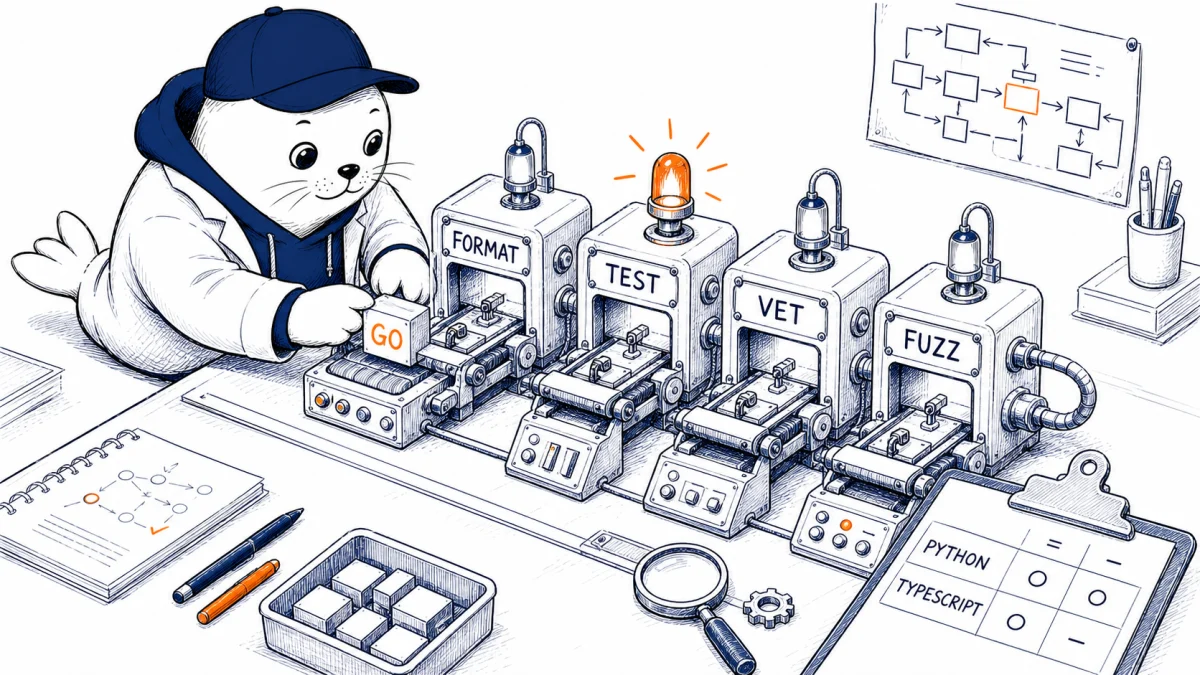
Go gave us a compact sequence of first-party commands that covered formatting, deterministic tests, static analysis, and fuzzing. The fuzz harness also lived beside the normal test. That makes the verification recipe easy to hand to an agent and easy for a reviewer to reproduce.
Deno offered a similarly cohesive formatter, type checker, and test runner for TypeScript. Python’s standard library covered syntax compilation and tests, while formatting, static typing, linting, property testing, and fuzzing normally require choices outside the standard library.
The fair conclusion is about defaults: Go’s default repository loop includes more of the evidence we wanted with fewer tool-selection decisions. It is not evidence that third-party Python or TypeScript stacks cannot provide equal or stronger checks.
What this test does not prove
- It does not measure how often an AI generates correct Go, Python, or TypeScript.
- It does not compare large repositories, frameworks, concurrency, dependencies, or production debugging.
- It does not measure human review time with enough samples for a statistical claim.
- It does not show that a passing formatter, compiler, test, or fuzz run proves business correctness.
Turn the language claim into an agent contract
- Give the agent one canonical command. It should format, compile or type-check, test, and run static checks.
- Require a changed-test path. A generated feature needs a test that fails without the implementation.
- Add fuzzing where inputs are open-ended. Parsers, protocols, and boundary code benefit most.
- Keep the diff small. Mechanical confidence does not replace a readable change.
- Record the commands and outputs. A reviewer should be able to rerun the same trail.
This complements our guide to setting review effort for Copilot: a deeper model pass is still only one layer. Our article on overnight coding-agent handoffs makes the same operational point, morning review needs artifacts, not confidence theater.
My verdict: Go’s advantage is the short evidence path
Google’s strongest case is not "agents love Go." It is that the repository can answer common review questions with a small, standardized command set. Our micro-test supports that narrower claim.
Choose Go when its runtime, ecosystem, and deployment model fit the product. If you choose another language, copy the useful part: make formatting, typing, tests, fuzzing, and review evidence feel like one path instead of five optional plugins.
Read the source and reproduce the test
- Read Google’s case for Go in AI-assisted software engineering.
Checked August 12, 2026. Musthave.ai’s experiment files, commands, versions, and raw result notes are preserved in the dated local release package. The test is deliberately small and should not be generalized into a language ranking.