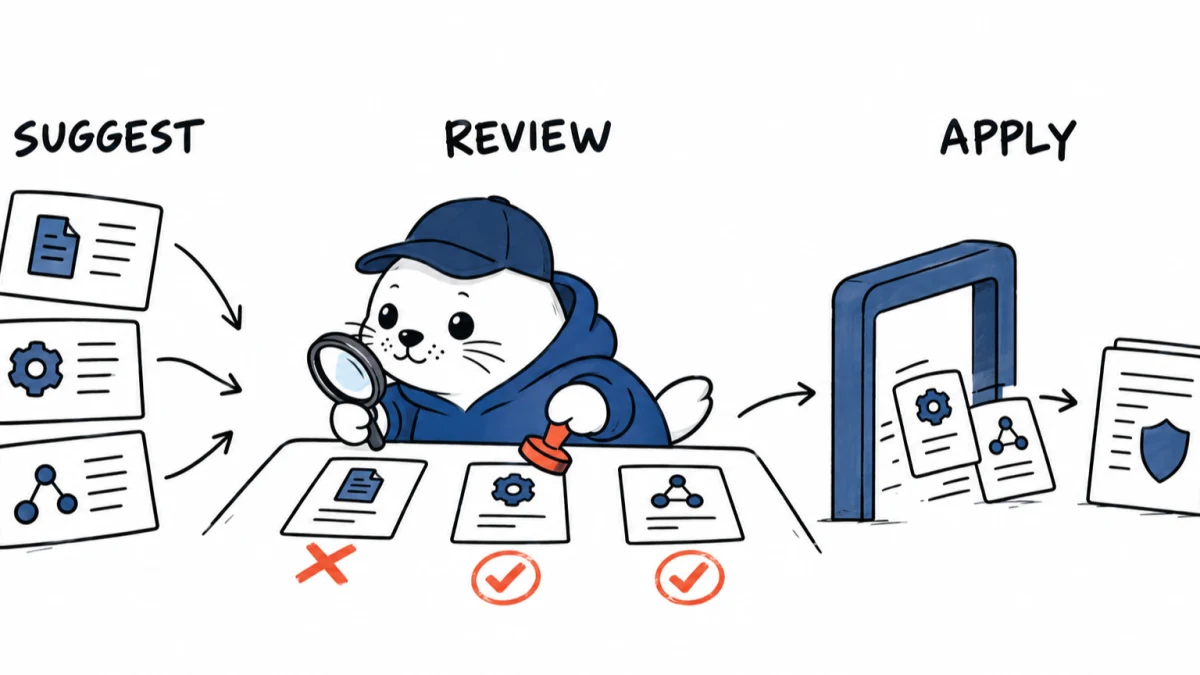
GitHub Copilot can now suggest allowed values when owners define custom repository properties. The public preview targets GitHub Business and Enterprise customers. It is a small feature with a large governance consequence because metadata often decides which repositories receive a rule, report or automation.
GitHub announced custom-property suggestions on September 15, 2026. Organization and enterprise owners can control the capability through policy. The suggestion appears while defining the permitted values of a custom property.
A property value can become a policy boundary
Custom properties help classify repositories by data sensitivity, business unit, service tier, lifecycle or ownership. Once rulesets and automations depend on those fields, a poor definition can create broad exceptions or silent gaps. The AI suggestion is therefore not just autocomplete. It can shape the vocabulary used by later controls.
The new workflow has three gates
| Gate | Question | Owner |
|---|---|---|
| Suggest | What allowed values fit the property? | Copilot draft |
| Review | Are the values complete, distinct and policy-safe? | Organization or enterprise owner |
| Apply | Which repositories and rules use the property? | Governance administrator |
Good definitions are mutually exclusive
A property such as service tier should not offer values that overlap without a clear rule. If both critical and customer-facing can apply, the field may be mixing impact with audience. Split the concepts or document precedence. Copilot can draft names, but only the organization knows which classifications drive audits, deployment approvals and incident response.
Test suggestions against the current estate
- Export the current repository inventory and existing property values.
- Map every suggested value to real repositories.
- Identify repositories that fit none or several values.
- Simulate affected rulesets before changing the definition.
- Record the human reviewer and reason for the approved vocabulary.
Owner policy is the right control point
GitHub says organization and enterprise owners can enable or disable the suggestion capability. That allows regulated environments to separate experimentation from authoritative taxonomy changes. A practical approach is to enable suggestions for a sandbox organization, compare drafts with the established data dictionary and expand only after review.
What GitHub has not published
The changelog does not include an accuracy benchmark, evaluation dataset or error rate for suggested values. It also does not claim that Copilot assigns properties to every repository. The public preview concerns help with property definitions. Treat output as a draft and avoid language that implies automatic compliance.
Our GitHub Copilot Auto tiers guide examines a separate model-routing change. The Copilot Autofix analysis shows why a generated proposal should stay separate from enforcement and merge approval.
A compact governance checklist
- One concept per property.
- Values are mutually exclusive or have declared precedence.
- An owner is responsible for each value.
- Ruleset impact is previewed before publication.
- Legacy and unclassified repositories have an explicit path.
The practical verdict
GitHub Copilot custom properties can reduce the blank-page work of creating repository metadata. The feature is safest when suggestions are tested against the real repository estate and approved before any ruleset, audit or automation depends on them.
Primary source
Checked September 15, 2026. Availability and owner controls come from GitHub. Governance interpretation and review steps are MustHave.ai analysis.