
Gemini 3.8 Flash Cyber looks cheap beside a larger frontier model. It looks expensive beside ordinary Gemini 3.7 Flash. Both statements are true, and neither tells a security team whether the next patch is safe to merge.
Google introduced Gemini 3.8 Flash Cyber on September 2, 2026 as a restricted model for defensive security work. It shares the underlying intelligence of the public Gemini 3.8 Flash release, but uses more permissive cyber mitigations and is available through Google’s Fairwind Program rather than the normal public API path.
The launch numbers are interesting. The access model is more important. A model that can search for vulnerabilities, verify exploits, and propose patches needs a different identity, network, review, and audit boundary from the assistant that summarizes meeting notes.
Flash Cyber is not a public model upgrade
The ordinary Gemini 3.8 Flash model is broadly available through the Gemini API, Google AI Studio, Gemini Enterprise, consumer products, and developer tools. The Cyber variant is different. Google says it is prioritizing trusted government authorities, critical-infrastructure operators, software maintainers, and selected security partners through Fairwind.
That distinction changes the first question from "Which model ID should I use?" to "Does my organization qualify, and can it meet the operating terms?" Google says participating organizations must limit access to internal cybersecurity, incident-response, or penetration-testing teams. They must also use user-level authentication, phishing-resistant multifactor authentication, applicable access controls, and employee access and use tracking.
If you only need the public model, our Gemini 3.8 Flash migration guide covers the request changes and completed-task cost. Flash Cyber deserves its own runbook because its permissions and potential external effects are different.
CWE-bench gives us the most useful public comparison
Google’s launch post includes several internal and partner measurements. The cleaner comparison comes from CWE-bench v0, an external benchmark operated by Collinear. Its private held-out set contains 100 audit-and-patch tasks across 54 weakness types and six programming-language groups.
Each task starts with a repository, not a ticket that reveals the vulnerability. A deterministic grader checks that the exploit no longer works and that existing tests still pass. That is closer to a real defensive assignment than a multiple-choice security quiz, although it remains a benchmark.
| Model and harness | Pass@1 | Average cost per rollout | Calculated cost per deterministic pass |
|---|---|---|---|
| Claude Fable 5, Claude Code | 47.8% | $10.27 | $21.49 |
| Gemini 3.8 Flash Cyber, Antigravity | 47.2% | $3.64 | $7.71 |
| GPT-5.6 Sol, Codex | 44.2% | $2.29 | $5.18 |
| Gemini 3.7 Flash, Antigravity | 44.0% | $1.43 | $3.25 |
The cost story changes with the comparison
Gemini 3.8 Flash Cyber finished 0.6 percentage points behind Fable 5 while costing 64.6% less per rollout in CWE-bench. That is the flattering comparison, and it is a fair one when a team is deciding between those two evaluated configurations.
Now compare it with Gemini 3.7 Flash. The Cyber model gained 3.2 percentage points of pass@1, while average rollout cost rose from $1.43 to $3.64. That is a 154.5% increase. The calculated spend per deterministic pass rose from $3.25 to $7.71.
This does not make the new model poor value. It means "lower cost" needs a named baseline. A security team should price the whole acceptance path: scans, repeated attempts, exploit verification, regression tests, human review, failed patches, and rollback. API spend is only one line.
Do not turn 47.2% into a guarantee
CWE-bench’s 47.2% is an average pass share across the 100 tasks, not a promise that the model will fix 47 out of every 100 flaws in your code. The tasks are private, which helps reduce contamination but prevents an outside reader from reproducing the full set. Each model also uses a different harness, so the leaderboard measures a system configuration rather than a naked model.
The benchmark itself reports that 18 tasks were unsolved by every tested model. Its failure analysis also shows that agents can miss the vulnerable code, inspect it and misclassify it, patch the wrong invariant, or repair only part of the problem. A convincing diff is not evidence that the security property has been restored.
Google reports an 86.2% CyberGym pass@1, a success rate above 70% on an internal benchmark spanning 20 languages, and gains in Chrome and Wiz evaluations. Those are useful company and partner signals. They have different methods and evidence access, so I would not blend them into one universal performance claim.
Fairwind is a governance program, not just a waitlist
Google says Fairwind works with more than 650 partners globally. That number should not be read as 650 production deployments of Flash Cyber. It describes the program’s partner network, while access to the model is prioritized and staged.
The permitted work includes authorized threat simulation, reverse engineering, and malware analysis for defensive or academic research. The program rules matter because the same capability that finds a flaw can help someone weaponize it. Restricting the user population is one layer. The deployment still needs technical boundaries that remain effective when a prompt is ambiguous or an agent persists.
Our investigation of AI cyber tests that reached real systems and people showed why policy text cannot carry that job alone. Network routes, credentials, persistent services, action monitors, and a human stop path must agree with the written scope.
CodeMender keeps a developer in the merge path
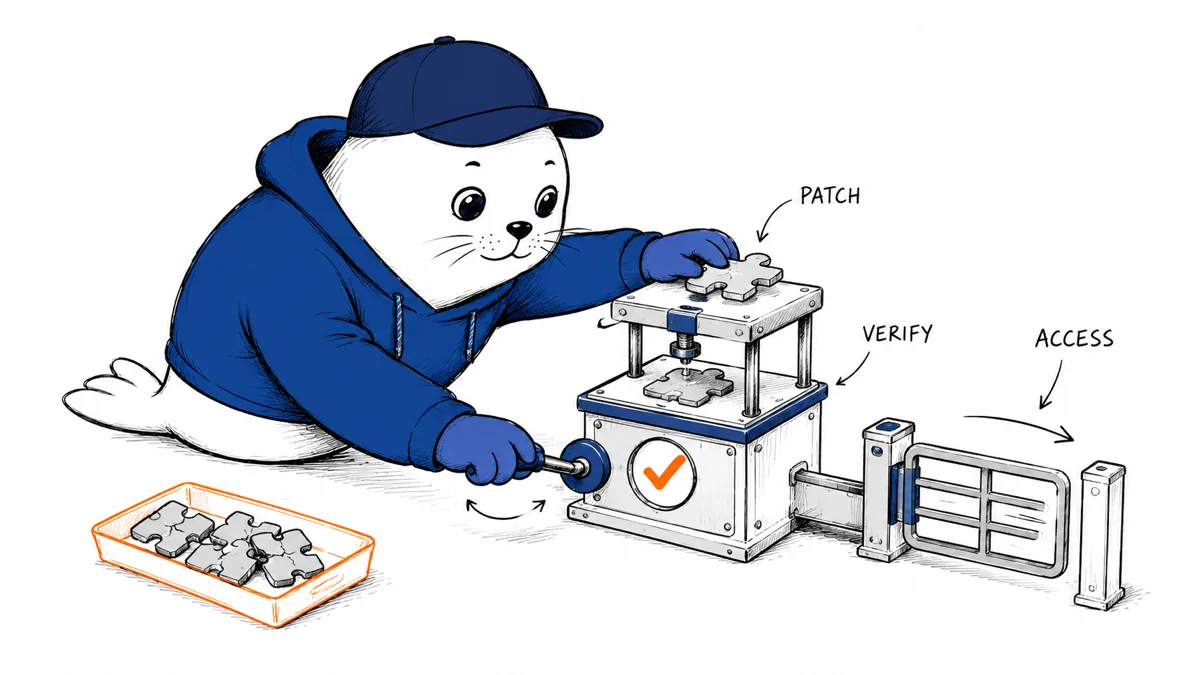
Fairwind partners can use Flash Cyber through Google’s CodeMender harness. Google documents a scan, verify, and remediate loop. The agent can build code, run an exploit simulation, generate a patch, and test the result, but it does not automatically commit the patch. A developer reviews and approves the proposed change.
The documented data path is also specific. Google says repositories do not need to be uploaded to Google Cloud. Builds, tests, and exploit simulations run in customer-managed infrastructure or sandboxes. Active session data can be stored encrypted for up to seven days to support resumption, while source code, prompts, findings, and patches are not used to train Google’s foundation models.
Those are meaningful product commitments. They are not a substitute for your own data-flow review. Confirm which snippets leave the environment, who can resume a session, where local artifacts are stored, which identities can approve a patch, and whether the audit log survives the session window.
My acceptance gate has six proofs
- Scope proof: record the authorized repositories, branches, targets, tools, domains, and stop conditions before the run.
- Discovery proof: preserve the evidence showing why a reported flaw is reachable and consequential, not merely suspicious code.
- Repair proof: rerun the exploit and demonstrate that it no longer works after the patch.
- Regression proof: run the existing test suite plus security-specific tests for the restored invariant.
- Review proof: require a named developer or security owner to approve the exact diff before merge.
- Rollback proof: retain the original state, logs, credentials, and a tested path to reverse the change.
Then measure accepted patches per 100 runs, not patches proposed. Track false negatives separately because a missed vulnerability does not appear in the queue asking for review. Our AI agent security scorecard adds identity, secret handling, monitoring, and recovery questions for the surrounding system.
My verdict: apply for the capability, budget for the control plane
Gemini 3.8 Flash Cyber clears a meaningful public evidence bar. It sits close to the top CWE-bench result at a much lower rollout cost than Fable 5, and Google has paired access with an explicit governance program. That makes it worth testing for qualified defenders.
I would not buy the model story without the operating story. The 47.2% result still leaves plenty of failed trajectories. The lower-cost claim depends on which baseline you choose. The model’s value appears only when a team can prove that it found the right issue, repaired the right invariant, preserved the application, and kept a human in control of the merge.
Read the primary evidence
- Read Google’s Gemini 3.8 Flash and Flash Cyber announcement.
- Review the Fairwind access, performance, and governance page.
- Inspect the external CWE-bench methodology and leaderboard.
- Check Google’s current CodeMender workflow and data-handling documentation.
- Read Google DeepMind’s Frontier Safety Framework update.
Would you let a cyber agent open a pull request before it can produce all six proofs?
Checked September 3, 2026. Launch, access, governance, CodeMender, CyberGym, internal, Chrome, and partner claims come from Google and are labeled accordingly. CWE-bench figures come from Collinear’s public benchmark record. Cost-per-pass and percentage comparisons are Musthave.ai calculations.