
DeepSeek V4 Pro reached general availability with stronger agent scores and the same API alias. Three days later, every routing spreadsheet built on the launch price becomes wrong.
DeepSeek V4 Pro 0813 rolled out on August 13 across the DeepSeek app, web product, and API. Existing API integrations continue to call deepseek-v4-pro, which now resolves to the 0813 version. The service lists a one-million-token context window, up to 384,000 output tokens, and a concurrency limit of 500.
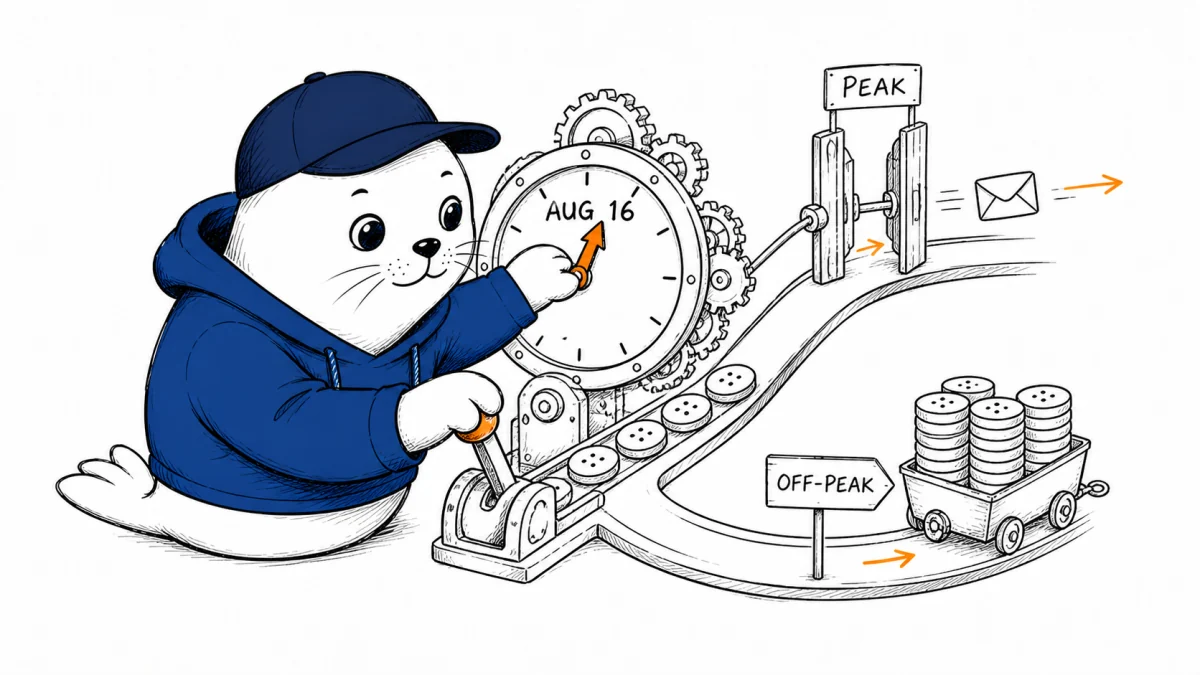
The release also sets a deadline. At 16:00 UTC on August 16, DeepSeek will replace its current rates with peak and off-peak pricing. Off-peak is half the peak rate, but it is not a discount from today’s price. For several token classes, even the new off-peak rate is materially higher.
The model alias stays put while the version changes
DeepSeek’s stable alias reduces migration work, but it also means an application can receive a new model build without changing its configuration. The official pricing page identifies the served version as DeepSeek-V4-Pro-0813. Teams that need reproducible behavior should record the observed version in evaluation and incident logs rather than storing only the alias.
The API supports JSON output, tool calls, the OpenAI Responses API, and an Anthropic-compatible API. Prefix completion and fill-in-the-middle completion remain limited to non-thinking mode. Pro and Flash now offer low, high, and max thinking effort. A higher effort setting can improve difficult work, but it can also change latency and output volume, so treat effort as part of the test configuration.
August 16 creates two price sheets
Peak hours are 01:00-04:00 UTC and 06:00-10:00 UTC, a total of seven hours per day. The remaining seventeen hours use off-peak rates. A queue that can move safely outside the peak windows can halve the new token price, but real-time work cannot assume that flexibility.
| V4 Pro token class | Current | Off-peak from Aug 16 | Peak from Aug 16 |
|---|---|---|---|
| Cache-hit input | $0.003625 | $0.022 | $0.044 |
| Cache-miss input | $0.435 | $0.66 | $1.32 |
| Output | $0.87 | $1.98 | $3.96 |
The output price rises about 128% off-peak and 355% at peak compared with the current $0.87 rate. Cache-miss input rises about 52% off-peak and 203% at peak. Cache-hit input increases more sharply in percentage terms because the starting price is extremely small. Those percentages describe list-price changes, not a workload’s final bill.
A request-level example shows the real change
Consider a request with 10,000 uncached input tokens and 2,000 output tokens. At the current V4 Pro rates it costs about $0.00609. Under the new schedule, it costs about $0.01056 off-peak or $0.02112 at peak. Ten thousand such requests would move from $60.90 to $105.60 or $211.20.
| 10K uncached input + 2K output | Per request | 10,000 requests |
|---|---|---|
| Current V4 Pro price | $0.00609 | $60.90 |
| New off-peak price | $0.01056 | $105.60 |
| New peak price | $0.02112 | $211.20 |
The schedule makes batch timing a real architecture decision. Evaluation runs, indexing jobs, bulk transformations, and nonurgent coding queues can target off-peak windows. Interactive user requests and incident-response agents may have to absorb peak rates. Do not delay safety-critical work to save tokens.
The agent scores improved, but the harness still matters
DeepSeek reports 87.9 on Terminal Bench 2.1, 61.5 on NL2Repo, 83.3 on Cybergym, 62.7 on DeepSWE, and 74.1 on Toolathlon-Verified. It also reports 42.7 on Humanity’s Last Exam without tools and 60.0 with tools. Agents’ Last Exam is listed at 25.7 and AutomationBench Public at 31.8.
These are company-reported results. They tell a team which capabilities DeepSeek wants the release judged on; they do not reveal cost per accepted task, reviewer effort, or how a custom tool stack changes the result. Internal DSBench scores are even harder to compare because outsiders do not have the same test set.
The right reproduction package pins the alias and observed version, thinking effort, temperature, context, output cap, tool schema, harness, and endpoint. Our analysis of the Endpoint Accuracy Index shows why the provider path can change the capability delivered by the same model name.
Route by urgency, cache behavior, and acceptance rate
- Separate peak and off-peak spend. Do not average the two rates before you know when traffic arrives.
- Log cache classes. Keep cache-hit input, cache-miss input, and output visible in cost reports.
- Pin thinking effort. Compare low, high, and max on the same tasks and record output growth.
- Measure accepted work. Add retries, review time, reverted changes, and failed tools to the token bill.
- Keep a fallback. The stable alias can change underneath the application, so preserve a tested alternative route.
DeepSeek V4 Flash remains the lower-cost route, but its rates also change on August 16. We updated our DeepSeek V4 Flash pricing analysis with the new schedule. For cross-provider budgeting, our GPT-5.6 price breakdown uses the same request-level method.
My verdict: retest now and schedule what can wait
DeepSeek V4 Pro 0813 is a meaningful production release because the agent-focused build, native Responses API support, and broader thinking controls arrive across every first-party surface. The most urgent action is financial: teams have until August 16 to replace the old price assumptions.
I would rerun the acceptance set on 0813 before moving critical workflows, then split eligible batch traffic into the seventeen off-peak hours. The cheaper window can improve the economics. It does not restore today’s price, and it does not make a company benchmark a substitute for your own failures.
Read the primary documentation
- Read DeepSeek’s August 13 model update.
- Check the current and scheduled API price table.
- Review the thinking-effort documentation before changing effort levels.
Which of your agent jobs can move outside the seven daily peak hours without harming the user?
Checked August 13, 2026. Release scope, model specifications, benchmark figures, feature support, concurrency, and prices come from DeepSeek’s official API documentation. Benchmarks are company-reported. Price-change percentages and request examples are Musthave.ai calculations.
Service update: V4 Pro will continue after September 14
Update, September 12, 2026: DeepSeek’s V4.1 Flash launch page said deepseek-v4-pro requests would begin routing to V4.1 Flash at 04:00 UTC on September 14. The current API changelog now says DeepSeek decided to continue V4 Pro service after that date with unchanged billing.
Current migration status: keep V4 Pro and V4.1 Flash as separate production targets. Do not assume the Pro endpoint will alias to Flash on September 14.
| Current API model | Vision | Context | Max output | Peak input miss | Peak output |
|---|---|---|---|---|---|
deepseek-flash | Yes | 1M | 384K | $0.30 / 1M | $1.20 / 1M |
deepseek-v4-pro | No | 1M | 384K | $1.32 / 1M | $3.96 / 1M |
The official pages currently disagree. The launch article still carries the planned redirect, while the newer operational wording in the API changelog says Pro will remain. For live routing and billing decisions, I am treating the changelog and current pricing table as controlling until DeepSeek resolves the launch page.
If you already scheduled a forced migration, cancel that assumption and run both model IDs explicitly. Compare output quality, latency, cache behavior and total accepted-task cost before choosing a default.
September 13 update: Fireworks sets a September 25 serverless cutoff
Fireworks AI says its serverless DeepSeek V4 Pro (0813) route will be decommissioned after September 25, 2026. The provider recommends moving to DeepSeek V4.1 Flash and says dedicated deployments are unaffected. This changes the serving-path availability described here; it does not rewrite the historical peak and off-peak price sheet analyzed in the original article.
Teams should compare the newer route on their own Pro workload, including quality, tool calls, token use and latency, before changing production traffic. See our complete Fireworks AI migration matrix for every affected DeepSeek, GLM, Muse and Kimi route.