
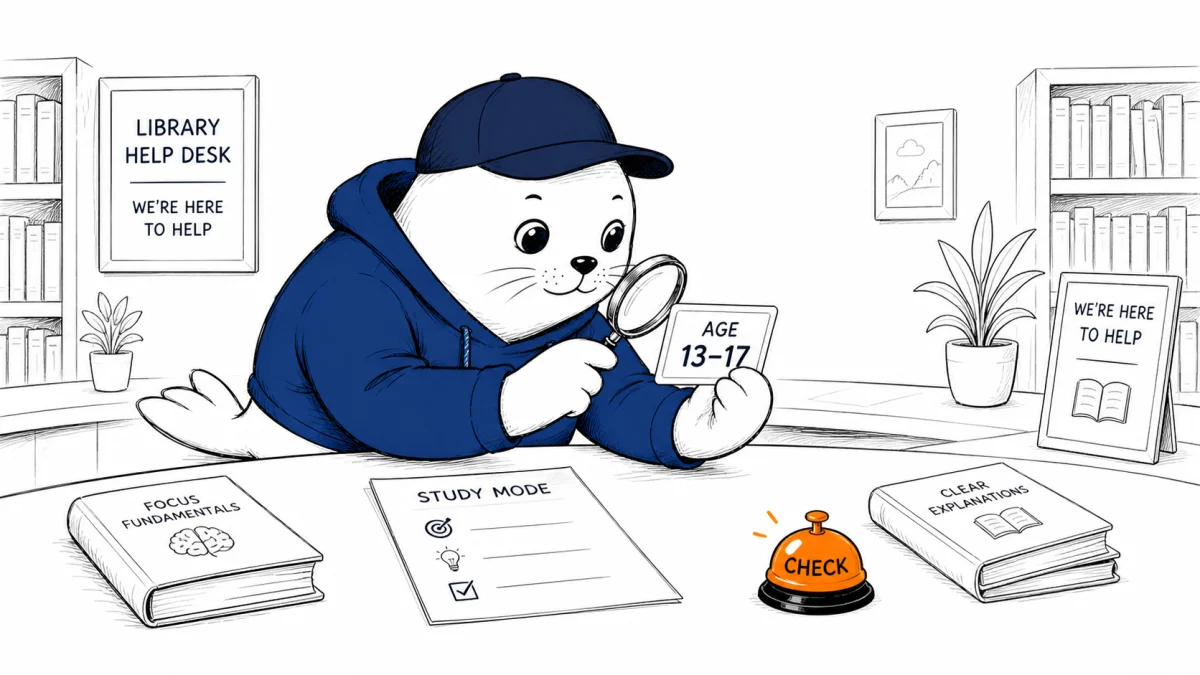
A teen product is only as reliable as the routing step that decides who receives it. OpenAI explains what happens after an account enters the protected experience. It has not published how often the system sends the wrong person there, or misses someone who should be there.
ChatGPT for Teens began rolling out on August 18, 2026 for eligible accounts on Free and paid personal plans. OpenAI says an account enters the experience automatically when account-provided age, verified age, or age prediction indicates that the user is under 18. The company expects full availability in Australia on September 8.
The product combines learning features with stricter content handling. Study Mode, responsible homework reminders, sensitive-image warnings, teen onboarding, and optional parental controls sit alongside limits for graphic violence, harmful challenges, sexual or romantic roleplay, extreme beauty standards, and unhealthy dieting content.
The routing decision happens automatically
OpenAI says users do not need to turn on the teen experience. The system can use age information already associated with the account, a verified age, or an age prediction. Its help documentation says prediction may consider general conversation topics, usage times, account-use patterns, and account age.
This is a consequential classifier even though it does not close an account. It changes the content policy, feature set, and availability of some interactions. The company acknowledges that the system can be wrong. An adult placed in the teen experience can verify age to remove the protections, after which OpenAI says age prediction will no longer run on that account.
That correction path addresses false positives. The harder case is a false negative: a teen account that remains in the adult experience. Public pages describe stronger safeguards and correction procedures, but I could not find published false-positive, false-negative, subgroup, or regional error rates for the age-routing system.
The learning tools deserve their own evaluation
OpenAI frames the product around active learning. Study Mode can use guiding questions and step-by-step support. Homework reminders are meant to recognize attempts to shortcut an assignment and redirect the teen toward collaborative problem solving.
The feature sounds sensible, but it creates another classification task. A student asking for a concise explanation is not always cheating. A system that interrupts too often can become nagging; one that rarely intervenes becomes cosmetic. Schools and families need examples of what triggers the reminder, how the teen can continue with a legitimate request, and whether the setting behaves differently across subjects and languages.
Our article on OpenAI education plugins makes the boundary clear: software can build a lesson or scaffold a problem, but the teacher still owns the judgment about learning goals, student context, and acceptable assistance.
Parent controls do not expose conversations
OpenAI says parents or guardians can manage selected settings when accounts are linked through parental controls, but they do not receive access to the teen’s conversations. That is an important privacy boundary. Supervision should not silently become transcript surveillance.
Families still need a shared plan for exceptions. If a teen is mistakenly routed, who handles age verification? If a distress notification or content restriction appears, what information is available to the teen, parent, school, and provider? A setting page cannot answer those relationship questions.
OpenAI also says the teen experience does not show ads. That matters because age routing can otherwise become an advertising boundary as well as a safety boundary. The company should keep publishing whether data uses, recommendations, and future monetization differ by route.
OpenAI has started publishing teen-specific evaluations
The launch page points to under-18 evaluations added to system cards. They cover difficult sensitive-content cases involving self-harm, eating disorders, violence, age-restricted goods and services, and sexual content. This is better evidence than a generic statement that the product is safer.
Content-safety evaluations do not measure age-routing quality. A complete evidence package needs both layers: how the model behaves once teen policy applies, and how reliably the system decides that teen policy should apply. It should also report performance across languages, regions, account histories, and users close to the age boundary.
As we argued in our guide to student judgment with AI, the goal is not to turn every difficult question into a block. It is to help users understand the answer, test it, and know when a person should enter the conversation.
A family or school acceptance test
- Confirm the account route. Check whether the account receives the teen experience and record the correction path before it is needed.
- Test Study Mode on real work. Try a practice problem, an essay outline, a factual explanation, and a legitimate request for a direct answer.
- Probe the boundaries together. Use safe examples to see how the product handles harmful challenges, body-image pressure, romantic roleplay, and graphic material.
- Review privacy settings. Discuss memory, model-training controls, linked-parent settings, image uploads, and what parents cannot see.
- Agree on escalation. Name the teacher, parent, counselor, or other trusted adult the teen will contact when an answer involves health, safety, abuse, or a major decision.
- Recheck after changes. Age routing and safety behavior can roll out gradually; repeat the test when the account, region, or model changes.
My verdict: publish the routing scorecard
ChatGPT for Teens puts several sensible protections and learning tools into a product that many young people already use. Automatic routing also avoids making safety depend on a teen finding the right toggle.
The launch evidence is incomplete until OpenAI reports routing accuracy. I want to see false positives, false negatives, subgroup results, regional rollout status, and the time required to correct a mistake. A safer model response is valuable only when the right accounts reliably receive it.
Read the official guidance
- Read OpenAI’s ChatGPT for Teens launch announcement.
- Check the availability and product help page.
- Review how age prediction works and how adults correct it.
- Read the broader age-prediction approach.
Can your family or school verify both sides of the system: who gets routed and what happens after the route?
Checked August 24, 2026. Availability, features, routing signals, privacy boundaries, and correction steps come from OpenAI’s launch and help documentation. OpenAI states that prediction can be wrong; no public routing error rate was found.