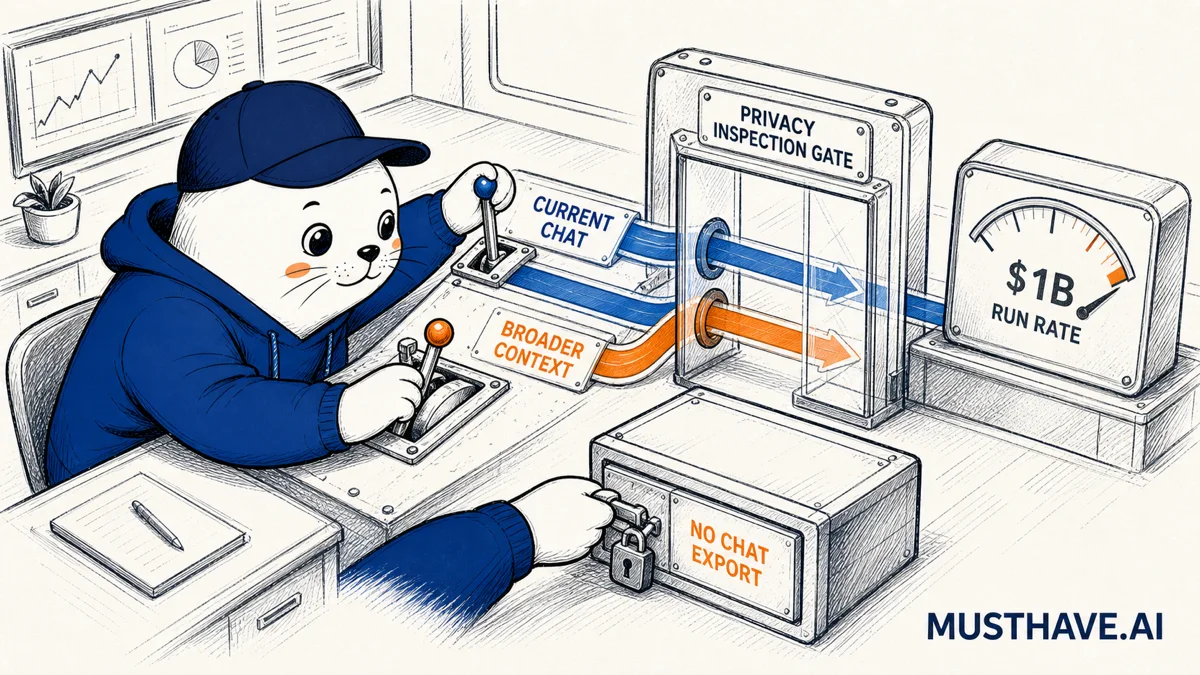
OpenAI says ChatGPT Ads reached a $1 billion annualized run rate less than 200 days after launch. That number will grab attention. The change builders should examine more closely is the targeting and measurement system that arrived with it.
ChatGPT Ads is no longer the five-country experiment described when this article first appeared. OpenAI now reports availability in more than 40 countries, tens of thousands of advertisers, and more than 50 technology and measurement partners. Self-service Ads Manager access is also opening across India, Europe, the Middle East, and North Africa.
All of those figures come from OpenAI. They establish scale, but they do not independently establish campaign quality, user trust, or profitable economics for a typical advertiser. Those questions need separate tests.
The five-country test became an advertising platform
| Surface | Earlier rollout | August 31 position |
|---|---|---|
| Availability | United Kingdom, Mexico, Brazil, Japan, and South Korea joined the initial US test | OpenAI reports more than 40 countries |
| Buying route | Managed sales, agencies, and partners | Ads Manager self-service is expanding across four large regions |
| Advertiser base | Early pilot | Tens of thousands of advertisers, according to OpenAI |
| Measurement | Views, clicks, and early controls | Pixel, Conversions API, outcome optimization, and 50+ technology and measurement partners |
| Targeting | Conversation topic, earlier chats, and ad interactions | Current-conversation context plus broader ChatGPT context where country rules and user settings allow it |
The platform now supports CPC and outcome-optimized bidding for most campaigns, according to OpenAI. Product feeds, geographic and platform targeting, and custom audiences make the buying surface look much more like a mature performance channel.
That does not make it a conventional search-ad product. A search box usually receives a short query. A ChatGPT conversation can contain goals, constraints, preferences, corrections, and several rounds of comparison. The commercial value of that context is obvious. So is the need for a clean permission boundary.
The targeting boundary has two different sides
OpenAI says its ad system uses the current conversation to select a relevant ad. Depending on the country and the user’s settings, it may also use context from the user’s broader ChatGPT experience.
The company separately says advertisers do not receive private conversations. Those statements can both be true. The ad system can process context internally while exposing only delivery and measurement signals to the advertiser. Readers should not collapse those two data flows into one.
| Question | OpenAI’s stated position | What still needs evidence |
|---|---|---|
| What can select the ad? | Current conversation and, where enabled, broader ChatGPT context | The exact fields, retention window, exclusions, and country-specific defaults |
| What can the advertiser see? | Not the user’s private conversations | Event-level fields, audience construction, export controls, and partner access |
| Can an ad change the answer? | OpenAI says advertising does not influence answers | Repeatable tests across ad histories, markets, and commercial topics |
| Can users control personalization? | OpenAI says users can control the personalized ad experience | Whether the control is easy to find and what product allowance changes when it is used |
This is the same reason I treat connected accounts as permission boundaries. Our review of multiple Google accounts inside ChatGPT shows how quickly identity and context can cross when one conversation can reach several data sources.
A $1 billion run rate is not $1 billion of booked annual revenue
Annualized revenue run rate takes a recent revenue pace and expresses it as a full year. It is useful for describing current velocity. It is not the same thing as audited revenue collected over the previous twelve months, and it says nothing by itself about margins.
If the reported pace were perfectly steady, $1 billion annually works out to about $83.3 million per month or $2.74 million per day. Those are Musthave.ai calculations, not figures OpenAI published. The real path will move with advertiser demand, country launches, pricing, seasonality, and campaign performance.
OpenAI also ties the ad-supported tier to more than one billion weekly active ChatGPT users. That user count and the ad run rate are company-reported. We do not have a geographic denominator for ad-eligible users, revenue per eligible user, traffic-acquisition cost, partner fees, or the operating cost of serving the underlying AI answers.
Two success stories are not a return benchmark
OpenAI highlights an ecommerce advertiser that achieved 3x return on ad spend over 28 days. A technology partner also reported that more than 80% of its ad-driven ChatGPT traffic came from new customers.
Both examples are useful proof that the system can produce measurable outcomes. Neither tells a buyer what to expect. We do not know the spend, creative mix, attribution window, conversion definition, gross margin, holdout result, or how the examples compare with the median campaign.
Treat 3x ROAS as a case study to reproduce, not a platform average to enter in a forecast.
Run a controlled buyer test before moving budget
- Define one commercial question. Choose a product with a clear purchase path and enough margin to absorb experimentation.
- Separate platform reporting from your ledger. Send campaign IDs into your analytics and reconcile conversions with refunds, cancellations, and retained gross profit.
- Create a holdout. Compare the same market, offer, and period without ChatGPT Ads. Otherwise, branded demand can look like incremental acquisition.
- Inspect the audience inputs. Record whether targeting uses a feed, geography, custom audience, conversation context, or broader experience context.
- Test the post-click path. Measure landing-page mismatch, checkout completion, support burden, and repeat purchase rather than celebrating the first click.
- Set a stop rule. Cap spend and name the evidence required to expand it.
I have now run that bounded test on a live advertiser account. My ChatGPT Ads Morocco case study records $41.62 in spend, 91 clicks, the under-25K audience limit, and the measurement gap I found before judging conversions.
Builders who already monitor model spend should apply the same discipline here. Our GPT-5.6 pricing analysis explains why the visible unit price is only one part of the cost. Advertising adds attribution, creative production, partner fees, and failed traffic to that calculation.
The user-side trust test remains unfinished
OpenAI says ads are clearly labeled, separate from answers, and unable to influence those answers. It also says users can control personalization. The next useful disclosure would be evidence: country-level complaint rates, sensitive-topic suppression results, label-recognition tests, control usage, and independent audits of answer separation.
The original rollout offered Free users an ads-free option with fewer daily messages. That made privacy and product capacity part of the same choice. The interface should state the exact allowance difference before consent, not hide the cost behind the word “fewer.” Our guide to Temporary Chat personalization controls makes the same practical point: choose the context mode before entering sensitive material.
My verdict: test the channel, audit the context
ChatGPT Ads has crossed from experiment into meaningful business line. The $1 billion run-rate claim gives advertisers a reason to look. The combination of conversational intent, broader context, conversion tooling, and custom audiences gives them a reason to slow down and design the test properly.
I would start with a bounded campaign and an independent conversion ledger. For users, I would inspect the personalization setting and the cost of opting out. Scale is now established by the company’s numbers. Trust still has to be demonstrated in the product.
Read the primary sources
- Read OpenAI’s August 31 ChatGPT Ads scale and targeting update.
- Review OpenAI’s original rollout, eligibility, and user-control description.
Updated August 31, 2026. Revenue run rate, user count, country reach, advertiser and partner counts, targeting inputs, campaign tools, and advertiser examples are company-reported by OpenAI. Monthly and daily run-rate equivalents are Musthave.ai calculations.