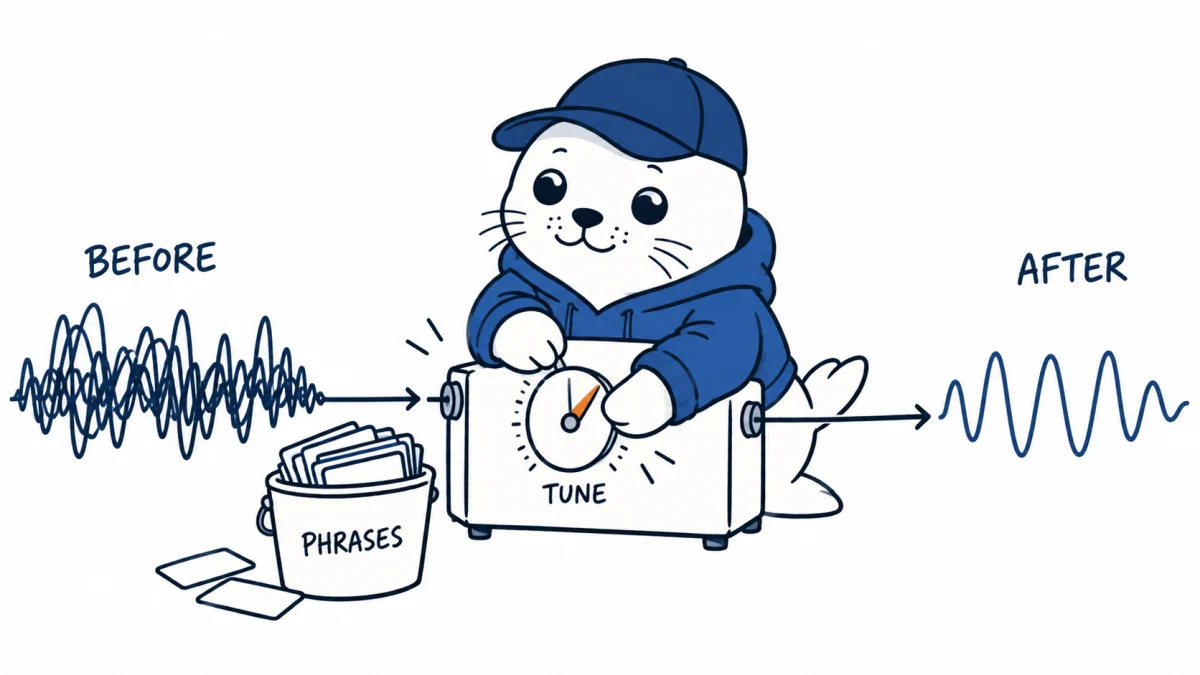
Microsoft is rolling out Azure AI Speech LLM 2607 as a service-side transcription upgrade. Customers do not select a new model name, which makes regression testing more important: the same application call can begin producing different latency and text.
Microsoft announced Speech LLM 2607 on September 10, 2026. The company says the update applies to the Fast Transcription API and Real-Time Speech to Text API and is delivered automatically.
What Microsoft says changed
| Area | Reported change | What to measure |
|---|---|---|
| Speed | Up to three-times faster transcription | End-to-end and server latency at fixed audio duration |
| Phrase lists | More than 2,000 entities | Recall, false insertions and list-update delay |
| Multilingual speech | Improved language coverage and accuracy | Per-language word error rate |
| Mixed language | Better handling within one recording | Switch points, names and punctuation |
| Delivery | Automatic service-side rollout | Output drift without a client model change |
Automatic rollout creates a versioning problem
A client library version does not fully identify a managed speech system when the service can update its model behind the endpoint. Teams need their own observation record: request time, region, API, configuration, phrase-list revision and returned text.
If Microsoft exposes a service or model version in response metadata, save it. If not, preserve a daily canary transcript so output changes are still detectable.
Build a fixed audio regression set
- Use 50 to 200 recordings sampled from real permitted workloads.
- Include quiet speech, background noise, accents, interruptions and low-volume audio.
- Create slices for every supported language and mixed-language pattern.
- Include product names, people, places and numbers that rely on phrase lists.
- Store human-reviewed reference transcripts and token-level differences.
- Retain audio consent, handling and deletion records.
Measure phrase-list benefits and damage
A larger phrase list can recover rare names. It can also bias the decoder toward the wrong entity. Test the list on audio that contains target entities and on a negative set where similar-sounding words should remain ordinary language.
| Metric | Positive set | Negative set |
|---|---|---|
| Entity recall | Did the named term appear correctly? | Not applicable |
| False insertion | Was another entity substituted? | Was an entity invented? |
| Case and punctuation | Is the final form usable? | Did bias distort nearby text? |
| Latency | Does a larger list slow the request? | Does baseline speed remain stable? |
Reproduce the three-times speed claim
Microsoft says 2607 can be up to three times faster. “Up to” identifies a best-case bound, not an average. Reproduction requires the same region, API, audio length, format, concurrency and measurement point.
Run each clip at least five times after a warm-up. Report the median and 95th percentile. Separate upload time, queue time and transcription time. A faster model does not guarantee a faster user experience if network or queuing dominates.
Real-time and batch need different gates
For real-time speech, measure partial-result stability, time to first text, finalization delay and correction behavior. For Fast Transcription, measure total completion time, throughput and failure rate at representative concurrency.
Voice systems also need a privacy review. Our GPT-Live guide explains why interruption handling and transport behavior should be tested separately from model quality.
A rollout checklist
- Freeze the reference audio and expected transcripts before the change reaches every region.
- Run canaries in each production region and API path.
- Compare accuracy slices, entity behavior, latency and cost.
- Set a release threshold for critical numbers, names and commands.
- Keep a fallback transcription path for workflows where errors create material harm.
- Document the observed change even if no client deployment occurred.
What remains unknown
Microsoft does not publish one global improvement number, a complete per-language table or a customer-selectable rollback switch in the announcement. The exact rollout timing can differ by service and region.
Information gain: a silent server-side model improvement is still a production change. Treat the endpoint response, not the client package, as the artifact under test.
My take: better defaults need better canaries
An automatic upgrade is convenient for teams that want better accuracy without migration work. It is risky for applications that assume the same request always produces the same transcript behavior.
Use the rollout to add a permanent speech canary. Save the evidence, not only the average score. For related reliability practice, see our AI reliability guide.
Primary sources
Checked September 11, 2026. Rollout, performance and feature statements come from Microsoft. The regression set, phrase-list test and deployment gates are MustHave.ai analysis.