

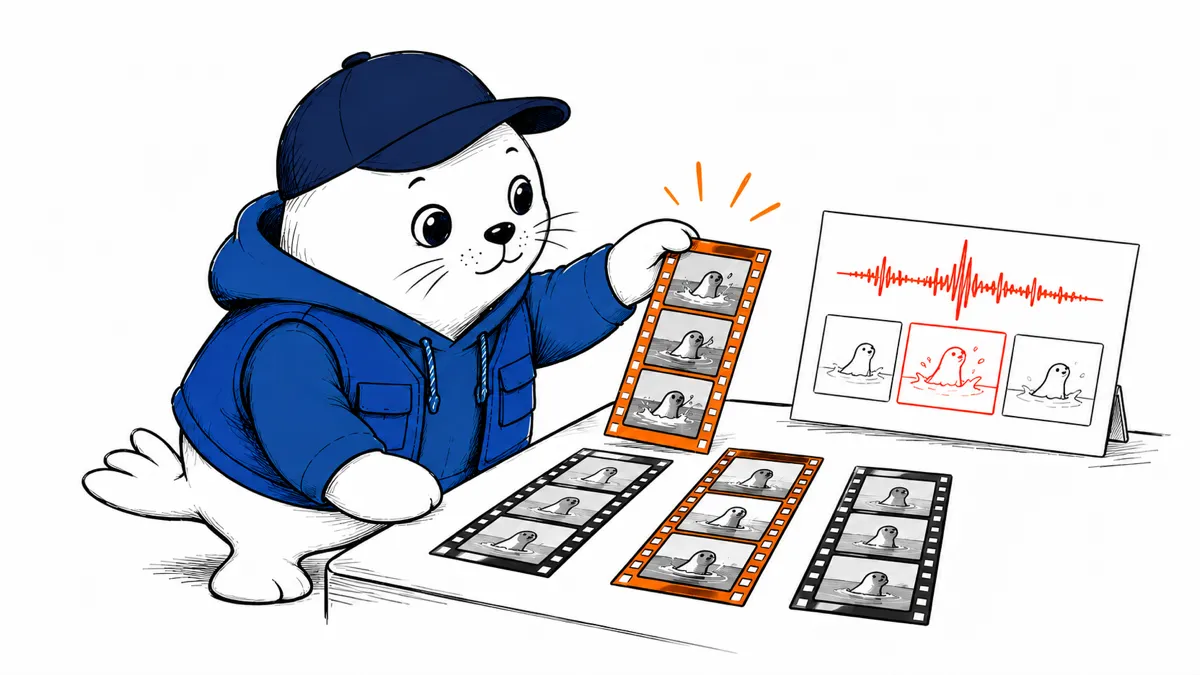
A useful search result can be a clip, a picture, or a document. It does not have to be a generated answer.
What Google released
Google announced EmbeddingGemma 2 on October 6, 2026. The 740-million-parameter model maps text, images, audio and video into a shared embedding space. Its official model repository provides weights and lists an Apache 2.0 license.
An embedding represents an input as a numerical vector. A retrieval system compares vectors to find related items. A generative model can then use those items as context when answering a question. This second stage is retrieval-augmented generation, or RAG.
Choose a search problem with answers you can verify
Start with a small collection that you own or have permission to process. For a media library, write queries whose correct clips you already know. Include similar clips that should not match. Keep private customer material out of the first trial.
A query such as “the segment showing the red component” needs more than a broadly related video. Decide whether success means finding the right file or the right moment within it. Save the expected answer before running the search.
A proposed retrieval checklist
- Record the model revision and inference library version.
- Choose one input modality for the first trial.
- Save queries and expected matches before indexing.
- Include a query with no suitable match.
- Inspect the highest-ranked results and their source locations.
- Measure retrieval time and memory on your actual device.
- Repeat the same queries after changing one setting.
This is a proposed evaluation, not a benchmark we have run. A relevant-looking result can still be the wrong source. Record false matches instead of hiding them behind a fluent generated answer.
Vector size changes storage, not just a setting
Google documents output vectors that can be reduced from 768 to 128 dimensions. At the same numeric precision, that reduces the raw vector payload sixfold. An entire index also contains identifiers, metadata, and search structures, so its total size need not shrink by the same factor.
Compare retrieval quality before choosing a smaller vector. A compact index that misses the right file may be a poor trade for your application.
Check the whole data path before calling it private
Google positions the model for on-device use. Your application can still send files or queries to remote services. Inspect the runtime, logging, storage, and any generated-answer stage separately. Local embeddings alone do not establish an end-to-end privacy guarantee.
Our local model and memory guide explain a similar boundary. The Claude-Mem checklist covers stored project context.
Keep search useful before adding answers
I would first make the correct source easy to retrieve and open. Add generated answers after that baseline works. Which collection has enough known matches for your first test?