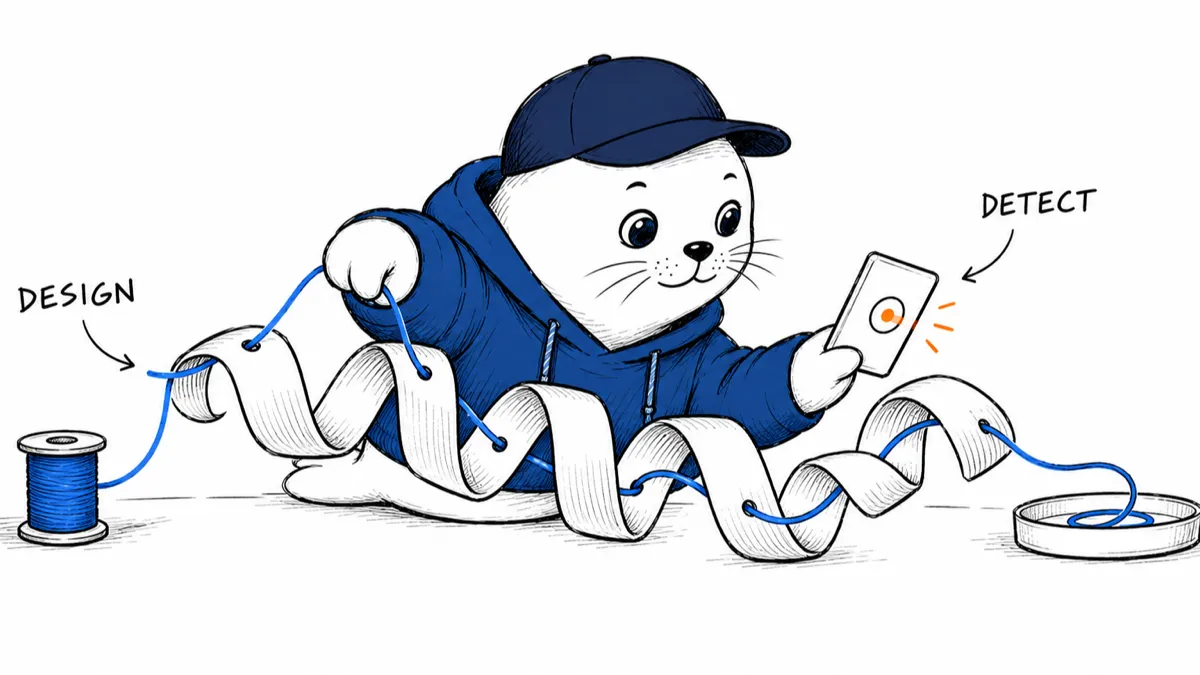
A watermark for a protein is not a visible stamp. It is a statistical pattern placed inside a sequence so a later test can estimate whether the design came from a participating system.
Google DeepMind introduced SynthID Bio on September 30 as a proof of concept for AI-designed proteins. The method modifies generated sequences while trying to preserve the properties needed for the design task. DeepMind says it is publishing the method, code, data, and model weights so other researchers can examine the approach.
What the watermark is meant to answer
The narrow question is provenance: does this protein sequence carry the statistical signature produced by a compatible generation process? That differs from asking whether the protein is safe, effective, novel, or created entirely by AI. A detector result should not be stretched into conclusions it was not designed to support.
DeepMind describes applying the method to both amino-acid sequences and predicted three-dimensional structures. The design process keeps choosing among biologically plausible options while nudging those choices toward a detectable pattern. The challenge is to retain enough freedom for the protein task while creating enough signal for later detection.
The wet-lab evidence covers three targets.
The reported experiments include binders involving VEGF-A, the receptor-binding domain of the SARS-CoV-2 spike protein, and PD-L1. DeepMind says watermarked candidates retained a matching hit rate, binding affinity, and diversity compared with unwatermarked designs, while the embedded signature remained close to perfectly detectable in its tests.
Those are company-reported results from a defined set of experiments. They do not establish that every protein-design model, target, laboratory workflow, or sequence transformation will preserve the same trade-off. The linked methods paper is the appropriate place to inspect the statistical assumptions and experimental setup.
A watermark is not a safety verdict.
SynthID Bio could help a model provider or researcher trace participating AI-generated designs. It does not determine whether a protein is harmful, whether a laboratory followed safety rules, or whether an unwatermarked sequence came from a person. A system outside the watermarking scheme can also produce designs without this signature.
Deliberate removal is another open problem. DeepMind identifies tampering robustness as an area for further work. Sequence edits, redesign, recombination, and downstream optimization can all affect detectability. Any operational use therefore needs a documented threshold, expected false-positive rate, and a policy for ambiguous results.
Questions to ask before relying on detection
- Which generator and model version created the watermark?
- Which transformations were tested after generation?
- What false-positive and false-negative rates apply at the chosen threshold?
- Does the detector work on the sequence, the predicted structure, or both?
- Who may interpret a result, and what action may follow?
The distinction resembles the one in our guide to AI-designed bacteriophage claims: an important technical result still has a specific experimental boundary. SynthID Bio is best understood as a provenance research tool. It may become one layer in a broader accountability system, but it is not a universal label for AI biology.