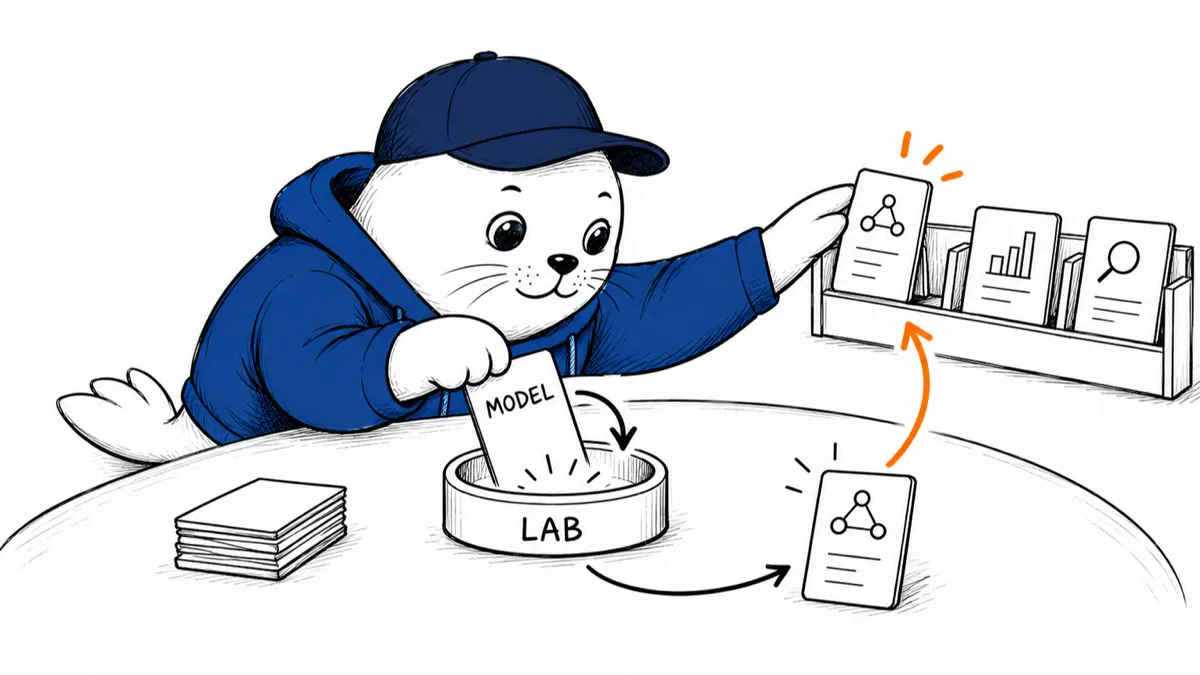
A biology model can generate a confident hypothesis. Quine is interesting because its workflow is designed to run that hypothesis through tools, researchers, and laboratory evidence.
Microsoft Research introduced Quine on September 29 as an experimental research system for biology. Microsoft describes it as a multimodal world model combined with a harness that can work with scientific literature, computational tools, researchers, and wet-lab feedback.
Quine is a research loop, not a clinical product.
The distinction is important. Quine is intended to help researchers formulate and test biological hypotheses. Microsoft does not present it as a diagnostic system, a treatment recommendation tool, or a substitute for medical review. Initial access is limited to Quine Fellows and selected collaborations.
The Quine project page frames the system around iterative scientific work. A model proposes or ranks possibilities, tools and data provide additional context, and experiments return evidence that can refine the next step. The value comes from the loop, not from treating the first model answer as a discovery.
What happened in the pancreatic-cancer experiment
Microsoft reports that a collaboration with the Broad Institute used Quine to prioritize compounds that might shift pancreatic-cancer cell states. Researchers selected candidates and tested them in wet-lab assays. The work therefore includes experimental follow-up, which is stronger evidence than a model-only ranking.
It is still an early research example. A cell-state effect in an assay is not a safe or effective treatment in a person. It does not establish dosage, toxicity, delivery, clinical benefit, or regulatory approval. Those questions require separate studies.
Treat the speed claim as project-specific
Microsoft says Quine helped researchers prioritize the work over a weekend and may have saved months. That is a company-reported account of one collaboration. It does not provide a general productivity rate for every laboratory, disease area, or dataset.
A useful evaluation would compare the full process: time to an experimentally testable shortlist, cost of failed candidates, researcher review time, reproducibility, and the quality of the evidence that comes back. A faster list that produces more unhelpful experiments may not improve the research program.
The access model limits what outsiders can verify.
Because Quine is not a generally available product, most teams cannot reproduce the workflow from a public API today. The appropriate response is not to write an installation guide. Instead, document the reported system, separate measured results from future possibilities, and watch for publications, protocols, and broader access.
Our P-Bench analysis shows why tool use alone does not guarantee sound scientific reasoning. A research harness can run code and consult evidence, but experiment design, statistical choices, and biological interpretation still need expert review.
What would make the evidence stronger?
- A peer-reviewed description of the model and harness.
- A documented baseline for compound prioritization.
- Independent replication of the selected experimental results.
- Clear accounting for researcher time and failed candidates.
- Access rules that explain data handling and permitted research use.
Quine is a credible example of an AI research system that closes the loop with experiments. The strongest claim today is modest: Microsoft and its collaborators used the system to prioritize candidates and validated selected effects in the lab. That is not the same as discovering a medicine.