
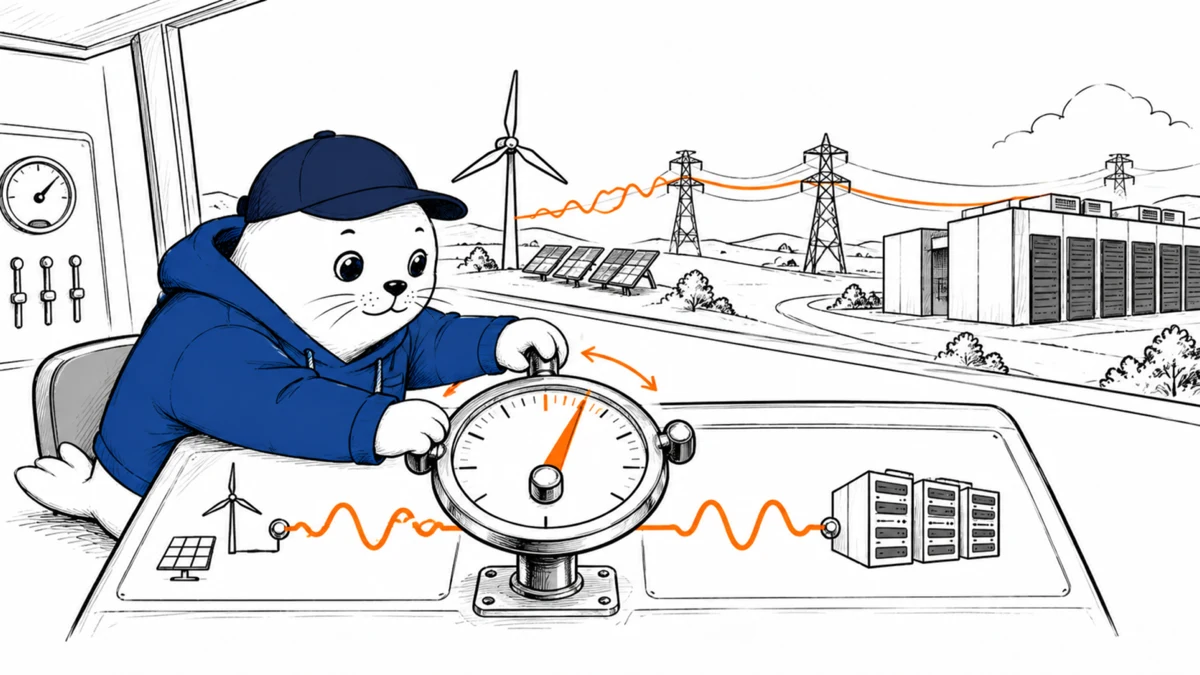
Data centers usually ask the grid for power as if every workload were urgent. A new alliance wants AI infrastructure to behave more like a controllable customer, but the contract details will decide whether utilities can trust it.
Emerald AI, Google and NVIDIA have launched the AI Energy Management Alliance. The group wants data centers to change electricity use in response to grid conditions and to create common expectations for utilities, operators and technology providers.
The alliance is trying to make flexibility measurable
“Flexible load” sounds simple until a grid operator has to depend on it. A data center may be able to delay one training job, move a batch workload or reduce nonessential cooling load for a short period. That does not mean every rack can disappear from the demand curve on command.
The alliance says it will work on response speed, duration, predictability, ride-through and curtailment obligations, data sharing and risk-adjusted interconnection paths. Those fields turn a marketing promise into something a utility can schedule and audit.
A useful flexibility product needs six numbers
| Field | Question it answers |
|---|---|
| Response time | How quickly can demand change after a signal? |
| Available megawatts | How much load can move under current conditions? |
| Duration | How long can the lower demand be sustained? |
| Recovery profile | Does the postponed load create a rebound peak later? |
| Availability | How often is the promised flexibility actually ready? |
| Failure consequence | What happens if the data center cannot deliver? |
The rebound question is easy to miss. Moving a training job away from one grid peak helps only if the workload does not return during the next constrained hour. Scheduling software needs a horizon long enough to see both the immediate reduction and the deferred demand.
Workload classes should not share one curtailment rule
- Delay-tolerant batch work can often move within a deadline window.
- Model training may pause or migrate only if checkpoints, network state and accelerator availability support it.
- Interactive inference has tight latency and availability limits, so flexibility may come from routing or spare capacity rather than shutting work off.
- Safety and control workloads may have no practical curtailment window at all.
A site-level promise should therefore be built from workload-level rules. Operators need to know which queue can move, the latest completion time and the quality or latency penalty a change would create.
Interconnection is the commercial prize
Grid queues are crowded in several major data-center regions. If a new facility can demonstrate predictable load reduction during constrained periods, a utility may be able to connect it under a different risk profile than an inflexible customer. The alliance explicitly includes risk-adjusted interconnection paths in its scope.
That is not a promise that flexible AI automatically gets a faster grid connection. Utilities still need local studies, enforceable controls and a remedy when performance misses the contract. Our Texas data-center grid audit shows why requested capacity and buildable capacity are not the same number.
What a credible pilot should publish
- Baseline demand and the method used to calculate it.
- The workload classes eligible for shifting or reduction.
- Signal-to-response time and delivered megawatts.
- Duration, rebound demand and missed commitments.
- Effects on latency, completed work and cooling.
- The utility event that triggered the change.
The public record should also say whether the response was automatic, operator-approved or simulated. The UK consultation on AI and clean energy is another reminder that governments are now asking for concrete operating rules, not broad efficiency claims.
Data sharing will need a privacy boundary. A utility needs enough telemetry to verify delivered flexibility, while a data-center operator may not want to expose customer workloads or cluster topology. The clean design reports power, timing, availability and contractual performance through an auditable interface without revealing prompts, model weights or tenant identity. Independent metering should settle disputes when the scheduler and the utility calculate different baselines.
Cybersecurity belongs in the same contract. A grid signal that can change large data-center loads becomes an operational control surface. Authentication, rate limits, manual override and an offline-safe mode should be tested before automated response reaches production.
The missing piece is deployment data
The AI Energy Management Alliance has named the right coordination problems. It has not yet published a standard, a completed deployment or measured grid results. The next useful update is a pilot with a real utility signal, a defined workload portfolio and a complete rebound curve.
Read the primary record
Checked September 19, 2026. Alliance membership and stated work areas come from NVIDIA. The six-field contract, workload classes and pilot disclosure list are MustHave.ai analysis.